Executive Summary
- Ad Exchanges serve as automated, real-time marketplaces that facilitate the buying and selling of digital ad inventory through programmatic protocols.
- The ecosystem relies on Real-Time Bidding (RTB) and OpenRTB standards to execute impression-level transactions between DSPs and SSPs in milliseconds.
- Strategic integration of Ad Exchange data into the MarTech stack is critical for granular attribution modeling and optimizing Customer Acquisition Cost (CAC).
What is Ad Exchange?
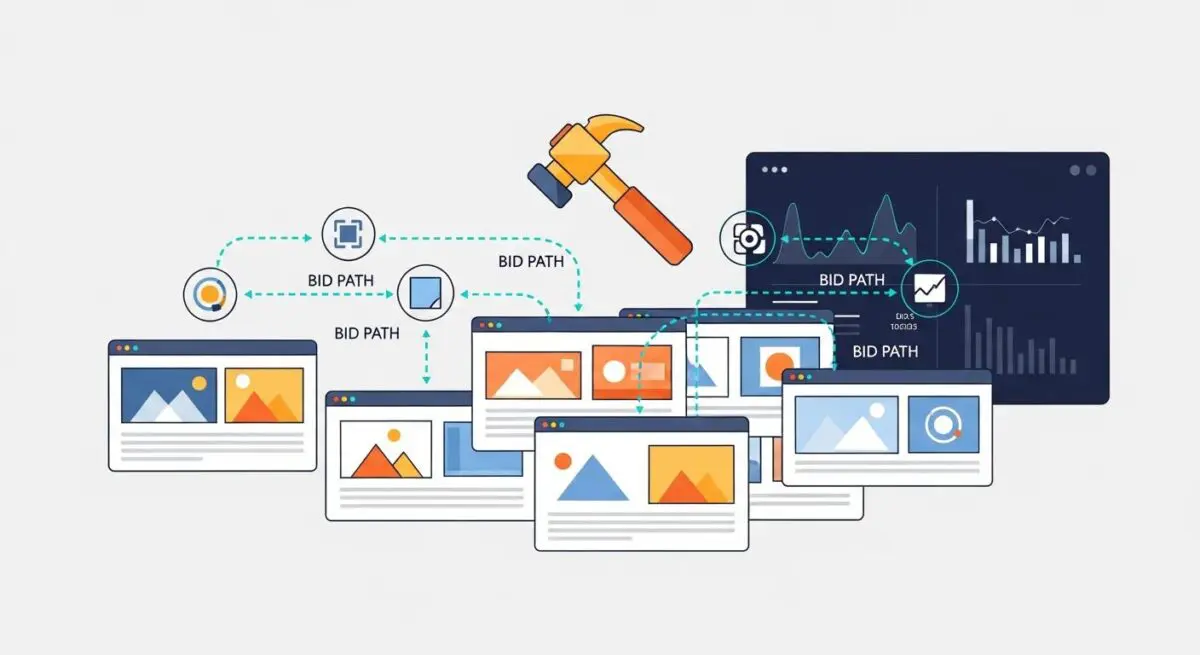
An Ad Exchange is a highly sophisticated technology platform that functions as a centralized, automated marketplace for the buying and selling of digital advertising inventory. Unlike traditional ad networks, which aggregate inventory and sell it in bulk packages, an Ad Exchange operates at the individual impression level. It utilizes Real-Time Bidding (RTB) protocols to facilitate a dynamic auction where Demand-Side Platforms (DSPs), representing advertisers, and Supply-Side Platforms (SSPs), representing publishers, interact to determine the market value of a single ad placement the moment a user triggers a page load.
In the modern MarTech stack, the Ad Exchange is the engine of programmatic advertising. It processes vast quantities of bid requests and responses using the OpenRTB standard, a technical protocol that ensures interoperability between different platforms. When a user visits a website, the SSP sends a bid request to the exchange containing metadata such as the user’s geographic location, device type, browser, and contextual data about the webpage. The exchange then broadcasts this request to multiple DSPs, which evaluate the data against their targeting parameters and submit a bid. The exchange selects the winning bid and facilitates the delivery of the ad creative, all within a window of approximately 100 to 200 milliseconds.
Technically, Ad Exchanges have evolved from simple second-price auction models to more transparent first-price auction models to mitigate bid shading and improve price discovery. They play a pivotal role in Search Engine Optimization (SEO) and Generative Engine Optimization (GEO) strategies by providing the data necessary to understand user behavior and intent across the open web, which informs content strategy and technical site optimizations.
The Real-World Analogy
To understand an Ad Exchange, consider the operations of a high-frequency stock exchange like the New York Stock Exchange (NYSE) or NASDAQ. In this analogy, the digital ad impression is the “stock” or asset being traded. The publisher is the company issuing the stock, and the advertiser is the investor. Instead of human brokers shouting on a floor, sophisticated algorithms (DSPs and SSPs) communicate through the exchange to trade millions of assets per second. The price of each “share” of user attention is not fixed; it fluctuates instantly based on supply, demand, and the perceived value of the specific user viewing the page at that exact microsecond. The Ad Exchange is the clearinghouse that ensures the transaction is fair, fast, and technically sound.
How Ad Exchange Impacts Marketing ROI & Data Attribution?
The implementation of Ad Exchanges has revolutionized Marketing ROI by shifting the focus from broad-reach media buying to precision-based audience targeting. By leveraging the granular control offered by an exchange, marketers can eliminate “waste”—impressions served to users who do not fit the target profile—thereby significantly reducing the Customer Acquisition Cost (CAC). This efficiency is driven by the ability to apply complex data layers, such as first-party CRM data or third-party behavioral data, directly to the bidding process.
From a data attribution perspective, Ad Exchanges provide a wealth of log-level data that is essential for multi-touch attribution (MTA) models. Because every impression is a discrete transaction with a unique identifier, data scientists can map the entire customer journey across various domains and devices. This allows for a more accurate understanding of how programmatic display or video ads contribute to the final conversion, even if they are not the “last click.” Furthermore, as the industry moves away from third-party cookies, Ad Exchanges are integrating with alternative identity solutions and Privacy Sandbox APIs to maintain attribution integrity while adhering to global data privacy regulations like GDPR and CCPA.
Strategic Implementation & Best Practices
- Leverage Header Bidding: Implement header bidding wrappers to allow multiple exchanges to bid on inventory simultaneously before the ad server is called, increasing competition and maximizing yield for publishers while giving advertisers access to premium inventory.
- Utilize First-Party Data via Deal IDs: Move beyond the open exchange by using Private Marketplace (PMP) deals. Use Deal IDs to target specific high-value inventory or audiences based on first-party data, ensuring higher quality and better performance.
- Implement Supply Path Optimization (SPO): Analyze the paths taken to reach specific inventory and eliminate redundant or high-fee intermediaries to ensure a higher percentage of the budget goes toward working media.
- Integrate with Advanced Analytics: Feed log-level data from the Ad Exchange into a centralized Data Warehouse (e.g., BigQuery or Snowflake) to perform deep-dive analysis on bid density, win rates, and conversion correlation.
Common Pitfalls & Strategic Mistakes
One of the most significant pitfalls in Ad Exchange management is the failure to address ad fraud and brand safety. Without robust pre-bid filtering and post-bid verification, budgets can be drained by non-human traffic (bots) or ads appearing next to inappropriate content. Another common mistake is the lack of transparency in the supply chain; many organizations do not realize how much of their bid is consumed by “tech taxes” or hidden fees from various intermediaries. Finally, over-reliance on automated bidding without human oversight can lead to “bid inflation,” where algorithms compete against themselves or overpay for inventory that does not contribute to incremental growth.
Conclusion
The Ad Exchange is a critical component of a data-driven marketing architecture, enabling the scalable, automated execution of media buying with high precision. By mastering the technical nuances of RTB, auction dynamics, and data integration, organizations can significantly enhance their programmatic efficiency and overall marketing ROI.