Executive Summary
- Vite utilizes native ES modules (ESM) to provide near-instantaneous Hot Module Replacement (HMR) and development server starts.
- The tool leverages esbuild for dependency pre-bundling and Rollup for highly optimized production asset generation.
- Integration with WordPress requires a bridge between the Vite manifest and the PHP-based wp_enqueue_script system.
What is Vite?
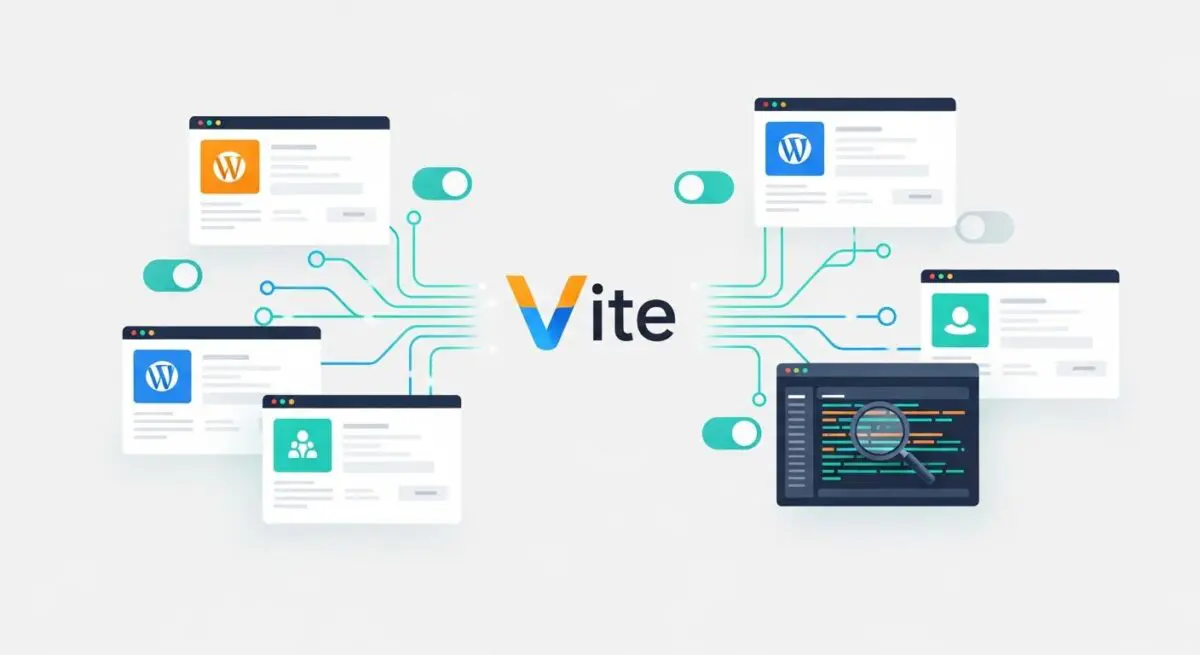
Vite is a modern frontend build tool designed to significantly improve the developer experience (DX) and production performance of web applications. Created by Evan You, Vite (the French word for “fast”) addresses the inherent inefficiencies of traditional bundlers like Webpack or Parcel. In a legacy bundling workflow, the entire application must be crawled and processed before a development server can start. As WordPress projects grow in complexity—particularly with the rise of the Block Editor (Gutenberg) and headless architectures—this traditional approach leads to significant latency in build times.
Vite operates on two primary pillars. First, it serves source code over native ES modules during development. This allows the browser to take over part of the bundler’s job, requesting only the specific modules needed for the current view. Second, it uses esbuild, a bundler written in Go, to pre-bundle dependencies. This combination ensures that the development server remains fast regardless of the project size. For production, Vite employs Rollup, which is configured to output highly optimized static assets, including CSS code-splitting and efficient tree-shaking, ensuring that the final WordPress theme or plugin payload is as lean as possible.
The Real-World Analogy
To understand the difference between Vite and traditional bundlers, imagine a massive library. A traditional bundler is like a librarian who insists on photocopying every single page of every book in the building and binding them into one giant volume before they will allow you to read a single sentence. If the library grows, your wait time increases exponentially. Vite, conversely, is like a digital tablet that allows you to walk into the library and instantly view only the specific page you need. If you want to see a different page, the tablet fetches it immediately without needing to re-process the rest of the library. This “on-demand” approach is why Vite remains fast even as the codebase expands.
How Vite Impacts Server Performance & Speed Engineering?
Vite’s impact on WordPress performance is primarily realized through the optimization of the critical rendering path and the reduction of total blocking time (TBT). By utilizing Rollup for production builds, Vite generates assets that are automatically optimized for modern browsers. This includes sophisticated code-splitting strategies where CSS and JavaScript are broken down into smaller, cacheable chunks. In a WordPress environment, this means that a user visiting a specific landing page only downloads the assets required for that page, rather than a monolithic main.js file containing logic for the entire site.
Furthermore, Vite facilitates the use of modern JavaScript features without the overhead of heavy polyfills unless explicitly required. This results in smaller file sizes and faster execution on the client side. From a server-side perspective, Vite-optimized assets are easier to manage via Content Delivery Networks (CDNs) because the hashed filenames and granular chunks allow for more precise cache invalidation. For developers working with Headless WordPress (using frameworks like React, Vue, or Svelte), Vite is the de facto standard for ensuring that the frontend remains decoupled and performant, minimizing the Time to First Byte (TTFB) and improving Core Web Vitals across the board.
Best Practices & Implementation
- Implement a Manifest Bridge: Since WordPress uses PHP to enqueue scripts, you must use a helper function to read the manifest.json file generated by Vite. This ensures that the correct hashed filenames are enqueued in production while pointing to the Vite dev server (usually localhost:5173) during development.
- Leverage Dependency Pre-bundling: Use Vite’s optimizeDeps configuration to pre-bundle large libraries like lodash or three.js. This prevents the browser from making hundreds of individual requests for small dependency files, which can bottleneck the dev server.
- Configure Conditional Loading: Use the is_admin() check in WordPress to only enqueue Vite-processed blocks or scripts where they are needed, preventing unnecessary script execution in the WordPress dashboard.
- Utilize Environment Variables: Use .env files to manage different API endpoints for local development and production environments, ensuring that your Vite build process remains environment-aware.
- Optimize for the Block Editor: When developing Gutenberg blocks, use Vite to handle the JSX transformation and SCSS compilation, ensuring that the editor.css and style.css are properly separated and enqueued via block.json.
Common Mistakes to Avoid
One frequent error is failing to handle the CORS (Cross-Origin Resource Sharing) headers when running the Vite dev server alongside a local WordPress environment (like LocalWP or Lando). If the dev server is on a different port, the browser may block asset loading unless the server is configured to allow the WordPress domain. Another common mistake is ignoring the legacy browser support requirements. While Vite targets modern browsers by default, enterprise WordPress sites often require support for older versions. Developers must explicitly include the @vitejs/plugin-legacy to generate polyfills and transformed code for these environments.
Conclusion
Vite represents a paradigm shift in WordPress frontend engineering, replacing slow, legacy bundling processes with a high-performance, ESM-based workflow. By integrating Vite into the WordPress development lifecycle, architects can achieve faster iteration cycles and superior site performance through optimized asset delivery.