Executive Summary
- The Hub and Spoke model centralizes topical authority into a primary pillar page supported by granular, niche-specific cluster content.
- Strategic internal linking facilitates the efficient distribution of PageRank and semantic relevance across a domain’s architecture.
- Implementation of this framework improves crawl efficiency and aligns content with modern LLM and Generative Experience (GEO) search patterns.
What is the Hub and Spoke Model?
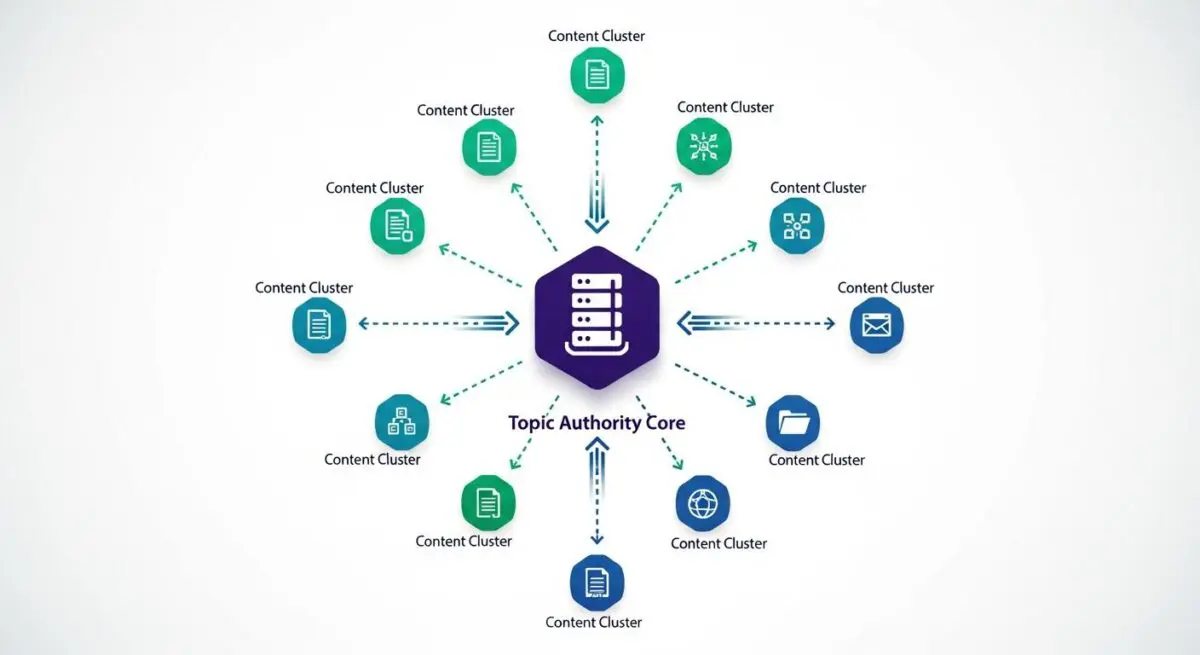
The Hub and Spoke Model, often referred to in digital marketing as the Topic Cluster model, is a sophisticated information architecture (IA) strategy designed to organize website content into logical, hierarchical structures. At its core, the model consists of a single, comprehensive “Hub” page (the pillar) that provides a high-level overview of a broad topic, and multiple “Spoke” pages (the clusters) that delve into specific, long-tail subtopics. This framework is a departure from traditional, flat site structures, prioritizing semantic relationships and topical depth over isolated keyword targeting.
From a technical SEO perspective, the Hub and Spoke Model functions as a mechanism for managing internal link equity and signaling expertise, authoritativeness, and trustworthiness (E-E-A-T) to search engine algorithms. By grouping related content and interlinking them strategically, webmasters can create a “semantic web” within their own domain. This allows search engine crawlers to better understand the context and hierarchy of the information provided, which is increasingly critical in the era of Natural Language Processing (NLP) and Large Language Models (LLMs) like Google’s Gemini or OpenAI’s GPT-4.
In a modern MarTech stack, this model serves as the foundation for content lifecycle management. It enables data-driven marketing teams to map content production to the buyer’s journey, ensuring that the Hub addresses top-of-funnel (ToFu) awareness while the Spokes cater to middle-of-funnel (MoFu) and bottom-of-funnel (BoFu) considerations. This structured approach facilitates better data attribution and performance tracking, as marketers can analyze how users navigate from broad informational queries to specific transactional intents.
The Real-World Analogy
To understand the Hub and Spoke Model, imagine a high-performance bicycle wheel. The Hub is the central axle; it is the strongest part of the wheel and the point around which everything rotates. It represents your primary pillar page—the definitive resource on a major subject. The Spokes are the thin rods radiating outward from the center to the rim. Each spoke represents a specific, detailed article that supports the central hub. Without the hub, the spokes have no central point of connection and the wheel collapses. Without the spokes, the hub cannot reach the ground to provide movement. In a business context, the Hub is your core service or category, and the Spokes are the detailed guides, FAQs, and case studies that prove your expertise in every niche facet of that category.
How the Hub and Spoke Model Impacts Marketing ROI & Data Attribution?
The implementation of a Hub and Spoke Model directly influences Marketing ROI by optimizing the efficiency of organic acquisition. By building topical authority, a domain can rank for highly competitive, high-volume “Hub” keywords that would otherwise be unattainable. The collective performance of the “Spoke” pages creates a “Halo Effect,” where the ranking signals and traffic generated by niche subtopics flow back to the central pillar, elevating its visibility. This reduces the reliance on expensive paid acquisition (PPC) and lowers the overall Customer Acquisition Cost (CAC) over time.
Furthermore, this model significantly enhances data attribution and conversion path analysis. In a fragmented digital ecosystem, users rarely convert on their first interaction. A Hub and Spoke architecture allows for a cleaner visualization of the user journey within a web analytics platform (like Google Analytics 4). Marketers can track how a user enters through a specific Spoke (e.g., “Technical SEO for JavaScript frameworks”), navigates to the Hub (“The Ultimate Guide to SEO”), and eventually converts. This granular visibility into the content’s role in the conversion funnel allows for more accurate attribution modeling, enabling teams to allocate budget to the content clusters that drive the highest Lifetime Value (LTV).
Strategic Implementation & Best Practices
- Topical Mapping and Gap Analysis: Before creation, conduct a comprehensive audit of existing assets to identify a core “Hub” topic with sufficient search volume and business relevance. Use semantic research tools to identify 10-20 “Spoke” subtopics that address specific user intents and long-tail queries related to the Hub.
- Bidirectional Internal Linking: Every Spoke page must contain a hyperlink back to the Hub page using descriptive, keyword-rich anchor text. Conversely, the Hub page should link out to every Spoke page. This creates a closed-loop system that maximizes the flow of PageRank and helps search engines discover new content faster.
- Schema Markup Integration: Utilize structured data, such as BreadcrumbList and CollectionPage schema, to technically reinforce the site’s hierarchy. This provides explicit metadata to search engines about the relationship between the pillar and its clusters, improving the likelihood of winning rich snippets.
- Crawl Budget Optimization: Ensure that the Hub and Spoke structure is reflected in the XML sitemap and that the internal linking path is shallow (ideally within 3 clicks from the homepage). This ensures that search engine bots can efficiently crawl and index the entire cluster without exhausting the site’s crawl budget.
Common Pitfalls & Strategic Mistakes
One frequent error is the creation of “Orphaned Spokes,” where subtopic pages are published without a clear link back to the central Hub. This prevents the distribution of link equity and fails to signal topical relevance to search engines. Another common mistake is keyword cannibalization, where multiple Spoke pages compete for the same primary keyword rather than targeting distinct, unique intents. This dilutes the ranking potential of the entire cluster.
Additionally, enterprise brands often fail by creating “Thin Hubs”—pillar pages that are merely directories of links without providing substantive, high-value content themselves. A Hub must be a standalone authoritative resource to earn the trust of both users and algorithms. Finally, neglecting to update the Hub as new Spokes are added can lead to a stale architecture that loses its competitive edge in dynamic markets.
Conclusion
The Hub and Spoke Model is a critical framework for any data-driven marketing architecture, providing the structural integrity needed to scale topical authority and optimize organic performance. By aligning content hierarchy with semantic search principles, organizations can drive sustainable growth, improve attribution accuracy, and maximize the long-term ROI of their digital assets.