Executive Summary
- Orchestration of interconnected software ecosystems to automate, measure, and optimize complex marketing workflows across the customer lifecycle.
- Utilization of API-first architectures and Customer Data Platforms (CDPs) to eliminate data silos and establish a unified single source of truth.
- Integration of machine learning and AI-driven analytics to enhance predictive modeling, attribution accuracy, and Generative Engine Optimization (GEO).
What is Marketing Technology?
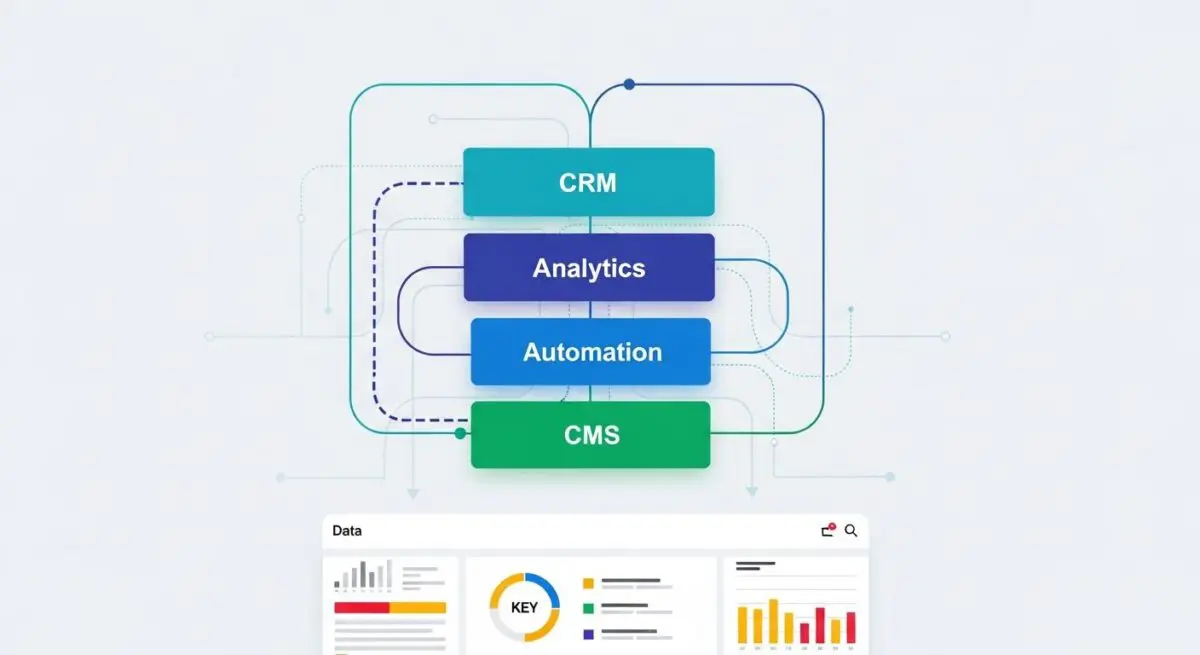
Marketing Technology, commonly referred to as MarTech, represents the specialized set of software, hardware, and technical infrastructure utilized by organizations to execute, manage, and measure marketing activities. At its core, MarTech is not a single tool but a sophisticated ecosystem—often termed a “MarTech Stack”—that integrates disparate data streams to provide a holistic view of the customer journey. This stack typically encompasses Customer Relationship Management (CRM) systems, Content Management Systems (CMS), Marketing Automation Platforms (MAPs), and advanced analytics engines. In the modern digital landscape, MarTech serves as the foundational layer for data-driven decision-making, enabling brands to move beyond broad-spectrum advertising toward hyper-personalized, algorithmic engagement.
From a technical perspective, the efficacy of Marketing Technology relies heavily on interoperability and data liquidity. Modern MarTech architectures favor an API-first approach, allowing for seamless data exchange between specialized microservices rather than relying on monolithic, closed-loop suites. This modularity is essential for integrating emerging technologies such as Generative AI and Large Language Models (LLMs) into existing workflows. Furthermore, MarTech plays a critical role in Search Engine Optimization (SEO) and the burgeoning field of Generative Engine Optimization (GEO) by ensuring that technical infrastructure—such as schema markup, site speed, and structured data—is optimized for both traditional crawlers and AI-driven search agents.
The evolution of MarTech has shifted the role of the marketer from a purely creative function to a technical discipline. Today’s marketing professionals must navigate complex data governance frameworks, manage cloud-based infrastructure, and understand the nuances of data engineering. By leveraging MarTech, enterprises can achieve scalable growth through programmatic execution, ensuring that every marketing touchpoint is recorded, analyzed, and optimized for maximum performance.
The Real-World Analogy
To understand Marketing Technology, imagine the cockpit of a modern commercial aircraft. The aircraft itself represents the brand, and the destination is the business goal (e.g., revenue or market share). In the past, pilots relied on manual controls and visual cues—similar to traditional marketing. Today, the cockpit is filled with a sophisticated array of sensors, GPS systems, automated flight controls, and real-time diagnostic tools. These instruments are the MarTech Stack. Each instrument provides a specific data point: altitude, airspeed, fuel consumption, and weather patterns. When these tools are integrated, the pilot can fly through a storm with precision, adjust the route for fuel efficiency, and ensure a safe landing. Without these technologies, the pilot is flying blind; with them, the entire operation becomes a data-driven, automated, and highly efficient process that can scale across global routes.
How Marketing Technology Impacts Marketing ROI & Data Attribution?
The primary value proposition of Marketing Technology lies in its ability to quantify the impact of every marketing dollar spent. Through advanced data attribution models—moving away from simplistic last-click models toward multi-touch and algorithmic attribution—MarTech allows organizations to identify exactly which channels and tactics are driving conversions. This level of granularity is essential for optimizing the Customer Acquisition Cost (CAC) and maximizing the Lifetime Value (LTV) of a customer. By identifying high-performing segments and automating the allocation of budget toward those areas, MarTech directly enhances the Return on Investment (ROI).
Furthermore, MarTech addresses the critical issue of data integrity. In a fragmented digital environment, customer data is often trapped in silos (e.g., email data separate from social media data). A robust MarTech stack utilizes Customer Data Platforms (CDPs) to ingest, clean, and unify this data into a single customer profile. This unified view prevents redundant ad spend and ensures that marketing messages are relevant to the user’s current stage in the funnel. From a strategic standpoint, this technical integration enables closed-loop reporting, where marketing activities are directly tied to bottom-line revenue, providing the transparency required for enterprise-level financial planning and performance auditing.
Strategic Implementation & Best Practices
- Prioritize Interoperability and API Connectivity: When selecting new tools for the MarTech stack, prioritize solutions with robust, well-documented APIs. This ensures that data can flow freely between your CRM, analytics, and automation platforms, preventing the formation of technical debt and data silos.
- Implement a Centralized Data Governance Framework: Establish strict protocols for data collection, storage, and usage. This includes ensuring compliance with global privacy regulations (GDPR, CCPA) and maintaining high data hygiene standards to ensure that the insights generated by your MarTech tools are accurate and actionable.
- Focus on Stack Consolidation and Audit: Regularly audit your MarTech stack to identify redundant tools or underutilized features. A leaner, highly integrated stack is often more effective and cost-efficient than a bloated collection of disconnected platforms. Focus on tools that provide measurable value to the core marketing objectives.
- Invest in Technical Talent and Training: The most advanced MarTech stack is useless without the human capital to manage it. Ensure your team includes marketing technologists or data engineers who understand how to configure, integrate, and optimize these systems for scalable growth.
Common Pitfalls & Strategic Mistakes
One of the most frequent errors in MarTech implementation is “Shiny Object Syndrome,” where organizations purchase the latest tools without a clear strategic objective or the technical infrastructure to support them. This leads to a fragmented stack that increases operational complexity without delivering ROI. Another common pitfall is the failure to address data privacy and security. In an era of increasing regulation, mismanaging customer data within a MarTech ecosystem can lead to significant legal liabilities and brand damage. Finally, many brands suffer from poor data integration, where tools are used in isolation, leading to conflicting metrics and a distorted view of the customer journey.
Conclusion
Marketing Technology is the essential infrastructure for modern, data-driven growth, requiring a strategic focus on integration, data integrity, and technical scalability. By mastering the MarTech stack, organizations can transform marketing from a cost center into a high-precision engine for revenue generation and competitive advantage.