Executive Summary
- Orchestration of disparate data streams across heterogeneous platforms to create a unified customer profile.
- Optimization of cross-platform attribution models to accurately calculate Customer Acquisition Cost (CAC) and Return on Ad Spend (ROAS).
- Elimination of organizational data silos through robust API-driven MarTech integration and centralized Customer Data Platforms (CDPs).
What is Multi-Channel Marketing?
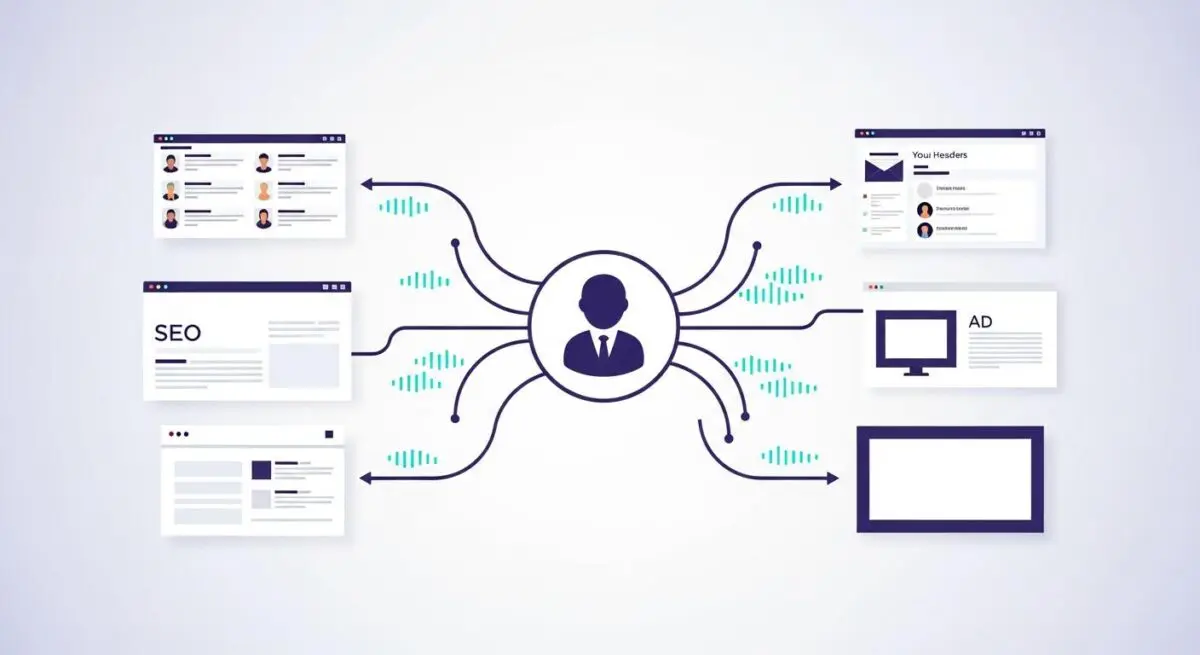
Multi-channel marketing is the strategic practice of interacting with customers across various communication nodes, including social media, email, search engines, mobile applications, and physical retail environments. From a technical perspective, it involves the deployment of a unified messaging architecture that operates across disparate digital and analog ecosystems. Unlike single-channel strategies, multi-channel frameworks recognize that the modern consumer journey is non-linear, requiring a brand to maintain a persistent presence across multiple touchpoints to facilitate conversion. In the context of a modern MarTech stack, multi-channel marketing necessitates a sophisticated data infrastructure capable of ingesting, processing, and normalizing data from various sources to ensure a cohesive brand experience.
At its core, multi-channel marketing is about choice and accessibility. By providing multiple avenues for engagement, organizations can meet consumers in their preferred environments, whether that is an algorithmic feed on a social platform or a direct-to-inbox communication. However, the technical challenge lies in the synchronization of these channels. Without a centralized Customer Data Platform (CDP) or a robust CRM, multi-channel efforts often result in fragmented data, leading to redundant messaging and inefficient budget allocation. For SEO and GEO professionals, multi-channel marketing implies the optimization of content for diverse search environments, including traditional SERPs, AI-driven search interfaces, and platform-specific discovery engines.
The Real-World Analogy
Consider a major international airport. A traveler (the customer) can arrive at the airport via several different modes of transportation: a high-speed train, a shuttle bus, a private vehicle, or a taxi. Each of these transport modes represents a different marketing channel. The airport itself represents the brand. Regardless of how the traveler arrives, the airport must provide a consistent level of service, clear signage, and a streamlined check-in process. If the train station at the airport uses different terminology than the bus terminal, or if the traveler’s ticket information isn’t recognized across all entry points, the experience becomes frustrating and inefficient. Multi-channel marketing is the logistical framework that ensures all these “transportation lines” are synchronized, allowing the traveler to transition seamlessly from their arrival method to their final destination (the purchase).
How Multi-Channel Marketing Impacts Marketing ROI & Data Attribution?
The primary impact of multi-channel marketing on ROI is the amplification of brand frequency and reach. By diversifying the channel mix, organizations can lower their overall Customer Acquisition Cost (CAC) by engaging users in lower-cost environments (such as organic social or email) before they reach high-intent, high-cost channels like Paid Search. This strategy leverages the “Rule of 7,” which suggests that a prospect needs to encounter a brand multiple times before taking action. From a data science perspective, multi-channel marketing significantly complicates attribution modeling. Traditional last-click attribution models fail to account for the value provided by top-of-funnel channels, often leading to the undervaluation of awareness-driving platforms.
To accurately measure ROI in a multi-channel environment, technical teams must implement advanced attribution models, such as linear, time-decay, or position-based (U-shaped) attribution. Even more advanced is Data-Driven Attribution (DDA), which utilizes machine learning to assign credit to each touchpoint based on its actual contribution to the conversion path. Furthermore, the integration of server-side tracking (e.g., GTM Server-Side) is essential to maintain data integrity in an era of increasing privacy regulations and the deprecation of third-party cookies. By capturing first-party data across all channels and unifying it via a “Golden Record” in a CDP, marketers can achieve a holistic view of the Customer Lifetime Value (LTV) and optimize their spend with surgical precision.
Strategic Implementation & Best Practices
- Implement a Centralized Data Warehouse: Utilize a CDP or a robust CRM to act as the Single Source of Truth (SSOT). This ensures that customer interactions on social media are visible to the email marketing team, preventing redundant or conflicting communications.
- Leverage API-First Architecture: Ensure that every tool in your MarTech stack—from your ESP to your DSP—has open API connectivity. This allows for real-time data synchronization and the automation of cross-channel workflows, such as triggering an SMS based on an abandoned cart on the website.
- Adopt Identity Resolution Techniques: Use deterministic and probabilistic matching to identify users across different devices and platforms. This is critical for maintaining a continuous customer journey and avoiding the inflation of unique visitor metrics.
- Execute Dynamic Content Optimization (DCO): Use data feeds to serve personalized creative assets across different channels based on the user’s previous interactions, geographic location, or browsing behavior, ensuring relevance at every touchpoint.
Common Pitfalls & Strategic Mistakes
One of the most frequent errors in multi-channel marketing is the creation of data silos. When the social media team, the SEO team, and the paid media team operate independently without shared data, the result is a disjointed customer experience and “attribution overlap,” where multiple channels claim 100% credit for the same conversion. This leads to an inflated perception of ROI and inefficient budget distribution. Another common pitfall is the failure to adapt creative assets for specific platforms; a technical whitepaper designed for LinkedIn will rarely perform well if cross-posted directly to a visual-centric platform like Instagram without significant reformatting.
Additionally, many enterprise brands suffer from “frequency fatigue.” Without cross-channel frequency capping, a user might be bombarded with the same advertisement across five different platforms simultaneously, leading to brand erosion and increased opt-out rates. Finally, neglecting the technical health of the underlying website—such as slow Core Web Vitals—can negate the effectiveness of all inbound channels, as the final conversion point remains a bottleneck.
Conclusion
Multi-channel marketing is a technical necessity for modern enterprises, requiring a sophisticated integration of data, technology, and strategy to optimize the customer journey and maximize ROI. Success in this domain depends on the elimination of data silos and the implementation of advanced attribution models to guide strategic investment.