

Executive Summary
- Agentic Orchestration: Modern systems have evolved past passive dashboards, utilizing AI to autonomously execute workflows like localized labor scheduling and dynamic menu engineering.
- Vertical Integration Dominance: Venture capital is abandoning fragmented point solutions, pouring billions into unified platforms that control the entire operational stack.
- Margin Recovery: Consolidating disconnected software into a single intelligence layer drastically reduces administrative labor and structurally protects profit margins from operational leakage.
The Great Consolidation of Restaurant Technology
The restaurant industry is currently navigating a strange and frustrating economic paradox. We are witnessing record-breaking sales volumes across the sector, yet nearly half of independent operators remain fundamentally unprofitable. The culprit is rarely the quality of the food or the dedication of the hospitality staff.
Instead, the silent killer of enterprise profit margins is a phenomenon known as point solution fatigue. Over the last decade, operators were sold a digital bill of goods by fragmented software vendors. They were instructed to buy one application for delivery, another for labor scheduling, a third for inventory, and a fourth for loyalty programs.
This created a chaotic, disconnected operational nightmare. Managers spend hours manually transferring data between tablets that refuse to communicate with one another. The market is now aggressively correcting this mistake through a phase industry insiders are calling the Great Consolidation.
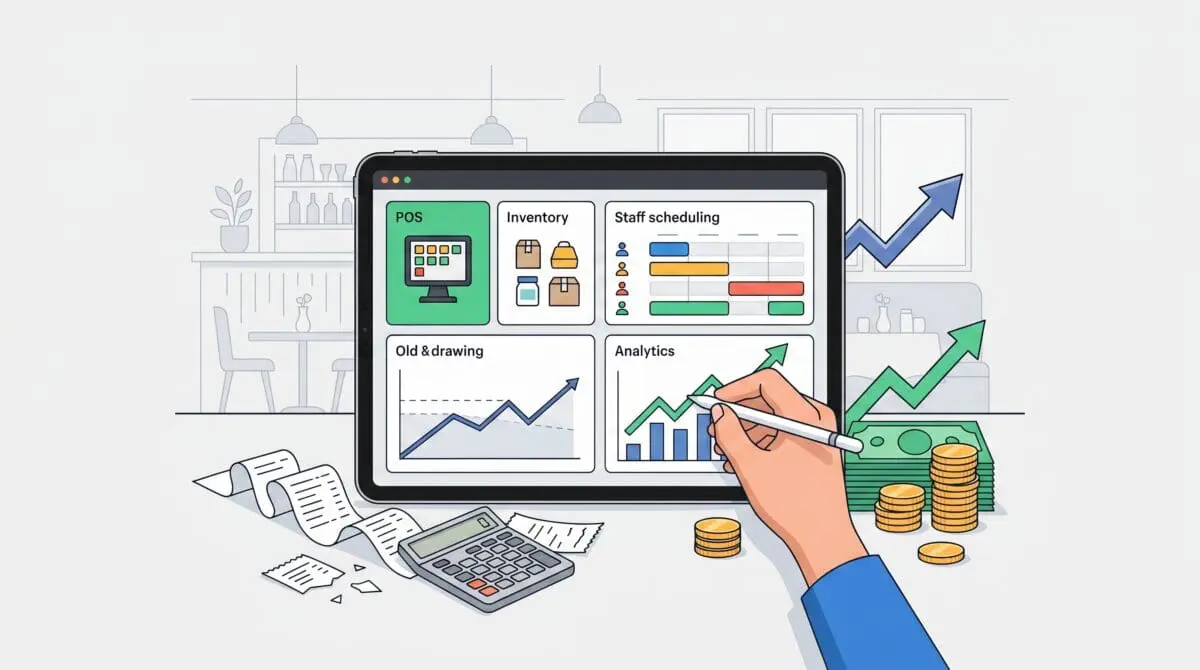
The strategic pivot is moving rapidly away from these isolated applications and toward unified intelligence layers. Figuring out how to run your restaurant more efficiently with an all-in-one system is no longer just an optional IT upgrade. It is a fundamental requirement for financial survival in a hyper-competitive landscape.
These unified platforms act as an overarching operating system for the entire enterprise. They collapse dozens of expensive subscriptions into a single, cohesive digital environment. This shift is not just about saving money on software; it is about fundamentally restructuring how a restaurant breathes, operates, and scales.
Moving Beyond Dashboards: The Era of Agentic Orchestration
The most profound breakthrough in this space is the rapid transition from generative fluff to agentic execution. Generative AI was initially introduced as a neat party trick for writing creative menu descriptions or social media captions. However, agentic AI is an entirely different beast that actually executes complex workflows without human prompting.
Modern platforms like Nory and Burnt are deploying these agentic layers to orchestrate the back-of-house invisibly. These systems do not just show you a passive dashboard of rising labor costs. They actively and autonomously adjust staffing schedules based on localized, real-time data.
If a sudden weather shift occurs or a nearby concert is announced, the system pulls the API data instantly. It then cross-references historical sales velocity and automatically schedules three extra prep cooks for the evening rush. This entirely eliminates the guesswork that has plagued human managers for decades.
This deep intelligence extends directly to the guest experience through dynamic menu engineering. In a unified system, menus are no longer static digital files sitting on a tablet. They are fluid, discovery-driven interfaces that react to the immediate needs of the business.
A dynamic menu notices a lull in foot traffic at three in the afternoon. It autonomously triggers a flash happy hour via SMS to loyalty members within a strict one-mile radius. Simultaneously, it pushes high-margin inventory items to the top of digital ordering kiosks to maximize profitability during peak hours.
For high-growth enterprises, this unified approach enables sophisticated cluster management. Operators can use integrated telemetry to manage multiple units within a geographic cluster as a single, breathing entity. Inventory is seamlessly redistributed between nearby locations by AI-managed logistics.
If one location runs out of premium packaging, the system does not force a manager to make an emergency supplier run. It simply locates a surplus at a sister property three miles away and coordinates a transfer. This unified visibility cuts emergency logistical runs by nearly forty percent across enterprise fleets.
Follow the Smart Money: The Vertical Integration Boom
If you want to understand the future trajectory of any market, you simply have to follow the smart capital. Venture capital firms are no longer writing checks for isolated, single-feature startups. The heavy hitters in the investment world are pouring billions into vertical integrators.
Firms like GV and Accel understand that controlling the entire operational stack creates an impenetrable competitive moat. Wonder Group is the definitive example of this massive strategic shift. Armed with a massive billion-dollar funding round, they are building the blueprint for the next decade of hospitality.
They combine mobile kitchens, proprietary point-of-sale systems, and delivery logistics into one cohesive, vertically integrated machine. This creates a powerful Restaurant-as-a-Service model that bypasses traditional operational bottlenecks. It proves that piecemeal software architecture is officially a relic of the past.
We are also seeing the rise of a fierce challenger class aiming to disrupt legacy tech monopolies. Labrador AI is aggressively capturing mid-market share by bundling sixteen different operational systems into a single stack. By linking the software directly to processing fees, they are effectively offering enterprise-grade technology for zero monthly subscription costs.
Meanwhile, procurement disruptors are fixing the most broken part of the supply chain. Startups like Saltz are using agentic AI to collapse the chaotic, multi-trillion-dollar food procurement industry. They are automating the endless stream of late-night text messages and messy PDF invoices exchanged between chefs and suppliers.
Solving the Breakeven Crisis in the Real World
To understand why this technological shift matters on the ground, we have to look closely at the breakeven crisis. The sheer cost and friction of managing fifteen disconnected software subscriptions is bleeding independent operators dry. This manual leakage is exactly where profit margins go to die.
Consider the recent operational data from the Meridian Restaurant Group. By migrating their entire portfolio to a unified inventory layer, they recovered tens of thousands of dollars in annual food costs. The system caught pricing discrepancies and waste patterns that human eyes simply missed.
More importantly, this consolidation eliminated dozens of hours of manual administrative labor every single week. Strategic all-in-one systems eliminate what industry insiders call decision latency. Shift leads currently spend the vast majority of their time on mundane data entry rather than hospitality.
By automating decision-heavy tasks like floor-plan optimization and no-show prediction, human managers are freed from their screens. The system can predict no-shows with incredible accuracy, automatically adjusting overbooking ratios to ensure a full dining room. This returns the staff to high-touch hospitality, which is the actual product being sold.
Margin protection is also being completely revolutionized by these unified intelligence layers. Companies like Solink are blending advanced video AI directly with point-of-sale transactional data. This instantly detects operational fraud, unauthorized voids, and sweethearting in real time.
When a suspicious transaction is rung up, the camera tags that exact timestamp automatically. Remote owners receive a compiled video reel of all anomalies at the end of the day. This level of oversight is impossible when your security cameras and your cash registers exist in different digital universes.
Running a modern restaurant on fifteen disconnected software platforms is like running a kitchen where every chef speaks a different language and uses a different recipe book. The ingredients might be excellent, but the sheer friction of communication guarantees that the final dish will be late, over budget, and chaotic. A unified operating system acts as the universal translator and master expeditor, ensuring every station moves in perfect, profitable harmony.
The 24-Month Horizon: Where Hospitality Meets Automation
Looking ahead over the next twelve to twenty-four months, founders must prepare for several massive operational pivots. The AI consumer operating system is rapidly becoming the primary interface for digital ordering. Brands are integrating instant checkout capabilities directly into large language models to capture intent instantly.
Forward-thinking brands like Wingstop are already leveraging these frictionless ordering channels. By allowing customers to order directly through AI chat interfaces, they successfully bypass aggregator platforms. This strategic move reclaims up to thirty percent in lost commission fees.
Kitchen automation is also maturing past the experimental gimmick phase into true fleet-level reliability. Robotics-as-a-Service is being integrated directly into unified enterprise dashboards. Operators can now view robotic maintenance alerts and return-on-investment analysis right next to their daily sales data.
Furthermore, sustainability is transitioning from a corporate buzzword into a hard margin play. Tracking food waste is now embedded directly into the profit and loss statement through advanced computer vision. Systems like Winnow and Nuvilab identify exactly what is being thrown away and suggest immediate portion adjustments.
Finally, the traditional point-chasing loyalty model is effectively dead. The modern consumer demands more than a free appetizer after spending five hundred dollars. The future belongs to surgical personalization powered by concierge AI.
These unified systems recognize a guest’s specific dietary preferences and past wine selections the moment they enter the geofence. This empowers servers to deliver a highly customized experience without asking a single question. This scalable VIP treatment consistently drives significantly higher check averages across the board.
Andres SEO Expert’s Final Analysis: The Future-Proof Foundation
As we look toward the end of the decade, the divide between the profitable and the obsolete will come down entirely to infrastructure. Enterprises simply cannot scale a broken, fragmented digital foundation. The transition to an all-in-one operating system is the only viable path to achieving true operational leverage.
The technology is no longer just about tracking what happened yesterday. It is about deploying an intelligent layer that actively shapes what will happen tomorrow. Restaurants that embrace this unified approach will operate with leaner teams, tighter margins, and vastly superior guest experiences.
In a fast-moving digital landscape, having the right strategic foundation is what separates market leaders from forgotten brands. It is about building a business that is agile, intelligent, and fiercely competitive from the inside out. If you are ready to explore how these technological shifts impact your broader digital strategy, connect with Andres SEO Expert to build a future-proof roadmap for your enterprise.