Executive Summary
- From Connected to Autonomous: The strategic shift from manual automation to Ambient Intelligence allows buildings to proactively manage human performance and mitigate operational friction.
- Real Estate as a Yield Generator: Through energy arbitrage and Virtual Power Plants, AI-integrated offices are transitioning from traditional cost centers into revenue-generating assets.
- Solving the Hybrid Ghost Town: Proximity-based collision logic and dynamic space reconfiguration eliminate wasted overhead while organically rebuilding corporate culture.
The Evolution of the Modern Workspace
The definition of a modern workspace has fundamentally fractured. We have officially moved past the era of manual automation.
A wall-mounted tablet outside a conference room is no longer the pinnacle of workplace technology. Today, the strategic shift has moved rapidly toward Autonomous Work Environments.
These spaces do not wait for human input. They anticipate operational friction and eliminate it before it impacts the bottom line.
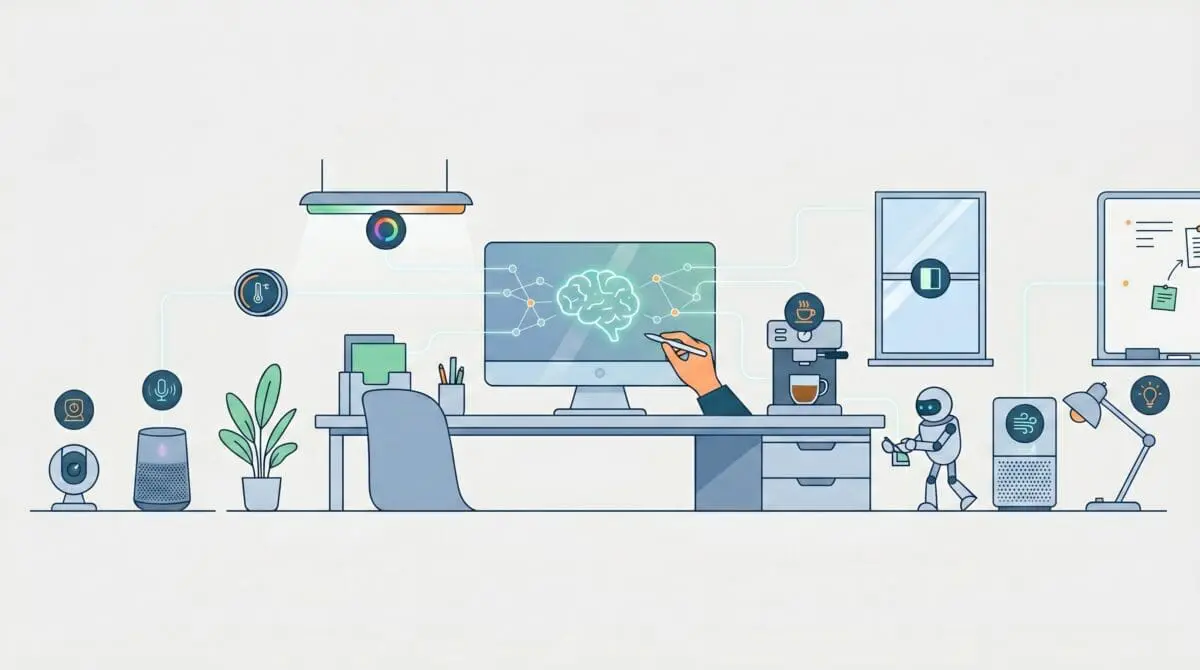
The killer strategy driving this enterprise adoption is Ambient Intelligence. This is a layer of multi-modal AI that operates entirely without user prompts.
It functions as a silent operational partner. By seamlessly integrating the Internet of Things with predictive models, the office becomes a proactive participant in your business strategy.
The Cognitive Campus and Biological Optimization
Real-world adoption of this technology is being led by what industry insiders call Cognitive Campuses. These are environments where the building itself actively manages human performance.
Traditional HVAC and lighting systems are being replaced by generative AI models. These models analyze historical productivity data against real-time biometric feedback.
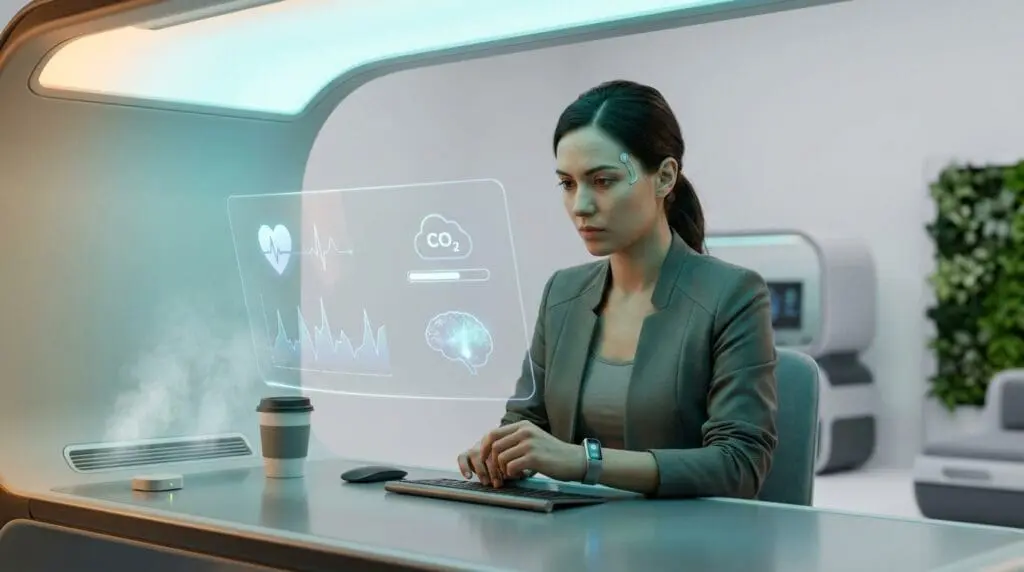
Enterprise leaders are leveraging data points like heart rate variability and ambient CO2 levels. This allows the building to make micro-adjustments to the physical environment.
Firms are integrating Bio-Sync protocols to directly combat the notorious mid-afternoon productivity slump. The system autonomously adjusts oxygen levels and color temperatures in real-time.
This precise environmental calibration mitigates circadian fatigue. Early data suggests these autonomous adjustments can boost afternoon output by up to fourteen percent.
Dynamic Space and the End of Static Real Estate
Commercial real estate carries a massive overhead burden. Paying for specialized, underused rooms is a capital inefficiency that modern startups are actively solving.
Through the deployment of modular, robotic furniture, a ten thousand square foot footprint can now function with the utility of a space three times its size.
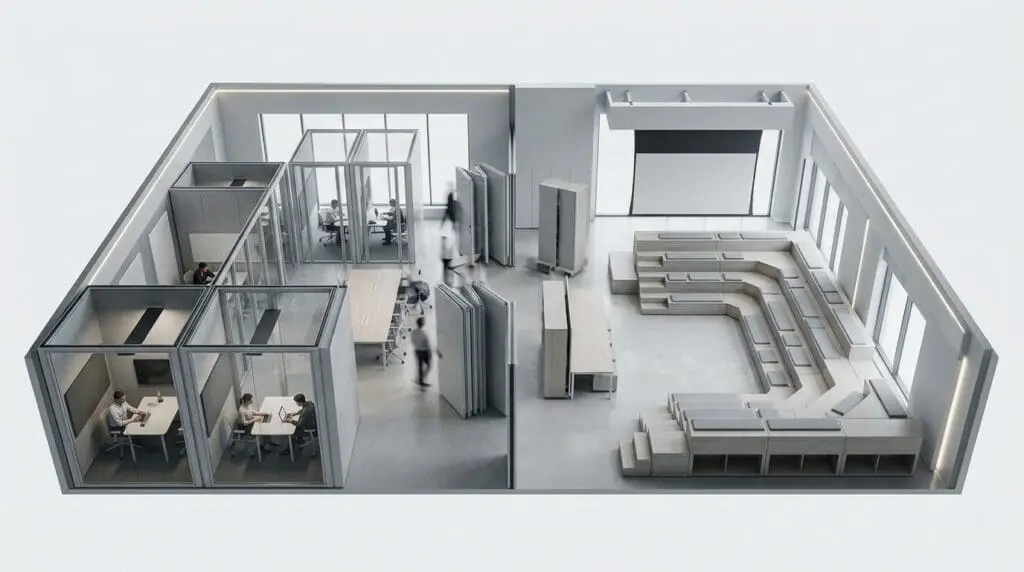
This is made possible by IoT floor-pressure sensors paired with advanced vision-language models. The building physically adapts to the schedule of the day.
During deep-work hours, the office automatically deploys enclosed focus pods. By noon, these structures retract seamlessly into the ceiling to create open town hall configurations.
This dynamic reconfiguration eliminates wasted space. It allows fast-scaling companies to maximize their real estate ROI without signing expansive new leases.
The Invisible Concierge API
Enterprise leaders are rapidly abandoning clunky, manual room booking software. The friction of scheduling is being outsourced entirely to Agentic AI.
These autonomous agents act as invisible concierges, silently monitoring digital communication channels like Slack or Microsoft Teams.
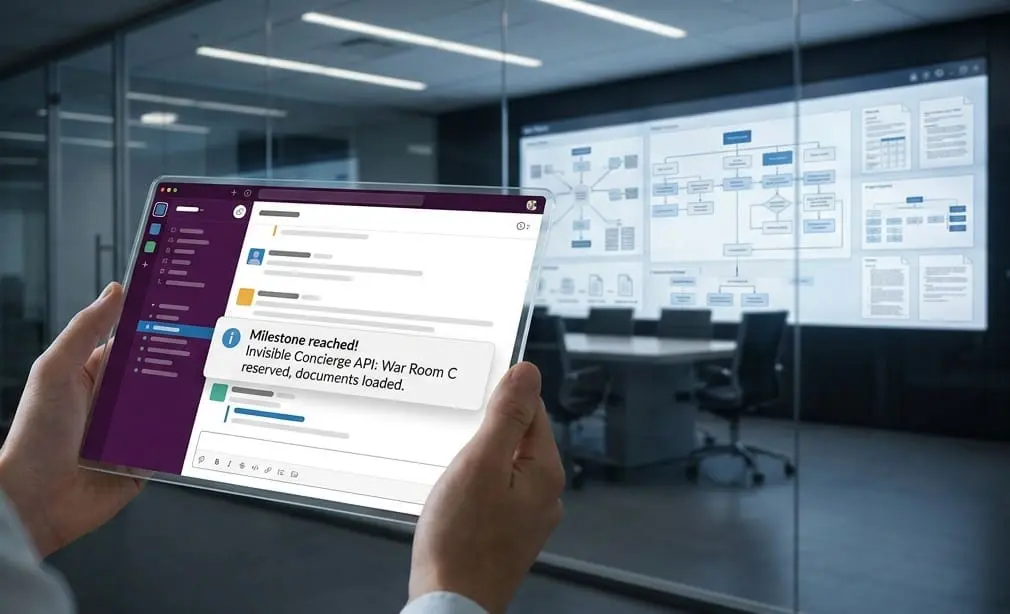
When a project discussion reaches a critical milestone in a digital chat, the AI takes immediate physical action. It autonomously reserves a physical war room for the team.
The system prepares the digital whiteboard with all relevant project documents. It can even order catering based on the attendees’ known dietary preferences.
All of this data is stored securely in encrypted edge-cloud nodes. The transition from digital ideation to physical collaboration happens with zero administrative drag.
PropTech 3.0 and the Battle for Spatial Intelligence
Venture capital is actively fleeing pure-play SaaS models. Smart money is now flowing directly into full-stack spatial intelligence.
Total investment in AI-integrated property technology has reached staggering heights over the last twelve months. The specific focus is entirely on hard-tech integration.
Legacy industrial giants have evolved into comprehensive Office OS providers. They are competing directly with major tech conglomerates for dominance over the physical workspace.
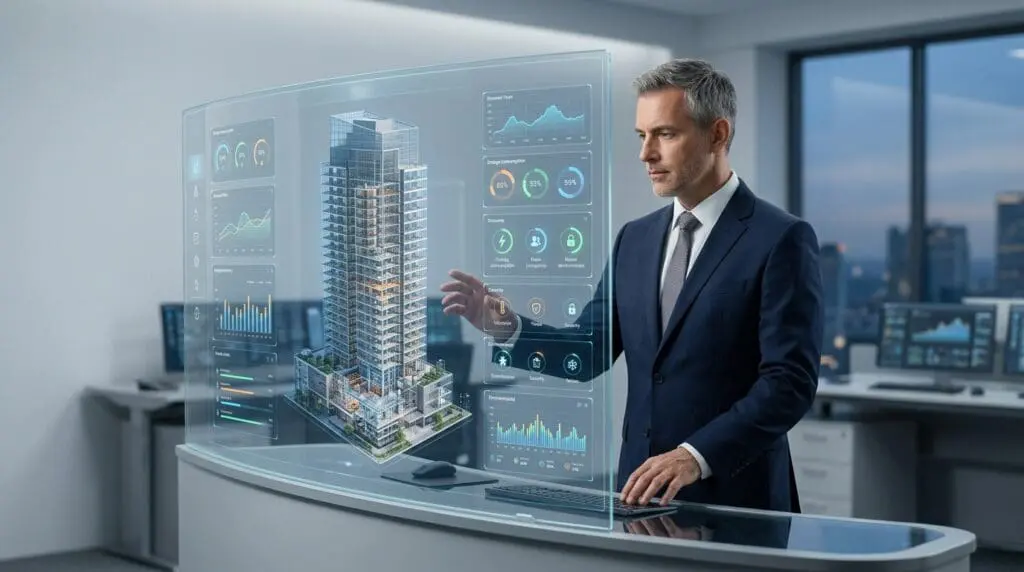
The ultimate prize in this battle is the Digital Twin. This is a real-time, three-dimensional replica of the physical building.
This digital twin serves as the central command center for all IoT data. It allows executives to simulate and optimize building performance from a single dashboard.
Key Drivers of PropTech 3.0 Integration
- Full-Stack Spatial Intelligence: Moving beyond single-point solutions to holistic building operating systems.
- Lidar-on-a-Chip: Delivering precise occupancy tracking without compromising employee privacy.
- Energy Arbitrage: Transforming passive real estate into active, yield-generating virtual power plants.
Smart-Office-as-a-Service and Energy Arbitrage
Disruptive startups are capturing massive mid-market share by removing the traditional barriers to entry. They offer Smart-Office-as-a-Service to eliminate high upfront capital expenditures.
Instead of forcing companies to buy expensive sensors, they utilize a subscription model. Buildings are retrofitted with advanced Lidar-on-a-chip technology.
This provides near-perfect occupancy accuracy without the privacy risks associated with traditional camera systems. It is a frictionless upgrade for legacy spaces.
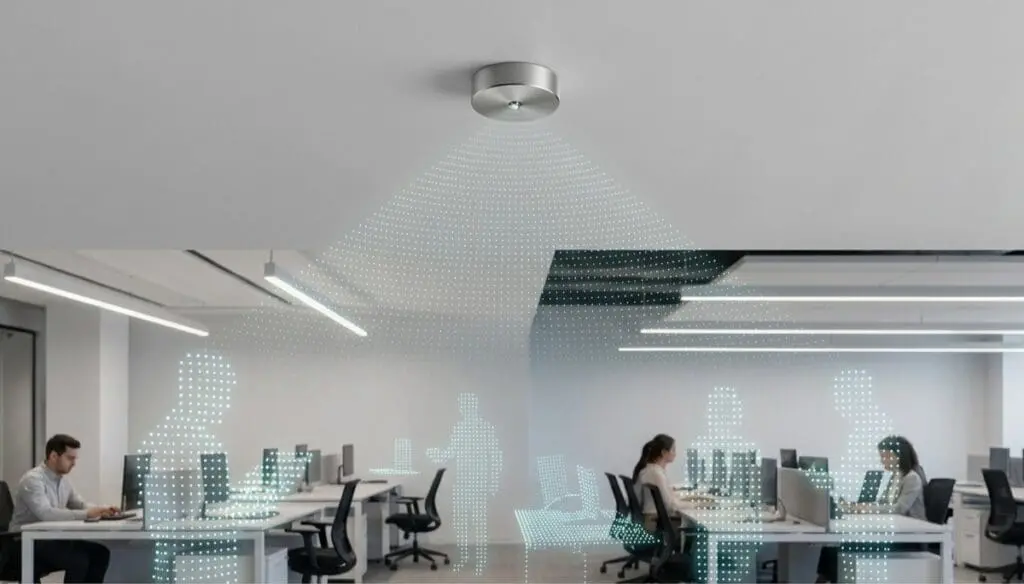
Meanwhile, institutional investors are placing massive bets on energy arbitrage. Smart offices are being systematically transformed into Virtual Power Plants.
By using AI to optimize grid-scale batteries within office basements, companies change their relationship with the energy grid. They are no longer just consumers.
These buildings sell excess energy back to the grid during peak pricing hours. This strategy turns the physical office from a traditional cost center into a yield-generating asset.
Curing the Hybrid Ghost Town
The most pressing operational problem of the current decade has been hybrid friction. Executives have struggled to solve the phenomenon known as the death of the dead floor.
High vacancy rates create a profound social coldness. Employees commute to the office only to sit on video calls in total isolation.

The solution to this isolation is proximity-based collision logic. Modern IoT badge systems utilizing ultra-wideband technology feed directly into connection dashboards.
The AI identifies when two cross-functional collaborators are in the building simultaneously. It then nudges them via haptic feedback or mobile alerts to connect in person.
It might suggest grabbing a coffee because a specific room is free for the next fifteen minutes. This engineered serendipity rebuilds corporate culture organically.
Strategic Solutions for Hybrid Environments
- Proximity-Based Collision Logic: Utilizing ultra-wideband technology to engineer serendipitous employee interactions.
- Real-Time Floor Mothballing: Dynamically shutting down unused zones to drastically reduce operational expenditure.
- Zero-Touch Compliance: Automating security audits through edge-based biometric verification.
Ruthless OPEX Reduction and Zero-Touch Compliance
Beyond culture, the financial implications of autonomous floors are undeniable. Enterprise data shows that AI-managed lighting and thermal zoning drastically reduce utility overhead.
In high-rise environments, these smart systems can cut energy costs by nearly forty percent. The building essentially manages its own metabolic rate.
When occupancy drops below a specific threshold, the system can mothball entire floors in real-time. This saves millions in operational expenditure while keeping active floors feeling highly energetic.
In highly regulated sectors like FinTech and BioTech, IoT sensors are automating critical audit trails. Manual security logs are a thing of the past.
Presence verification sensors confirm exactly who was in a secure data room and for how long. By utilizing gait analysis or edge-based iris recognition, human error is entirely removed from security protocols.
Think of the traditional corporate office as a static chessboard where employees are forced to navigate rigid, immovable pieces. An Autonomous Work Environment, powered by AI and IoT, is a living, breathing central nervous system. It does not wait for you to make a move; it anticipates your operational needs, reconfiguring the board in real-time to ensure every square foot is optimized for peak human performance.
Expert Outlook: The Next 24 Months of Autonomous Workspaces
As we look toward the immediate future, founders and CEOs must pivot toward the post-screen office. The concept of metabolic buildings will soon become the enterprise standard.
Within the next eighteen months, the smart office will be defined by the seamless integration of spatial computing. Wearable technology will overlay the physical world with persistent digital annotations.
Executives will leave spatial notes floating in mid-air within physical boardrooms. The next team to enter the room will instantly access this merged digital and physical archive.
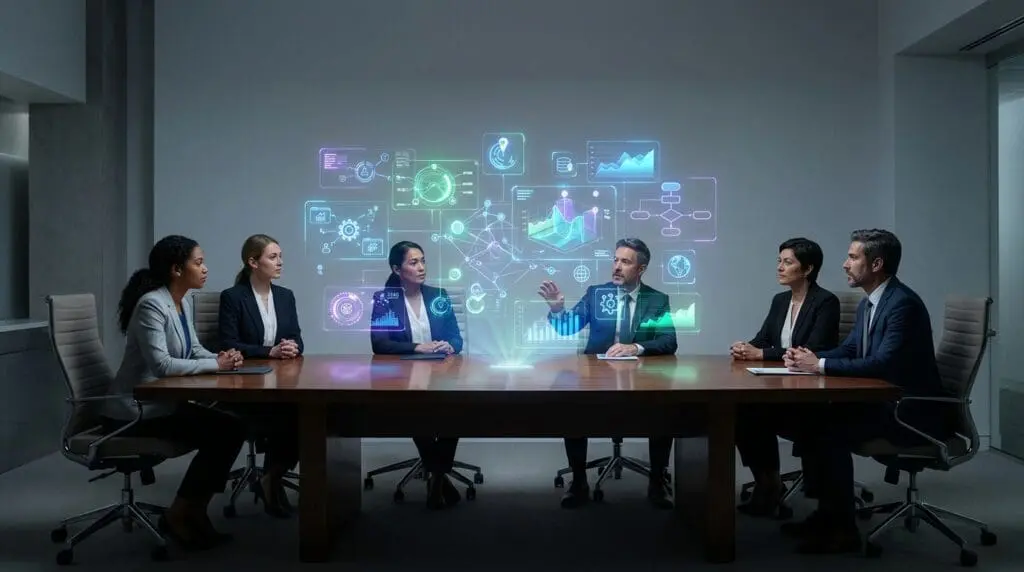
We are also moving rapidly toward the A/B testing of physical space. Generative floorplan iteration will allow AI to analyze months of traffic and collaboration data.
The system will suggest new floor plans every Sunday night. Robotic furniture will physically implement these changes to optimize for the specific goals of the coming week.
The next massive frontier is neuro-inclusive design. Smart offices will soon detect digital fatigue via eye-tracking and typing cadence sensors.
When a team’s collective stress levels hit a critical threshold, the building will autonomously initiate a recovery mode. Lights will dim, acoustic dampening will activate, and forest-scented phytoncides will circulate to force a biological reset.
Finally, we will see the rise of the holographic commute to solve the ongoing talent war. The smart office will expand directly into the employee’s home.
Companies will subsidize home-office IoT nodes that sync remote lighting and acoustics with the main headquarters. This shared sensory environment will bridge the psychological gap between remote and in-office teams.
Navigating this transition requires more than just buying new hardware. It requires a fundamental rethinking of how physical space interacts with human capital.
In a fast-moving digital landscape, having the right strategic foundation is the only way to maintain a competitive edge. The autonomous workspace is not a futuristic concept; it is a present-day operational necessity.
To ensure your enterprise is positioned for this spatial revolution, you need strategies that scale. Connect with Andres SEO Expert to build future-proof business strategies that drive real market dominance.