




Key Points
- Continuous Close Execution: AI-Native Revenue Lifecycle Management (RLM) eliminates the traditional accounting “Dead Week” by automating revenue deferrals and dispute resolutions in real-time.
- Event-Stream Architecture: The pivot from legacy ERP batch processing to sub-second Event-Stream Accounting leverages Generative AI to instantly map complex MSA obligations to ASC 606 standards.
- Outcome-Based Monetization: The subscription economy is transitioning toward autonomous billing agents that dynamically adjust pricing based on verified telemetry data and tangible customer ROI.
Table of Contents
The Financial Tech Friction: Killing the Dead Week
The global financial infrastructure is undergoing a massive architectural rewiring driven by algorithmic precision. According to the 2026 Global FinTech Index by Goldman Sachs, the total volume of transactions processed through AI-autonomous billing engines has surged by 142% year-over-year. This staggering acceleration puts the market on a definitive trajectory to reach a projected $4.8 trillion by the end of Q4 2026. Institutional capital is no longer interested in incremental upgrades to legacy billing systems.
Instead, the “smart money” is aggressively pivoting toward AI-Native Revenue Lifecycle Management (RLM) and Autonomous Revenue Recognition. For decades, enterprise finance teams have been paralyzed by the “Dead Week.” This is the traditional seven-to-ten day period required for companies to manually close their books, reconcile accounts, and chase down unbilled usage. It is a period defined by opaque data, manual spreadsheet auditing, and significant operational friction.
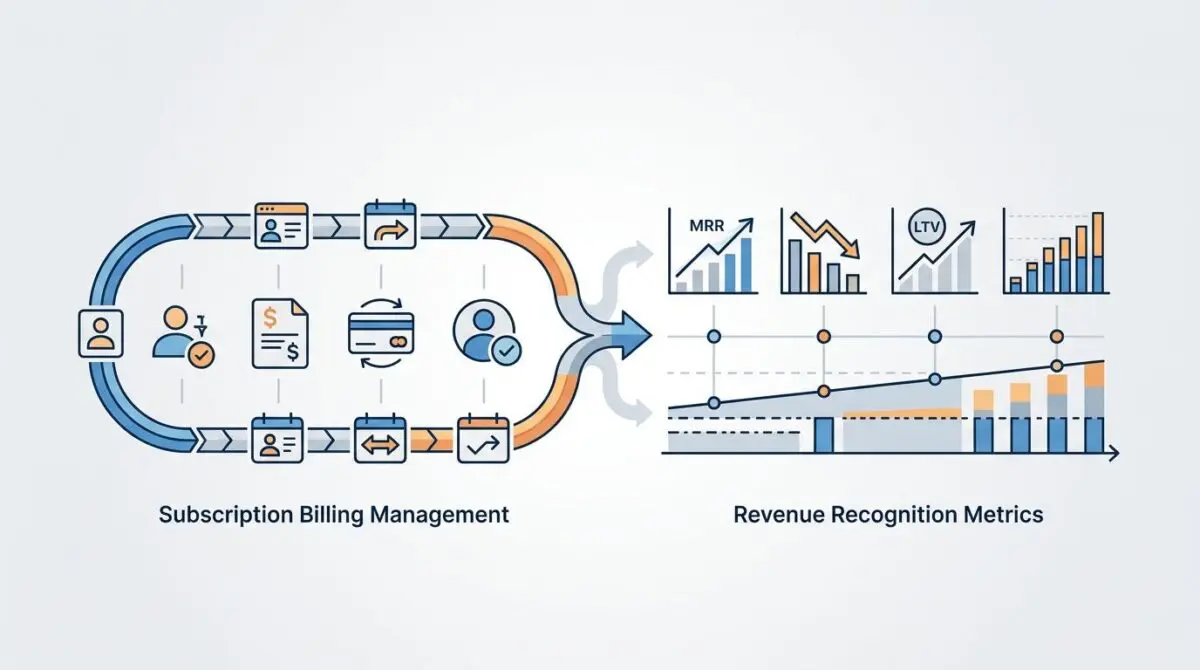
Legacy ERP systems simply cannot keep pace with the velocity of modern digital transactions. They were built for a world of static invoices, not hyper-dynamic, usage-based consumption models. AI-Native RLM fundamentally eliminates this structural bottleneck. By utilizing artificial intelligence to resolve billing disputes and automate revenue deferrals on the fly, businesses have achieved a true “Continuous Close” capability.
This technological leap enables CEOs and finance leaders to see live, GAAP-compliant financial statements at any given second. It drastically reduces the cost of annual audits and entirely eliminates the 15% revenue leakage typically associated with manual usage-based billing errors. Un-tracked API calls, forgotten overage charges, and misaligned contract terms are now instantly caught and monetized by autonomous agents.
Market Intelligence & Capital Flow
Market Intelligence & Data
Subscription Economy Valuation
The total market size for global subscription services is expected to exceed $1.5T by year-end 2026, according to analysis from Juniper Research.
CFO Adoption of Autonomous RevRec
The 2026 Deloitte CFO Survey indicates that nearly 9 out of 10 finance leaders have now deployed AI to automate at least 50% of their revenue recognition workflows.
Usage-Billing Latency
Data from the 2026 AWS FinTech Infrastructure Report shows that top-tier billing engines have reduced usage-tracking latency to under 15 milliseconds for hyper-scale SaaS.
Net Revenue Retention (NRR)
Enterprise firms using AI-driven dynamic pricing models reported a 30% boost in NRR over the last 12 months, per findings from the 2026 Forrester B2B Benchmark.
The data above paints a clear picture of a market in hyper-acceleration. A $1.52 trillion subscription economy requires an entirely new class of financial infrastructure to function efficiently. Traditional flat-rate billing mechanisms are crumbling under the weight of multi-dimensional pricing models. We are witnessing a profound migration away from monolithic, generic ERP bolt-ons.
Enterprise finance leaders are demanding composable billing stacks that offer 99.9% automated revenue recognition. This shift is not just about back-office efficiency; it is about capital preservation and maximizing Net Revenue Retention. When top-tier billing engines reduce usage-tracking latency to under 15 milliseconds, they unlock unprecedented agility for hyper-scale SaaS providers.
This microsecond precision allows companies to capture every fractional cent of value generated by their platforms. It transforms billing from an administrative burden into a front-line revenue generation engine. The 30% increase in NRR reported by Forrester is a direct result of aligning customer cost with actual platform value in real-time.
The FinTech Deep Dive: Rewiring the Billing Stack
The 2026 financial landscape is defined by the critical shift from batch-processed billing to “Event-Stream Accounting.” In the past, transactions were pooled and processed at the end of the month, creating massive data bottlenecks. Today, cutting-edge platforms process every user action as an isolated, instantly recognizable financial event.
From Batch Processing to Event-Stream Accounting
Modern AI agents are now capable of parsing highly idiosyncratic enterprise Master Service Agreements in real-time. These generative models instantly extract complex performance obligations and map them directly to the corporate ledger. They effectively create a digital twin of the contract that monitors compliance and usage simultaneously.
While navigating the labyrinth of ASC 606 and IFRS 15 regulations was once a nightmare for CFOs, AI now handles this compliance layer autonomously. This automation has a profound impact on corporate governance and institutional risk management. A 2026 deep-dive study by the International Federation of Accountants (IFAC) reveals that firms implementing real-time AI revenue recognition have seen a 65% reduction in ‘material weakness’ findings during annual audits compared to 2024 levels.
This drastic reduction in audit risk is driving massive institutional confidence in autonomous finance architectures. Furthermore, decentralized ledger technology is increasingly being utilized for multi-party settlement in ecosystem-led growth models. In a modern API economy, revenue sharing between partners must be calculated and distributed at the exact moment of the transaction.
DLT ensures that this capital distribution happens instantly, rather than being delayed until month-end reconciliation. This instantaneous settlement reduces counterparty risk and accelerates capital velocity across the entire software supply chain. It is the foundation of a truly frictionless digital economy.
Smart Money and Composable Architecture
Institutional capital is aggressively flowing into the infrastructure layer of this autonomous movement. Startups focusing on “Autonomous Finance” like LedgerFlow and RevEdge have closed massive Series C rounds in Q1 2026. These platforms are proving that the future of finance is modular, agile, and deeply integrated with modern data lakes.
Venture capital heavyweights like Sequoia and Andreessen Horowitz are prioritizing platforms that integrate directly into Snowflake or Databricks. This sub-second data processing capability is non-negotiable for the next generation of financial technology. It allows enterprises to run complex billing queries against petabytes of usage data without crashing their core transactional systems.
By separating the compute layer from the storage layer, these composable architectures offer limitless scalability for dynamic billing. Even the legacy tech giants are being forced to adapt to this new reality. Industry titans like Stripe and Adyen have rapidly expanded their “Billing-as-a-Service” suites to remain competitive.
They are now embedding predictive churn mitigation engines directly into the payment flow. These engines use AI to identify behavioral usage drops and deploy targeted discounts before a missed payment even occurs. It is a proactive, algorithmic approach to customer retention that traditional ERPs simply cannot execute.
The Strategic Action Plan: Outcome-Based Agents
Over the next 18 months, the subscription industry will evolve rapidly toward “Outcome-Based Billing Agents.” The era of charging a flat monthly fee for dormant software seats is coming to an abrupt end. Enterprise buyers now demand pricing models that are inextricably linked to tangible business value.
Strategic Trajectory
- Transition from legacy flat-rate or seat-based pricing toward intelligent ‘Outcome-Based Billing Agents’.
- Implement AI models to dynamically adjust subscription costs based on verified ROI delivered to the customer.
- Integrate advanced telemetry data streams to provide real-time verification of value-based pricing triggers.
- Architect a new generation of revenue recognition engines designed to manage infinite pricing variability.
- Automate regulatory compliance workflows to handle hyper-dynamic billing cycles without manual intervention.
To survive this transition, founders and institutional investors must completely re-architect their revenue engines. AI will soon dynamically adjust subscription costs based on the actual ROI delivered to the customer. For example, rather than paying a flat fee for a CRM, a business might pay a fractional percentage of the closed-won revenue generated through that specific tool.
This requires integrating advanced telemetry data streams to provide real-time verification of value-based pricing triggers. The software must autonomously prove its worth before it generates an invoice. This paradigm shift necessitates a new generation of revenue recognition engines capable of handling infinite pricing variability.
When every single customer pays a uniquely calculated rate based on their specific usage and ROI, manual reconciliation becomes mathematically impossible. Autonomous compliance workflows are the only way to manage these hyper-dynamic billing cycles. Finance teams must transition from being historical scorekeepers to becoming forward-looking revenue architects.
Conclusion: The Continuous Close Era
The transition to AI-Native Revenue Lifecycle Management is not merely a software upgrade. It is a fundamental rewiring of how digital value is measured, captured, and recognized across the global economy. Companies that cling to batch processing and manual audits will soon find themselves outpaced by competitors operating on a continuous close.
Autonomous revenue recognition transforms financial data from a historical record into a real-time strategic asset. It empowers executives to make capital allocation decisions with absolute certainty and microsecond precision. The future of the subscription economy belongs to those who embrace algorithmic agility and outcome-based monetization.
Navigating the intersection of financial technology, institutional capital, and market psychology requires a sharp strategy. To future-proof your FinTech architecture and scale with precision, connect with Andres at Andres SEO Expert.