Key Points
- Transitioning to an Autonomous Integrated FinTech Stack eliminates liquidity fragmentation by utilizing AI to instantly route capital to high-yield environments.
- Early-stage companies leveraging Agentic Finance operate with 3.5x more capital efficiency, fundamentally disrupting traditional corporate treasury models.
- The future of financial architecture relies on Outcome-Based Prompting, where dynamic systems autonomously architect debt and equity to meet strategic milestones.
Table of Contents
The Financial Tech Friction
According to the 2026 Global FinTech Index by Bloomberg, 68% of early-stage high-growth companies have now replaced their traditional CFO office functions with an ‘Autonomous Treasury Stack’ to manage real-time global liquidity.
This massive shift highlights a critical friction point in modern company building. Legacy banking systems simply move too slowly for the velocity of today’s digital-first startups.
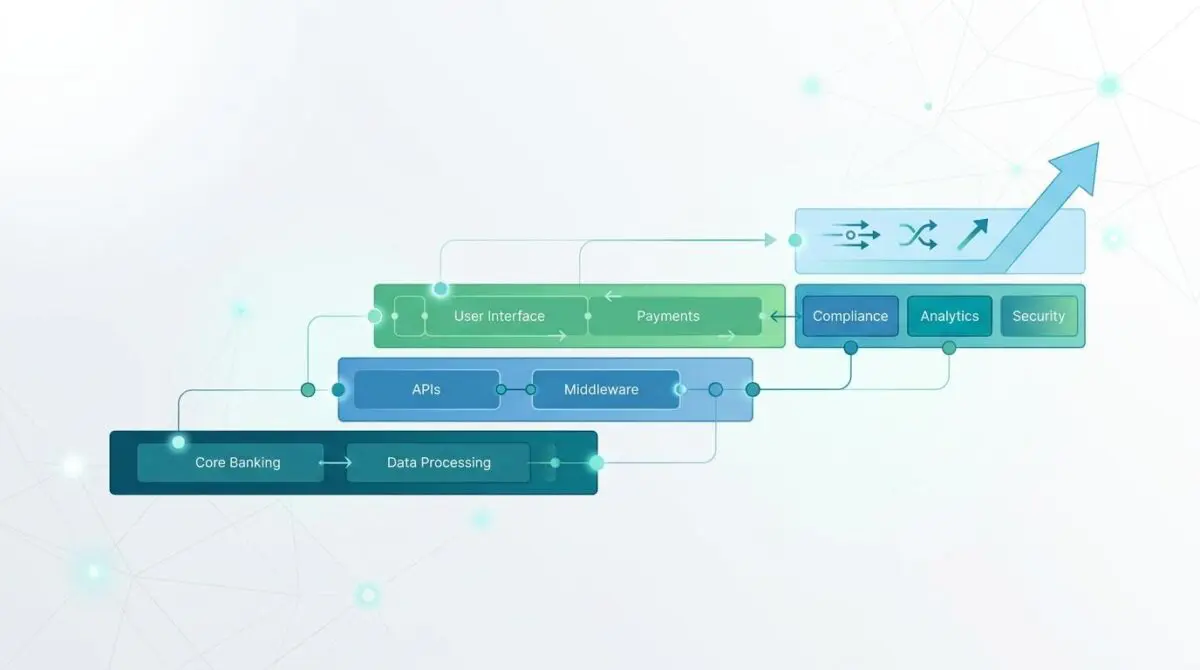
This is not merely a collection of connected APIs or a sleek dashboard. It is a fundamental rewiring of corporate finance, acting as a dynamic liquidity engine that anticipates capital needs before they arise.
For the early bird founder, adopting this architecture is no longer an operational luxury. It is a baseline requirement to secure institutional capital and scale without administrative bloat.
The traditional monthly close is a relic of the past, replaced by continuous, autonomous financial reconciliation. Startups that fail to adopt this infrastructure will inevitably bleed capital through operational inefficiencies.
Market Intelligence & Capital Flow
Market Intelligence & Data
AI-Managed AUM
Deloitte’s 2026 Wealth Management Report indicates that assets managed by autonomous AI agents have surpassed $4.2 trillion globally as of May 2026.
Instant Settlement Rate
Research from the Bank for International Settlements (BIS) in early 2026 shows that 94% of top-tier FinTech stacks now utilize DLT for near-instantaneous cross-border settlements.
VC Agentic Infusion
PitchBook’s Q1 2026 Venture Monitor reports a record $12.4 billion invested into ‘Agentic Finance’ startups in the first four months of the year.
Capital Efficiency Gain
A 2026 McKinsey Global Institute study reveals that early-stage firms using integrated AI stacks operate with 3.5x more capital efficiency than those on legacy banking systems.
The data paints a clear picture of where smart money is flowing. Institutional capital is aggressively abandoning static, retroactive ledgers in favor of predictive financial engines.
With AI agents now managing trillions in assets, the traditional boundaries of wealth management and corporate treasury have permanently blurred. Capital efficiency has become the ultimate metric for venture-backed survival.
Startups operating on legacy systems are effectively paying a massive hidden tax in the form of idle cash and delayed settlements. The transition to agentic finance represents a paradigm shift from passive accounting to active wealth generation.
Venture capitalists are no longer just funding product ideas; they are funding the underlying financial architecture that guarantees rapid scalability.
The FinTech Deep Dive
The 2026 landscape is entirely dominated by Agentic Finance. In this ecosystem, AI agents possess fiduciary-level autonomy to manage multi-currency liquidity and execute real-time tax provisioning.
Cutting-edge stacks have evolved far beyond simple API integrations. They now rely on Intent-Based Architectures powered by high-throughput Layer 2 blockchains and edge-computed biometric keys.
This technological leap enables sub-millisecond settlements and entirely passwordless, self-custodial ecosystems. The administrative burden of the monthly close is effectively eliminated through triple-entry accounting at the protocol level.
While regulatory frameworks like the updated Basel IV accords require enhanced cryptographic reporting, modern autonomous stacks handle these compliance layers invisibly. They generate real-time, audit-ready financial statements that update autonomously with every micro-transaction.
Intent-Based Architectures
The core of this disruption lies in how systems process commands. Traditional finance requires step-by-step manual execution for every capital movement.
Intent-Based Architectures allow founders to simply declare an end goal, such as maximizing yield on idle euros. The system autonomously charts the most efficient cryptographic path to achieve that exact outcome.
- Agentic Autonomy: AI systems that operate with fiduciary responsibility to execute complex multi-leg trades.
- Intent-Based Routing: Smart contracts that prioritize the desired financial outcome over manual step-by-step execution.
- Biometric Custody: Edge-computed security layers that completely eliminate passwords and central points of failure.
This level of abstraction removes human error from the equation entirely. It allows executive teams to focus purely on strategic growth rather than administrative execution.
Solving Liquidity Fragmentation
The modern stack elegantly solves the pervasive issue of liquidity fragmentation. It utilizes advanced AI orchestration to move capital instantly between high-yield environments.
This completely eliminates the idle cash problem that has historically plagued early-stage treasuries. Every dollar is continuously optimized for yield, risk, and operational readiness.
Recent data from the 2026 MIT Digital Currency Initiative suggests that over 30% of global consumer transactions are now mediated by ‘Invisible Wallets’ that negotiate dynamic pricing in real-time based on the user’s cross-platform loyalty data.
This level of autonomous negotiation is rapidly migrating from consumer tech into B2B financial architecture. The result is a hyper-efficient marketplace where liquidity is never stagnant.
Corporate treasury is no longer a defensive function. It is an aggressive, yield-generating profit center powered by real-time telemetry.
Cognitive Capital Platforms
Smart money is rapidly shifting away from traditional neo-banks toward Cognitive Capital Platforms. These platforms do not just hold money; they actively strategize its deployment.
Disruptors like Aion Financial and Nerve Infrastructure have secured over $8 billion in early 2026 funding, led by heavyweights like Sequoia and BlackRock. This signals a massive institutional validation of the autonomous thesis.
Furthermore, Apple’s 2026 expansion of its Apple Treasury suite has effectively consolidated the financial stack for 45% of new tech startups. This ecosystem lock-in has created a massive vacuum for traditional business banking services.
Founders must now choose between building a custom, composable autonomous stack or surrendering their treasury operations to monolithic tech giants.
The competitive advantage belongs to those who maintain architectural sovereignty over their liquidity engines.
The Strategic Action Plan
Strategic Trajectory
- Prepare for the 12-24 month transition toward ‘Hyper-Fluid Finance’ frameworks.
- Implement dynamic pricing for credit and insurance based on second-by-second telemetry.
- Integrate real-time cash flow telemetry to automate financial issuance and risk management.
- Pivot from individual product selection to ‘Outcome-Based Prompting’ for financial architecture.
- Enable autonomous stack orchestration for debt, equity, and hedging to meet growth milestones.
The next 12 to 24 months will mark the definitive transition toward Hyper-Fluid Finance. In this environment, credit and insurance are dynamically priced and issued second-by-second based on real-time cash flow telemetry.
Founders must aggressively pivot their operational mindset. They will move away from selecting individual financial products to embracing Outcome-Based Prompting.
By simply inputting a growth milestone, the stack will autonomously architect the necessary debt, equity, and hedging instruments to achieve that specific goal. Executives must ensure their data pipelines are clean and real-time to fuel this orchestration.
Building this infrastructure early provides an insurmountable moat against slower, legacy-bound competitors.
Conclusion
The era of static ledgers and reactive financial management is officially over. The Autonomous Integrated FinTech Stack represents the ultimate leverage for the early bird founder.
By embracing fiduciary AI agents, intent-based architectures, and hyper-fluid capital, startups can operate with unprecedented efficiency. This is the new baseline for venture-scale growth.
Capital is no longer just a resource; it is a programmable, intelligent entity that works autonomously on your behalf.
Navigating the intersection of financial technology, institutional capital, and market psychology requires a sharp strategy. To future-proof your FinTech architecture and scale with precision, connect with Andres at Andres SEO Expert.