




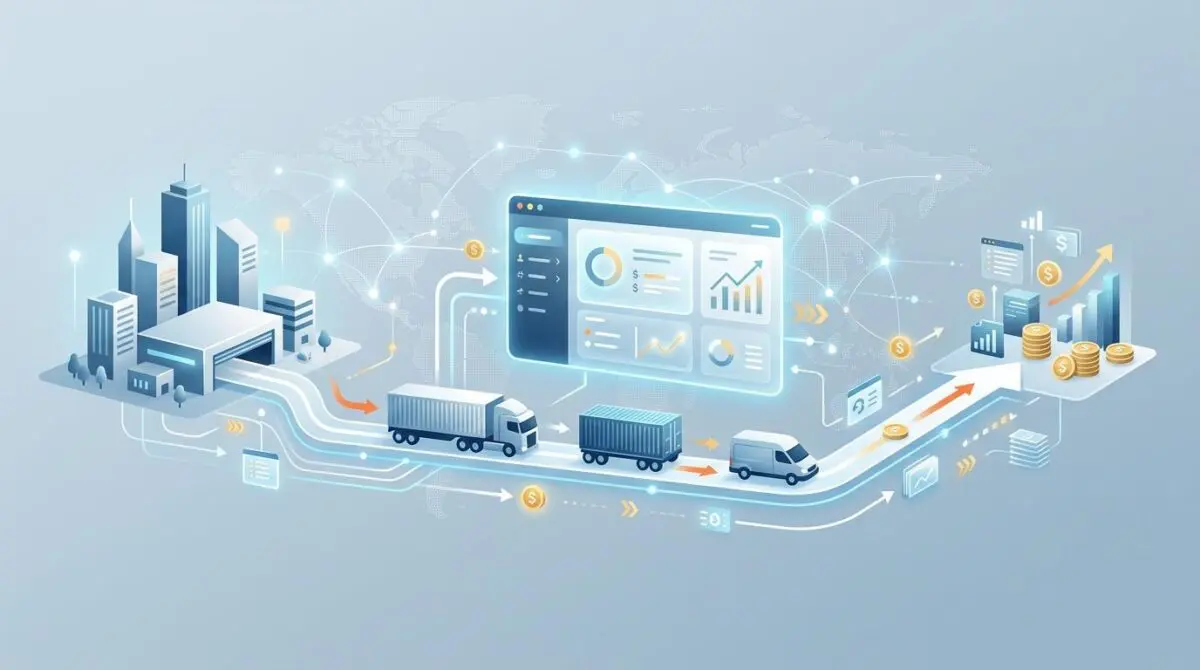
Key Points
- Freight-FinTech platforms are eradicating the traditional 30-90 day liquidity gap by leveraging AI-driven predictive factoring and GPS-triggered settlements to reduce DSO to under four hours.
- Machine-to-Machine (M2M) payment protocols and embedded insurance models are transforming fleet management systems into autonomous neo-banks, fundamentally displacing legacy financial intermediaries.
- The next frontier of logistics finance centers on asset-centric identity, where individual vehicles utilize sovereign digital identities to independently negotiate credit rates and monetize tokenized carbon offsets.
Table of Contents
The Financial Tech Friction: Breaking the Liquidity Gap
The global supply chain moves the physical world, yet for decades, it has been paralyzed by archaic, analog financial rails. According to a May 2026 report from McKinsey & Company, real-time freight settlement via automated API protocols now accounts for 48% of all North American logistics volume, a 400% increase from 2023 levels. This massive surge is not just a technological upgrade; it represents a fundamental rewiring of how capital flows through the transportation sector.
Historically, the logistics industry has been choked by a critical friction point known as the liquidity gap. Carriers and fleet operators routinely wait 30 to 90 days for invoice settlements while simultaneously bleeding cash to cover immediate, high-volume expenses like diesel, maintenance, and driver payroll. This mismatch between accounts payable and accounts receivable creates a structural vulnerability that stifles fleet growth and forces companies into predatory financing agreements.
Enter Freight-Specific Financial Technology (Freight-FinTech), the ultimate liquidity engine designed exclusively for the supply chain ecosystem. This is not generic banking software repurposed for trucking companies. Freight-FinTech represents a bespoke, hyper-specialized financial architecture that fuses telematics data with institutional-grade treasury tools.
By integrating digital wallets directly into fleet management software, these platforms are achieving unprecedented financial velocity. Companies are successfully reducing their Days Sales Outstanding from a sluggish 45 days to under four hours. This immediate capital injection eliminates the burdensome fees associated with legacy factoring and provides small-to-mid-sized fleets with the financial agility once strictly reserved for global logistics conglomerates.
Market Intelligence & Capital Flow
Market Intelligence & Data
Total Freight-FinTech Investment
According to Crunchbase data for H1 2026, venture capital flowing into logistics-specific financial tools has reached record highs as firms pivot to supply chain resilience.
Reduction in Settlement Time
The Federal Reserve’s 2026 Payments Study confirms that blockchain-based ‘Smart Contracts’ have reduced carrier payment cycles from weeks to minutes.
AI-Factoring Adoption Rate
A survey by Gartner in early 2026 shows that nearly three-quarters of fleet operators now use AI-driven credit scoring instead of traditional manual underwriting.
Fuel Cost Mitigation
Bloomberg Intelligence reports that fleets using AI-hedging fintech tools have seen an average 22% reduction in fuel price volatility compared to unhedged competitors.
The data presented above illustrates a profound shift in institutional investment strategies. Smart money is no longer chasing consumer-facing neobanks; it is aggressively flooding into industrial and supply chain financial infrastructure. The staggering influx of venture capital into Freight-FinTech signals that Wall Street views logistics liquidity not just as a niche market, but as a critical pillar of global economic resilience.
This capital migration is largely driven by the realization that manual underwriting in the freight sector is effectively dead. With AI factoring adoption rates soaring, the industry is moving toward algorithmic risk assessment that processes thousands of data points in milliseconds. This transition away from human-led credit analysis is democratizing access to capital, ensuring that fleets are evaluated on real-time operational efficiency rather than static, outdated financial statements.
Furthermore, the dramatic reduction in settlement times highlights the death of the legacy banking delay. Capital is now moving at the speed of the freight itself, unlocking billions of dollars that were previously trapped in transit. For a CEO or logistics founder, implementing these tools is no longer an operational luxury; it is a mathematical imperative to survive in a hyper-competitive, low-margin environment.
The FinTech Deep Dive: Infrastructure and Disruption
Autonomous Liquidity and Predictive Factoring
The traditional invoice discounting model is being rapidly dismantled by a new paradigm known as autonomous liquidity. Smart money is currently flooding into autonomous liquidity startups like Relay Payments and Vector, which secured a combined $1.2B in Series D funding in Q1 2026 led by Andreessen Horowitz and Goldman Sachs. These platforms are replacing archaic paperwork with dynamic, algorithmic underwriting engines.
At the core of this disruption is AI-driven predictive factoring. Instead of waiting for a signed paper bill of lading to be scanned and processed, these systems use real-time GPS and telematics data to underwrite risk on the fly. The moment a truck’s GPS records a geofence exit at the delivery site, the smart contract verifies the fulfillment and instantly releases funds to the carrier’s digital wallet.
This seamless integration of physical movement and financial execution creates a zero-friction environment. By eliminating the 3-5% predatory fees associated with legacy factoring, fleets can immediately reinvest their capital into fuel, driver retention, and route optimization. It is a masterclass in how applied artificial intelligence can unlock trapped capital and fundamentally alter the unit economics of an entire industry.
Operating System Neo-Banks and Embedded Insurance
Market dominance in the logistics space has decidedly shifted toward integrated operating system fintechs like Motive and CloudTrucks. These platforms have evolved far beyond basic fleet management software, transforming into full-scale neo-banks tailored specifically for carriers. They offer a unified dashboard where dispatching, compliance, and corporate treasury management converge into a single, cohesive user experience.
These disruptors are moving aggressively beyond simple lending and payment processing into the highly lucrative realm of embedded insurance. By harnessing real-time driver behavior data—such as hard braking events, average speeds, and route risk profiles—these platforms can dynamically adjust insurance premiums by the mile. This granular, usage-based approach to risk management is devastating to legacy providers.
In fact, traditional commercial auto insurers are currently losing 15% market share annually to these embedded fintech models. The competitive advantage is insurmountable: an insurance product that lives natively inside the truck’s operating system possesses infinitely better risk data than an external underwriter relying on annual historical audits. For fleet operators, this translates to immediate cost savings and a direct financial reward for maintaining a culture of safety.
Decentralized Ledgers and M2M Payment Rails
The technological landscape of 2026 is defined by the convergence of IoT telematics and autonomous payment rails. Data from the 2026 Global Logistics Innovation Index by Deloitte reveals that 62% of Tier-1 carriers have successfully implemented M2M (Machine-to-Machine) wallets, allowing autonomous trucks to pay for tolls, fuel, and charging without human intervention. This capability fundamentally redefines the commercial vehicle as a sovereign financial node.
Cutting-edge platforms now utilize programmable fueling, a protocol where the truck itself authorizes payments via encrypted M2M connections. When a vehicle pulls up to a compatible terminal, the transaction is negotiated directly between the truck’s digital wallet and the fuel pump. This entirely eliminates the risk of physical card skimming and prevents unauthorized purchases, closing a major loophole in fleet expense management.
Simultaneously, decentralized ledgers are being deployed to automate smart bill of lading settlements. These blockchain-backed systems trigger instant, cross-border payments in stablecoins the moment delivery parameters are met. By bypassing the fragmented, high-fee legacy banking networks, international logistics companies can execute borderless settlements with zero currency friction and total cryptographic certainty.
The Strategic Action Plan: Asset-Centric Identity
Strategic Trajectory
- Pivot toward ‘Asset-Centric Identity’ models over the next 18 months to modernize fleet valuation.
- Assign sovereign digital identities (DID) to individual trucks to facilitate autonomous financial profiles.
- Utilize maintenance history and route efficiency to allow vehicles to independently negotiate financing rates.
- Prepare for the integration of ‘Carbon-Fintech’ through telematics-verified emissions tracking.
- Automate the tokenization and direct sale of emissions reductions on carbon credit exchanges.
- Implement dashboard-integrated trading to create a secondary revenue stream for the fleet.
- Target an estimated 8% reduction in net fuel costs via automated carbon credit monetization.
The strategic roadmap outlined above provides a blueprint for institutional investors and fleet founders looking to capitalize on the next wave of financial innovation. Over the next 18 months, the industry will experience a massive pivot toward asset-centric identity. In this paradigm, the truck is no longer viewed simply as a depreciating piece of hardware; it becomes a dynamic, financially autonomous entity.
By assigning sovereign digital identities (DID) to individual vehicles, fleets can cultivate unique credit scores for every truck based on its specific maintenance history, fuel efficiency, and routing success. This allows the vehicle itself to interface with decentralized finance protocols to negotiate its own financing rates for repairs or upgrades. It is a profound shift from corporate-level borrowing to asset-level micro-financing, drastically reducing the overall cost of capital.
Furthermore, CEOs must urgently prepare their tech stacks for the integration of Carbon-Fintech. As global regulatory frameworks tighten, telematics-verified emissions reductions are becoming highly valuable commodities. By automatically tokenizing these carbon savings and selling them on digital credit exchanges directly from the vehicle’s dashboard, fleets can create a lucrative secondary revenue stream. This environmental arbitrage is projected to offset net fuel costs by an estimated 8%, transforming compliance from a cost center into a profit generator.
Conclusion
The integration of Freight-FinTech is not merely a software upgrade; it is a complete reimagining of industrial liquidity. By replacing analog delays with algorithmic precision, the logistics industry is shedding its legacy constraints and stepping into an era of autonomous capital velocity. The convergence of M2M payment rails, predictive factoring, and asset-centric identity is creating a supply chain where money moves as seamlessly as the physical goods it represents.
For institutional investors, founders, and fleet operators, the mandate is clear: adapt to these programmable financial rails or be priced out by competitors operating with zero capital friction. The future belongs to those who understand that in the modern logistics landscape, the flow of data and the flow of capital are indistinguishable.
Navigating the intersection of financial technology, institutional capital, and market psychology requires a sharp strategy. To future-proof your FinTech architecture and scale with precision, connect with Andres at Andres SEO Expert.