




Key Points
- Combinatorial Explosion: Unrestricted multi-dimensional filters generate infinite URL permutations, actively destroying crawl efficiency and delaying the indexing of high-priority content.
- Server-Level Intervention: Implementing strict Nginx or Edge Worker directives to return 410 Gone or X-Robots-Tag headers stops search bots from traversing redundant parameter strings.
- Canonical Enforcement: Dynamically rewriting canonical tags for multi-parameter URLs back to the clean category base prevents index fragmentation and consolidates link equity.
Table of Contents
The Core Conflict: Crawl Budget Depletion
According to a technical SEO study by Botify, faceted navigation typically accounts for nearly 50% of the total URLs crawled on e-commerce sites, yet these pages represent less than 1% of the total organic search conversions. This massive discrepancy is a direct result of Faceted Navigation Crawl Bloat. This technical anomaly occurs when a website filtering system generates a combinatorial explosion of unique URLs for every possible attribute combination.
Instead of discovering and indexing high-priority product pages, search engine crawlers become trapped in an infinite space of low-value, thin-content nodes. The technical impact is a severe reduction in crawl efficiency. This ultimately leads to delayed indexing of new content and a highly fragmented link equity distribution across millions of redundant query strings.
Understanding the Impact
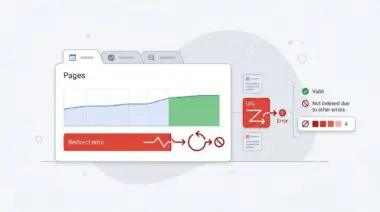
The primary symptom of this server-bot conflict manifests in the Google Search Console Crawl Stats report. You will observe a massive spike in Total crawl requests running parallel to a stagnant or actively decreasing Valid index count. Server log files will expose Googlebot repeatedly hitting URLs with long strings of query parameters.
These requests often feature the exact same parameters in different orders, artificially multiplying the crawl load. In the GSC Pages report, a high volume of these dynamic URLs will appear under Excluded by robots.txt or Crawled – currently not indexed statuses. This indicates that the crawler is wasting critical resources attempting to resolve pages that offer zero unique semantic value.
Diagnostic Checkpoints and Root Causes
Resolving this issue requires identifying the exact layer of your technology stack where the desynchronization occurs. This is rarely a single point of failure. It is typically a combination of application logic flaws, default SEO plugin behaviors, and lack of server-side parameter sanitization.
Diagnostic Checkpoints
Combinatorial Parameter Explosion
Infinite URL permutations via multi-dimensional filter stacking.
Unordered Query String Duplication
Duplicate crawling due to non-deterministic parameter ordering.
Self-Referential Canonical Tags
Bots index deep facet combinations via unique self-canonicals.
Lack of Link Obfuscation
Exposed standard links invite bots to explore thin facets.
Server and Application Desynchronization
At the application layer, particularly within WordPress, themes utilizing native WP_Query parameters often lack the logic required to prevent the stacking of multiple GET variables. This allows the server to theoretically generate millions of unique URL permutations if a site features multiple filters with several options each. Without server-side logic to limit depth, bots will attempt to crawl every single possible combination.
Furthermore, standard WordPress setups do not automatically enforce parameter alphabetization. This means plugins or custom AJAX filters generate non-deterministic URL strings that search bots perceive as entirely unique resources. Many SEO plugins compound this issue by defaulting to self-canonicalization for all query-string enabled URLs, signaling to search engines that the filtered view is an authoritative page.
Engineering Resolution Roadmap
To restore entity integrity and optimize server resources, you must implement a multi-layered defense strategy. This involves auditing active parameters, enforcing strict crawling directives, and fundamentally altering how the application handles canonical logic.
Engineering Resolution Roadmap
Audit and Prioritize Parameters
Identify the primary parameters that provide search value (e.g., /category/color-red/) and distinguish them from utility parameters (e.g., ?sort=price, ?session_id). Use GSC ‘Crawl Stats’ to see which parameters are being hit most frequently.
Implement Robots.txt Disallow Rules
Add specific Disallow rules to your robots.txt file to prevent bots from crawling multi-filter combinations. For example: Disallow: /*?*filter_*
Enforce Canonical Logic
Modify the header output so that any page with more than one active filter parameter points its canonical tag back to the clean category base URL.
Implement Nofollow on Filter UI
Update the filter templates to add rel=’nofollow’ to all filter links that lead to thin content or multi-parameter combinations.
Parameter Prioritization and Control
Before writing server rules, you must establish a clear hierarchy of URL parameters. Distinguish primary facets that offer semantic search value from utility parameters like session IDs or sorting modifiers. This foundational step is critical for managing your crawl budget effectively across large e-commerce architectures.
Once utility parameters are identified, you must modify your application logic to ensure proper canonicalization. Any page rendering more than one active filter parameter must point its canonical tag directly back to the clean category base URL. This aligns perfectly with modern faceted navigation SEO best practices, preventing deep index fragmentation.
Finally, address the user interface layer by obfuscating discoverable links. Update all facet templates to inject rel=”nofollow” attributes on links leading to multi-parameter combinations. This is a primary tactic for managing crawling of faceted navigation URLs, ensuring bots do not waste resources discovering links before encountering robots.txt blocks.
Resolution Execution: Nginx Configuration
While application-level fixes are necessary, the most robust defense against crawl bloat is executed at the server level. Intercepting requests before they trigger database queries preserves server CPU and forces immediate compliance from search bots.
Fixing via Nginx Edge
By utilizing Nginx location blocks, we can target specific query strings using regular expressions. The following configuration intercepts requests containing known utility or redundant parameter keys. It immediately injects a restrictive X-Robots-Tag header and terminates the connection with a 410 Gone status code.
location ~* \?(.*&)?(price|sort|session_id|orderby)= {
    add_header X-Robots-Tag "noindex, nofollow, noarchive";
    return 410;
}
This snippet instructs the server to look for any query string containing price, sort, session_id, or orderby. Returning a 410 status code is far more efficient than a 404, as it explicitly tells Googlebot that the resource has been permanently removed. This accelerates the deindexing process for already-crawled bloated URLs.
Validation Protocol and Edge Cases
Deploying server-side regex and header modifications carries inherent risk. You must validate the deployment immediately to ensure legitimate category pages are not inadvertently blocked. Relying solely on delayed GSC reporting is not an acceptable engineering practice.
Validation Protocol
- Use the ‘Google Search Console Live Test’ on a filtered URL to check if the ‘User-declared canonical’ matches the base category.
- Execute ‘curl -I -X GET “https://example.com/shop/?color=red&size=xl”‘ and check for the ‘X-Robots-Tag: noindex’ header.
- Monitor the ‘Crawl Stats’ report in GSC for a downward trend in ‘Requests by Purpose: Discovery’ for faceted URLs.
Cloudflare and Caching Conflicts
A critical edge case occurs when a Content Delivery Network like Cloudflare is configured with aggressive Cache Everything rules. If the origin server previously sent a 200 OK for a crawl-bloated URL, the edge node might hold that response in cache. Even after you update robots.txt or Nginx rules, the crawler may still receive the stale 200 OK directly from the edge.
This bypasses your origin server entirely. To resolve this, you must purge the CDN cache specifically for URLs containing query strings. Furthermore, ensure that any Cloudflare Page Rules or Edge Workers are not configured to strip custom HTTP headers, which would remove your newly implemented X-Robots-Tag directives.
Autonomous Monitoring and Prevention
Preventing future combinatorial parameter explosions requires establishing a strict crawl strategy early in the development lifecycle. This includes enforcing parameter alphabetization at the application level to ensure deterministic URL generation. Integrating a middleware layer or Edge Worker to intercept and normalize query strings before they hit the origin server is a highly effective preventative measure.
At the enterprise level, manual GSC checks are insufficient. Implementing automated log analysis tools via Make.com pipelines or custom API alerts ensures you are immediately notified of crawl efficiency degradation. Partnering with Andres SEO Expert ensures your architecture is continuously monitored for entity integrity, preventing minor application updates from triggering massive crawl anomalies.
Conclusion
Faceted navigation crawl bloat is a critical architectural failure that actively undermines your organic search visibility. By auditing parameter logic, enforcing strict server-side directives, and normalizing query strings, you can reclaim your crawl budget and force search engines to focus on revenue-generating content.
Navigating the intersection of technical SEO, server architecture, and generative search requires a precise roadmap. If you need to future-proof your enterprise stack, resolve deep-level crawl anomalies, or implement AI-driven SEO automation, connect with Andres at Andres SEO Expert.
Frequently Asked Questions
What is faceted navigation crawl bloat?
Faceted navigation crawl bloat is a technical SEO anomaly where filtering systems generate an infinite number of unique URL permutations for every possible attribute combination. This traps search engine crawlers in a massive space of low-value, thin-content nodes, wasting crawl budget and delaying the indexing of high-priority pages.
How do I identify crawl bloat in Google Search Console?
You can identify crawl bloat by observing a spike in ‘Total crawl requests’ alongside a stagnant or decreasing ‘Valid index’ count in the Crawl Stats report. Additionally, check the GSC Pages report for a high volume of dynamic URLs listed under ‘Excluded by robots.txt’ or ‘Crawled – currently not indexed’ statuses.
What are the best practices for managing crawl budget on e-commerce sites?
Managing crawl budget requires auditing parameters to distinguish between primary facets with search value and utility parameters like sorting or session IDs. Key tactics include using robots.txt disallow rules for multi-parameter combinations, enforcing canonical tags to the base category, and applying rel=’nofollow’ to filter links.
Why is a 410 status code preferred over a 404 for removing faceted URLs?
A 410 Gone status code is more efficient than a 404 because it explicitly tells Googlebot that the resource has been permanently removed. This clarity accelerates the deindexing process for bloated URLs, preventing the crawler from repeatedly attempting to resolve the page in the future.
How does Nginx help resolve crawl bloat issues?
Nginx can intercept crawl requests at the server level before they reach the application or database. By using regular expressions to identify utility parameters, Nginx can immediately inject a restrictive X-Robots-Tag (noindex, nofollow) and return a 410 status code, preserving server CPU and forcing bot compliance.
Can a CDN cache interfere with my faceted navigation SEO fixes?
Yes, CDNs like Cloudflare with aggressive caching may serve stale 200 OK responses for bloated URLs even after origin rules are updated. To ensure fixes take effect, you must purge the CDN cache for query-string URLs and verify that edge rules are not stripping custom X-Robots-Tag headers from the origin server.