Key Points
- Hybrid Inference: Enterprise architecture is aggressively shifting from centralized cloud reliance to deploying domain-specific Micro-LLMs directly onto local hardware.
- Sovereign AI: By neutralizing the Cloud Tax and processing data locally, companies ensure strict GDPR 2.0 compliance while eliminating connectivity fragility.
- Agentic Swarms: The ultimate trajectory for founders is the deployment of autonomous local agents that coordinate peer-to-peer, creating a resilient, Zero-Latency Enterprise.
Table of Contents
The Cloud Tax and the Edge AI Imperative
The era of centralized cloud computing is facing a catastrophic bottleneck. For over a decade, enterprise architecture relied on beaming massive datasets to remote servers for processing, analysis, and execution. This model is no longer sustainable for modern business operations.
According to a 2026 report from Gartner, 75% of all enterprise-generated data is now being processed at the edge, a massive leap from just 50% in 2024. Companies are racing to minimize inference latency and escape the crippling financial burden of cloud egress fees. The friction of moving petabytes of data back and forth has created an invisible ceiling on corporate scale.
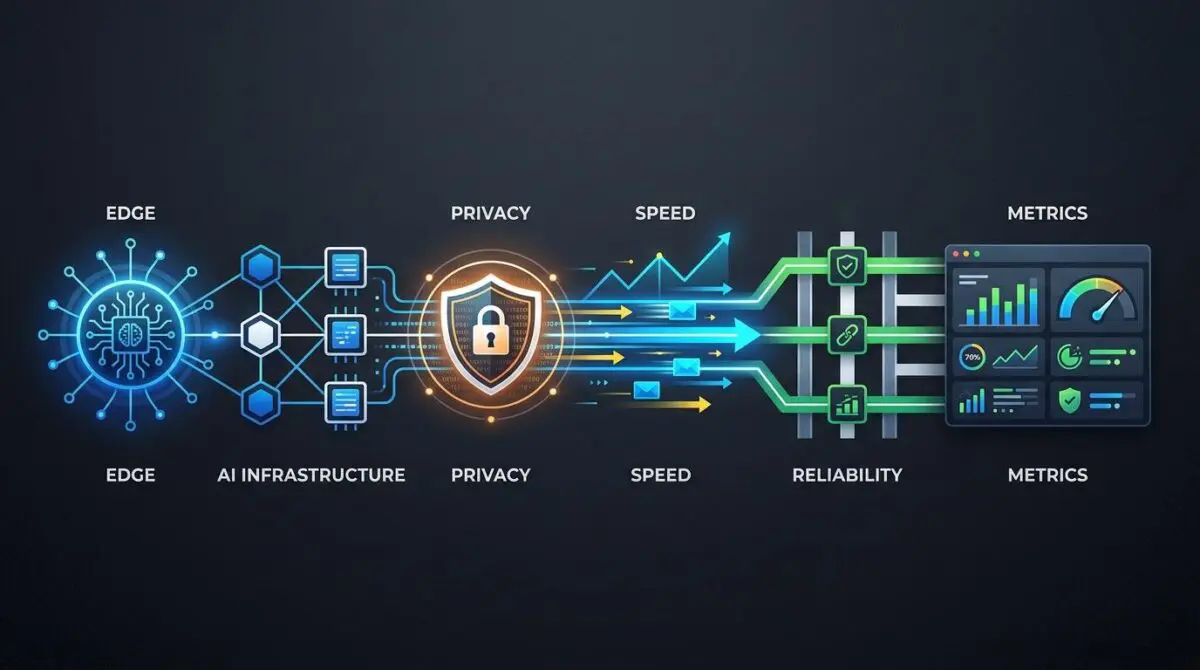
This is where Edge AI, or On-Device Intelligence, steps in as the ultimate market disruptor. It is not merely a technological upgrade but a fundamental redesign of how data flows and generates value. By moving the computational heavy lifting directly to the source of data generation, businesses are bypassing the traditional cloud entirely.
Founders and executives are realizing that relying on remote data centers introduces unacceptable risks. Connectivity fragility and bandwidth constraints mean that a single network hiccup can halt an entire automated supply chain. Edge AI neutralizes this risk by empowering devices to think, learn, and act autonomously in real-time.
Market Intelligence & Smart Capital
Market Intelligence & Data
Edge AI Market Valuation
IDC reports that the total market value for Edge AI hardware and software services reached this milestone in Q1 2026.
Industrial Response Time
Deloitte data shows that 2026-gen Edge AI chips have reduced the average response time for industrial robotics by 85% compared to 2024 cloud-based models.
NPU Ubiquity in Mobile
Counterpoint Research indicates that 92% of new enterprise smartphones shipped in 2026 feature dedicated Neural Processing Units for local generative AI.
Cloud Bandwidth Savings
Forrester research highlights that large-scale retailers have slashed their cloud bandwidth costs by 60% by moving computer vision processing to on-site edge gateways.
The financial metrics surrounding on-device intelligence paint a picture of aggressive institutional adoption. Smart money is rapidly pivoting away from generic software-as-a-service models toward vertically integrated hardware-software AI solutions. This capital rotation is driven by the undeniable economic advantages of localized compute.
When large-scale retailers can slash their bandwidth costs by 60% simply by moving computer vision to on-site gateways, the ROI becomes impossible to ignore. It is precisely why 75% of all enterprise-generated data is now being processed at the edge, permanently altering the digital supply chain. The days of paying a premium to rent distant server space for basic inference tasks are coming to an end.
Furthermore, the ubiquity of Neural Processing Units in mobile and enterprise hardware has democratized access to advanced machine learning. Devices are no longer dumb terminals waiting for instructions from a master server. They are highly capable analytical engines ready to deploy complex algorithms locally.
The Strategic Deep Dive: Disruption at the Edge
Solving Connectivity Fragility and Data Sovereignty
One of the most critical executive anxieties in 2026 revolves around data sovereignty and the strict mandates of GDPR 2.0. Centralized cloud models inherently require Personally Identifiable Information to traverse public networks. This creates massive attack vectors and compliance nightmares for multinational corporations.
Edge AI elegantly solves this by ensuring sensitive data never leaves the device. Localized Micro-LLMs process user inputs, extract intent, and execute commands entirely within the hardware enclave. This zero-trust approach to data transmission is rapidly becoming the gold standard for healthcare providers and financial institutions.
Beyond privacy, the elimination of connectivity fragility is revolutionizing critical infrastructure. Autonomous delivery drones and remote surgical robots cannot afford a sudden drop in internet stability. They require 100% operational reliability to prevent catastrophic failures in the field.
By severing the umbilical cord to the cloud, these machines achieve true autonomy. In the realm of advanced manufacturing, Deloitte data shows that 2026-gen Edge AI chips have reduced the average response time to a mere fraction of legacy architectures. This hyper-fast local processing allows smart factories to operate with unprecedented precision and safety.
The Hardware Arms Race and Sovereign AI
The transition to Hybrid Inference has triggered a massive hardware arms race. The killer strategy for enterprises is no longer about accessing the largest cloud model, but deploying the most efficient local model. Token-per-second-per-watt efficiency is the new battleground metric for silicon dominance.
Market leadership is currently a fierce contest between legacy silicon titans and specialized disruptors like Groq and Hailo. These agile challengers are building purpose-built architectures that dramatically outperform traditional GPUs in localized inference environments. They are providing the exact hardware required to run Adaptive Edge models seamlessly.
Institutional investors are taking aggressive notice of this paradigm shift. A 2026 internal strategy leak from SoftBank, reported by the Financial Times, reveals a dedicated $50 billion Edge-First fund focused exclusively on startups that eliminate the need for cloud-based LLM calls through local neuromorphic computing. This represents a monumental validation of the decentralized compute thesis.
Simultaneously, we are witnessing the explosive growth of Decentralized Physical Infrastructure Networks. These networks allow companies to pool local compute power across thousands of edge devices. This creates a resilient, distributed supercomputer that operates entirely outside the control of traditional hyperscalers.
The Executive Action Plan: Building the Zero-Latency Enterprise
Strategic Trajectory
- Orchestrate Agentic Edge Swarms by deploying autonomous local agents across disparate devices.
- Implement peer-to-peer coordination to resolve complex logistics and energy-grid challenges without central bottlenecks.
- Transition toward a Zero-Latency Enterprise where the delay between data capture and intelligent action is neutralized.
- Prepare for the total decentralization of corporate IT infrastructure through localized intelligence.
- Empower founders and CEOs to leverage distributed intelligence for resilient, real-time operational scale.
For founders and C-level executives, the path forward requires a radical reimagining of corporate IT infrastructure. The goal is to build a Zero-Latency Enterprise where the delay between data capture and intelligent action is effectively neutralized. This requires abandoning legacy cloud-first architectures in favor of distributed intelligence.
The next logical evolution is the deployment of Agentic Edge Swarms. Instead of a single central orchestrator, businesses will deploy fleets of autonomous local agents across disparate devices. These agents will communicate peer-to-peer, negotiating resources and solving complex logistics problems dynamically in the field.
Imagine a smart energy grid where individual solar inverters and battery storage units optimize power distribution locally, without waiting for instructions from a central utility server. This level of decentralization creates an anti-fragile operational model that can withstand massive network outages and cyber-attacks.
To execute this vision, executives must prioritize hardware-software vertical integration. Purchasing generic SaaS tools will no longer provide a competitive advantage. The future belongs to companies that own their local compute infrastructure and deploy proprietary Micro-LLMs tailored to their specific operational domains.
Conclusion: Decentralize or Die
The migration toward on-device intelligence is not a temporary trend but a permanent architectural shift. The financial weight of the cloud tax, combined with the strict demands of global data sovereignty, makes localized processing an absolute necessity. Businesses that fail to adapt will find themselves outpaced by faster, more secure, and highly efficient competitors.
By embracing Hybrid Inference and investing in specialized edge hardware, organizations can unlock unprecedented levels of operational autonomy. The transition to a Zero-Latency Enterprise will define the winners and losers of the next decade of digital transformation.
Navigating the intersection of technology, capital, and market psychology requires a sharp strategy. To future-proof your business architecture and scale with precision, connect with Andres at Andres SEO Expert.
Frequently Asked Questions
What is the Cloud Tax and how does it affect business scaling?
The Cloud Tax refers to the escalating financial burden of cloud egress fees and bandwidth costs associated with moving massive datasets to remote servers. This model creates an invisible ceiling on corporate scale, prompting enterprises to adopt Edge AI to reduce data movement costs and operational friction.
Why is Edge AI becoming the standard for enterprise data processing in 2026?
Edge AI is now a necessity due to the shift where 75% of enterprise data is processed locally. This transition is driven by the need to minimize inference latency—reducing industrial robotics response times to 15ms—and the requirement for 100% operational reliability that centralized cloud models cannot guarantee.
How does on-device intelligence improve data sovereignty and GDPR compliance?
On-device intelligence ensures that sensitive data and personally identifiable information never leave the local hardware enclave. By processing tasks using localized Micro-LLMs, organizations can satisfy strict GDPR 2.0 mandates and maintain a zero-trust approach to data transmission.
What are Neural Processing Units (NPUs) and why are they ubiquitous in 2026?
NPUs are dedicated hardware accelerators for local AI workloads. By 2026, 92% of enterprise mobile devices include NPUs, enabling them to function as analytical engines rather than dumb terminals. This democratizes access to localized generative AI and complex machine learning without cloud dependencies.
What are Agentic Edge Swarms and how do they function?
Agentic Edge Swarms are fleets of autonomous local agents that coordinate peer-to-peer across disparate devices. This decentralized model allows devices like smart grid inverters or logistics drones to negotiate resources and solve problems dynamically without waiting for instructions from a central utility server.
What are the strategic benefits of a Zero-Latency Enterprise?
A Zero-Latency Enterprise neutralizes the delay between data capture and intelligent action by using distributed intelligence. This creates an anti-fragile operational model capable of withstanding network outages and cyber-attacks while providing a massive competitive advantage through real-time autonomous execution.