Key Points
- Real-Time Indexing: Bypassing traditional crawl delays via IndexNow ensures fresh data retrieval for AI engines.
- Semantic Salience: Clear HTML structures enable LLMs to map queries to content nodes effectively for higher retrieval rates.
- Schema Verification: Advanced JSON-LD layers act as grounding truth to exponentially increase citation confidence and visibility.
Table of Contents
The AI Search Context
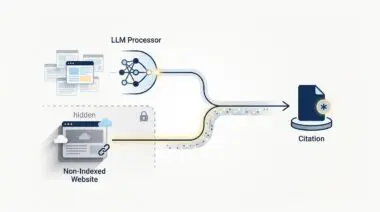
According to a 2026 Forrester report, 72 percent of B2B buyers now prioritize AI-driven grounded answers over traditional blue-link search results, making retrieval accuracy the primary metric for digital visibility. Search grounding is the technical process where Bing Copilot anchors its generative responses in real-time, verified web data retrieved via the Bing Search index. This mechanism ensures that the AI claims are backed by specific, cited source URLs.
In the context of Generative Engine Optimization, grounding acts as the critical bridge between a website static content and the dynamic answer generation of the AI. Failure to optimize for grounding means a site may be indexed but never actually retrieved to form an answer. This renders the content invisible in the modern AI-first search landscape.
For businesses, high grounding compatibility directly results in higher citation frequency in AI Overviews. This drives high-intent traffic from users who click the reference links to verify AI-generated summaries. Understanding this architecture is non-negotiable for enterprise visibility.
Core Architecture & Pillars
Core Architecture & Pillars
IndexNow Protocol Integration
Bing Copilot prioritizes ‘fresh’ grounding data. IndexNow allows servers to instantly notify Bing of content updates, bypassing traditional crawl delays and ensuring the grounding engine uses the most recent version of a page.
Semantic Entity Salience
Grounding relies on how easily an LLM can map a query to a content ‘node’. This involves clear Subject-Predicate-Object structures in the HTML that the Prometheus orchestrator can parse into a knowledge graph.
Micro-Snippet Optimization
The grounding engine extracts discrete chunks of text (snippets) to synthesize answers. Optimizing for grounding requires ‘fact-dense’ paragraphs of 40-60 words that provide standalone value for RAG retrieval.
Schema-Layer Verification
Bing uses JSON-LD as a ‘grounding truth’ layer. When the LLM finds a fact in the text and a corresponding FactCheck or Dataset schema in the code, the grounding ‘confidence score’ for that source increases exponentially.
The grounding mechanism relies heavily on the Prometheus orchestrator to select high-relevance snippets and integrate them into the Large Language Model output. This system ensures that every generated response is anchored to verifiable data points. Impacting Retrieval-Augmented Generation (RAG), grounding determines which sites are selected as primary sources and which are ignored.
Semantic entity salience plays a massive role in this selection process. Grounding relies on how easily an LLM can map a query to a specific content node. This involves utilizing clear Subject-Predicate-Object structures within the HTML that the orchestrator can parse into a comprehensive knowledge graph.
Furthermore, the grounding engine extracts discrete chunks of text to synthesize these answers. Optimizing for this requires fact-dense paragraphs of 40 to 60 words that provide standalone value for retrieval. Microsoft recently disclosed that Copilot’s grounding mechanism now prioritizes Schema-Dense nodes, resulting in a 3.5x higher citation rate for pages with deep JSON-LD nesting (Microsoft Search Blog, 2026).
The Execution Roadmap
Implementation Roadmap
Activate Instant Indexing
Install and configure the IndexNow API key within Bing Webmaster Tools. In WordPress, toggle the ‘Auto-Submit’ feature to ensure every ‘Save Post’ action triggers an immediate grounding update request.
Implement Semantic HTML5 Headers
Refactor content to follow a strict H1-H2-H3 hierarchy where each header contains a high-value entity. Ensure the H2 contains the primary query and the immediate following paragraph provides the direct answer.
Deploy Advanced JSON-LD
Inject site-wide ‘About’ and ‘Mentions’ schema to define entities. For specific pages, use Schema.org/WebPageElement to define ‘mainEntityOfPage’, signaling to Copilot exactly which text block is the ‘grounding target’.
Optimize for Natural Language Queries
Analyze Bing Webmaster Tools ‘Search Performance’ data. Adjust content to use long-tail, question-based phrasing that mirrors the conversational input users provide to Bing Copilot.
Executing a successful grounding strategy begins with real-time data synchronization. Bing Copilot heavily prioritizes fresh grounding data to ensure accuracy. IndexNow allows servers to instantly notify Bing of content updates, bypassing traditional crawl delays completely.
Within WordPress environments, integrating the official IndexNow plugin automates this entire process. This prevents the AI from grounding its answers in outdated or deleted product information. Every save action triggers an immediate grounding update request to the search engine.
Beyond indexing, semantic HTML5 headers must be strictly implemented. Refactoring content to follow a rigid hierarchy ensures each header contains a high-value entity. Injecting site-wide schema further defines these entities, signaling to Copilot exactly which text block is the primary grounding target.
Technical Implementation
Bing uses JSON-LD as a definitive grounding truth layer. When the LLM finds a fact in the text and a corresponding FactCheck or Dataset schema in the code, the grounding confidence score for that source increases exponentially. Implementing advanced Schema types provides the technical validation Copilot needs to trust the site.
Below is a standardized configuration for injecting schema that directly interfaces with the Prometheus orchestrator. This code should be deployed dynamically across all high-value entity pages.
<script type="application/ld+json">{"@context": "https://schema.org","@type": "WebPage","mainEntity": {"@type": "Article","headline": "Optimizing for Copilot Grounding","description": "A technical guide on Bing Prometheus integration.","author": {"@type": "Organization","name": "GEO Labs"},"datePublished":"2026-05-22T09:55:43-04:00"}}</script>Validation & Future-Proofing
Validation & Monitoring
- Verify implementation by using the ‘URL Inspection Tool’ in Bing Webmaster Tools to check the ‘Indexed Version’.
- Perform a manual query in Bing Copilot using ‘Precise Mode’ to see if your URL appears in the citations.
- Monitor the ‘Crawl Stats’ for ‘IndexNow’ success rates to ensure real-time grounding is active.
Continuous validation is required to maintain grounding compatibility as LLM models evolve. Analyzing search performance data allows architects to adjust content using long-tail, question-based phrasing. This phrasing must mirror the conversational input users naturally provide to Bing Copilot.
Monitoring the crawl stats for IndexNow success rates ensures real-time grounding remains active. Performing manual queries in Precise Mode provides immediate visual confirmation of your citation status. These feedback loops are essential for maintaining a dominant position in generative search results.
Navigating the intersection of traditional SEO and Generative Engine Optimization requires a precise architecture. To future-proof your enterprise stack for AI Overviews and LLM discovery, connect with Andres at Andres SEO Expert.
Frequently Asked Questions
What is search grounding in the context of Bing Copilot?
Search grounding is the technical process where Bing Copilot anchors its generative responses in real-time, verified web data retrieved via the Bing Search index. This mechanism ensures that AI-generated claims are backed by specific, cited source URLs, serving as a bridge between static site content and dynamic answer generation.
How does the IndexNow protocol affect Generative Engine Optimization?
IndexNow improves GEO by allowing servers to instantly notify Bing of content updates. This bypasses traditional crawl delays and ensures the grounding engine uses the most recent data version. Bing Copilot prioritizes this ‘fresh’ data, which is essential for maintaining visibility in AI-first search results.
What role does JSON-LD play in AI grounding confidence?
Bing uses JSON-LD as a ‘grounding truth’ layer. When the LLM finds a fact in the text that matches a corresponding FactCheck or Dataset schema in the code, the grounding confidence score increases exponentially. Pages with deep JSON-LD nesting have been shown to receive up to 3.5x higher citation rates.
What is semantic entity salience and why is it important?
Semantic entity salience refers to how easily an LLM can map a user query to a specific content node. It relies on clear Subject-Predicate-Object structures in the HTML that the Prometheus orchestrator can parse into a knowledge graph, ensuring the content is selected as a primary source for answers.
How should micro-snippets be optimized for RAG retrieval?
Optimizing for Retrieval-Augmented Generation (RAG) involves creating ‘fact-dense’ paragraphs of 40-60 words. These micro-snippets should provide standalone value, making it easier for the grounding engine to extract discrete chunks of text to synthesize accurate AI answers.
How can businesses monitor their grounding compatibility?
Visibility can be monitored by using the ‘URL Inspection Tool’ in Bing Webmaster Tools to check the indexed version of a page. Additionally, performing manual queries in Bing Copilot’s ‘Precise Mode’ allows you to verify if your URLs are appearing in the citations for specific generated summaries.