



Key Points
- Semantic Proximity: Generative engines prioritize mathematical vector alignment over traditional link-based PageRank metrics.
- Fragment Extraction: RAG systems isolate and cite highly specific data chunks regardless of a domain’s overall search ranking.
- Context Efficiency: Information-dense atomic content requires fewer computational tokens, making it highly preferred by LLMs.
Table of Contents
The AI Search Context
According to a 2026 report from the AI Search Insights Group, 42% of citations in AI Overviews originate from sources outside the traditional Top 10 Google Search results. This paradigm shift fundamentally alters how enterprises must approach digital visibility and content architecture. We are moving rapidly away from legacy PageRank signals and entering the highly technical era of Generative Engine Optimization.
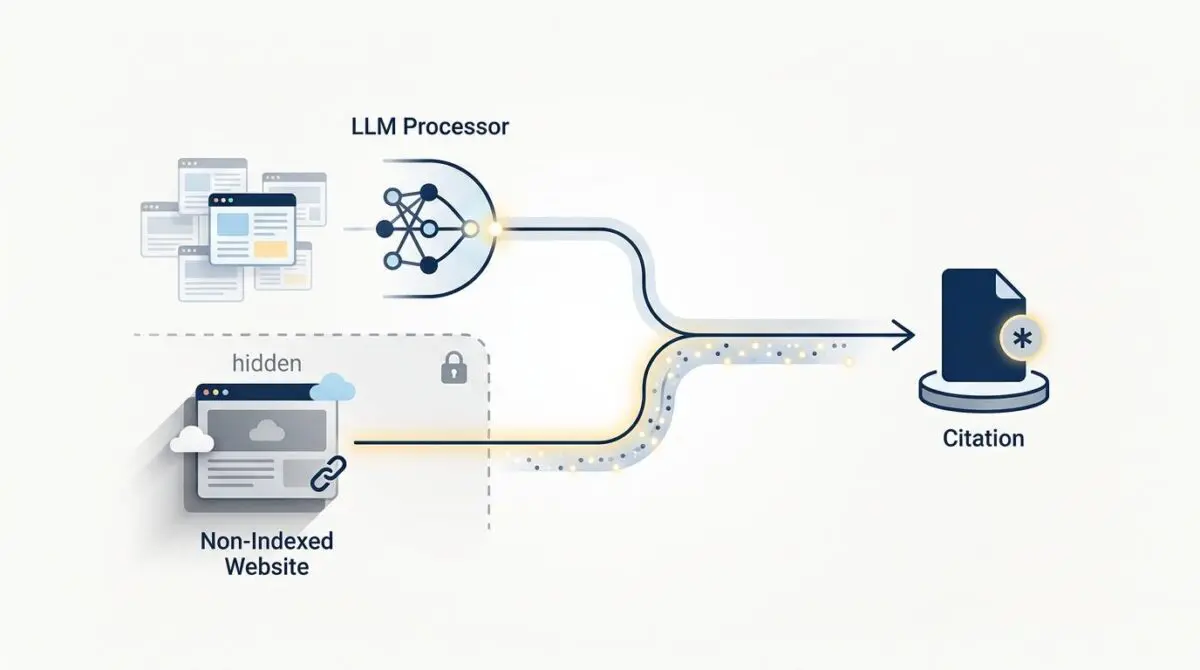
At the center of this transformation is the concept of Non-Linear Citation Authority. This framework explains why Large Language Models prioritize content based on semantic relevance, information density, and factual accuracy rather than domain age or backlink volume. In the modern AI search landscape, LLMs function as sophisticated reasoning engines rather than simple index retrievers.
These generative systems bypass traditional SEO signals if a lower-ranked site provides a more direct, computationally efficient answer. This architectural shift heavily favors atomic content that perfectly resolves a specific prompt component. Visibility is no longer tied strictly to Google’s Page 1, but rather to how well your data satisfies the retrieval query within the vector space.
Core Architecture & Pillars
Core Architecture & Pillars
Semantic Vector Proximity
Generative engines convert queries and web content into multi-dimensional vectors. An LLM cites a site because its vector embedding is numerically closer to the user’s intent than a high-ranking page that uses generic marketing language. This is ‘Semantic Matching’ vs ‘Keyword Matching’.
RAG Fragment Retrieval
Retrieval-Augmented Generation (RAG) breaks documents into ‘chunks’. If a site on Page 4 of Google contains one hyper-specific paragraph that perfectly resolves a query, the RAG system extracts that specific fragment. The LLM then cites the source of that fragment regardless of the overall page ranking.
Entity-Based Fact Verification
LLMs use internal knowledge graphs to cross-reference facts. If a top-ranking site contains outdated or conflicting information, the LLM may reject it in favor of a lower-ranking site that aligns with its pre-trained factual weights or recently verified real-time data nodes.
Context Window Optimization
LLMs have finite context windows. They prioritize content that is concise and information-rich because it uses fewer tokens. A Page 1 article that is 3,000 words of ‘fluff’ is less efficient for an AI to process than a 300-word precise answer found on Page 5.
Vector Proximity Over PageRank
Generative engines fundamentally change how information is parsed and retrieved at a structural level. Instead of relying on keyword density or lexical scoring algorithms like BM25, these systems convert queries and web content into multi-dimensional vectors. This mathematical transformation allows an LLM to cite a site simply because its vector embedding is numerically closer to the user’s underlying intent.
This semantic matching process completely bypasses high-ranking pages that rely on generic marketing language or bloated introductions. When a query is mapped in high-dimensional space, proximity dictates relevance. A highly technical, concise explanation on a low-authority domain will mathematically outperform a vague, 3,000-word guide on a legacy authority site.
In platforms like WordPress, excessive bloat from visual builders often dilutes this crucial semantic signal. AI crawlers favor clean HTML and high signal-to-noise ratios during the embedding phase. This allows low-DR sites with focused technical content to be retrieved over high-DR sites with generic, keyword-stuffed summaries.
The Mechanics of Fragment Retrieval
The architecture of Retrieval-Augmented Generation (RAG) fundamentally changes how documents are consumed by search engines. RAG pipelines break extensive documents into discrete, manageable chunks for processing. If a site on Page 4 of Google contains one hyper-specific paragraph that perfectly resolves a query, the RAG system extracts that specific fragment.
The LLM then cites the source of that isolated fragment, completely disregarding the overall page ranking or domain authority. This granular extraction means that individual paragraphs now compete independently in the retrieval index. Plugins like RankMath or Yoast are often ignored by RAG systems in favor of raw structural data and logical semantic boundaries.
Sites that utilize strict heading-answer-evidence structures provide significantly easier chunking boundaries for AI agents. When content is easily segmentable, it requires less computational effort to process. This directly leads to higher citation rates for domains that format their data atomically.
Fact Verification and Entity Resolution
Modern LLMs are increasingly reliant on entity-based fact verification processes to prevent hallucination. These models use internal knowledge graphs to cross-reference extracted facts in real-time before generating an output. If a top-ranking site contains outdated or conflicting information, the LLM will actively reject it during the generation phase.
Perplexity AI’s 2026 ‘Truthfulness Index’ reveals that 60% of their ‘Source Relevance’ weight is now based on Semantic Completeness rather than Domain Authority, effectively neutralizing the advantage of legacy authority domains. The system will favor a lower-ranking site that aligns perfectly with its pre-trained factual weights or recently verified real-time data nodes.
Many legacy WordPress sites suffer heavily from content decay, retaining high rankings due to historical backlinks despite outdated information. An LLM will skip these Page 1 results if its internal training data suggests the content is stale. It will instead cite a fresh, highly specific niche blog with high factual density and accurate entity relationships.
Optimizing for the Context Window
We must deeply consider the computational limits and processing costs of generative systems. LLMs have finite context windows, meaning they inherently prioritize content that is concise and information-rich. Every word processed consumes a token, and efficiency is paramount for AI search providers.
A Page 1 article containing thousands of words of fluff is vastly less efficient for an AI to process than a precise, 300-word answer found deep in the search results. Generative engines optimize for minimal token expenditure while maximizing factual retrieval. Excessive CSS and JavaScript in the DOM can further hinder AI scrapers during this process.
Low-ranking sites that offer a text-only or simplified view are often heavily preferred by generative engines. This token-efficiency during the retrieval phase ensures that the LLM can process multiple sources without exhausting its context limits. Dense, atomic content is the ultimate currency in this computational ecosystem.
The Execution Roadmap
Implementation Roadmap
Implement Micro-Semantic Markup
Move beyond basic Schema.org. Use ‘about’ and ‘mentions’ properties in JSON-LD to explicitly link your content to established entities in Wikidata and DBpedia, creating a bridge for the LLM to verify your authority.
Optimize for Information Density (N-Gram Tuning)
Audit content to ensure the ‘Answer’ appears within the first 100 tokens of a section. Use technical terminology that matches the ‘n-gram’ patterns found in academic or high-authority training sets used by LLM providers.
Structure Content for Fragment Extraction
Apply a ‘Question-Answer-Data’ hierarchy. Use H2 tags as specific questions and the immediate following <p> tag as a direct 50-75 word answer. This mirrors the ‘chunking’ logic used by Perplexity and SearchGPT.
Enhance API-First Content Delivery
Enable a headless-style delivery or a dedicated /ai-index/ path that serves content in Markdown format. Generative engines process Markdown more efficiently than nested HTML divs, increasing the likelihood of citation.
Micro-Semantic Markup
To capitalize on Non-Linear Citation Authority, organizations must rethink their content architecture from the ground up. The first critical step involves moving far beyond basic organizational Schema markup. You must implement micro-semantic bridges that explicitly define the entities within your text.
By utilizing specific properties like ‘about’ and ‘mentions’ in your JSON-LD, you can link your content directly to established entities in Wikidata and DBpedia. This creates a mathematically verifiable bridge for the LLM to confirm your topical authority. It removes the ambiguity of text parsing and provides direct database alignment.
Information Density and N-Gram Tuning
Content must be rigorously audited for information density and precise n-gram tuning. The core answer to any query must appear within the first 100 tokens of a specific section to ensure rapid extraction by RAG pipelines. Delayed gratification in content writing is detrimental to generative engine optimization.
Using highly technical terminology that matches the exact n-gram patterns found in academic training sets further increases your likelihood of selection. LLMs are statistically weighted to favor phrasing that mirrors their highest-quality training data. Aligning your vocabulary with these high-authority datasets signals semantic reliability to the model.
Structuring for Fragment Extraction
Structuring your content specifically for fragment extraction is arguably the most impactful tactical change you can make. Applying a strict question-answer-data hierarchy perfectly mirrors the chunking logic used by leading generative engines like SearchGPT. This removes the guesswork for the parsing algorithms.
Using H2 tags as highly specific questions, followed immediately by a direct 50-75 word answer in a standard paragraph tag, allows AI agents to isolate the exact data they need. Subsequent paragraphs can then provide the supporting data or context. This modular approach ensures your content survives the fragmentation process intact.
API-First Content Delivery
Enhancing your infrastructure for API-first content delivery ensures your data is accessible in the cleanest format possible. Traditional HTML, heavily nested with divs and styling classes, requires significant computational overhead to parse. Serving content in Markdown format via a headless architecture mitigates this issue entirely.
Creating a dedicated /ai-index/ path that serves raw, structured Markdown significantly reduces parsing overhead for AI crawlers. Generative engines process Markdown vastly more efficiently than complex DOM trees. This frictionless ingestion process directly increases the likelihood of your fragments being indexed and cited.
Technical Implementation
Implementing the structural foundation for Non-Linear Citation Authority requires precise data modeling and markup execution. The following JSON-LD snippet demonstrates how to structure a page to directly answer a complex query for an LLM crawler. This specific markup provides the exact semantic signals required by generative engines to bypass traditional ranking metrics.
<script type="application/ld+json">{"@context": "https://schema.org","@type": "WebPage","mainEntity": {"@type": "Question","name": "Why do LLMs cite low-ranking websites?","acceptedAnswer": {"@type": "Answer","text": "LLMs prioritize semantic vector proximity and factual density over traditional PageRank. If a site provides a mathematically efficient answer that fits the RAG context window, it is cited regardless of its Google SERP position."}}}</script>Validation & Future-Proofing
Validation & Monitoring
- Monitor ‘Citation Share’ using AI-specific tracking tools like BrightEdge Generative Parser or custom scripts.
- Query the Perplexity API directly to track citation occurrences for specific non-linear fragments.
- Inspect server logs for ‘GPTBot’ and ‘PerplexityBot’ traffic hitting specific fragment identifiers.
- Verify that target entities are correctly resolved through the JSON-LD ‘about’ and ‘mentions’ paths.
As generative engines evolve rapidly, traditional rank tracking becomes increasingly obsolete and misleading. Monitoring your true visibility requires a shift toward AI-specific tracking tools and custom API queries to measure your citation share. You must actively track how often your non-linear fragments are selected by engines like Perplexity or Google AI Overviews.
Server log analysis also takes on renewed importance in this new ecosystem. Identifying traffic from specific AI bots, such as GPTBot, hitting deep-link fragment identifiers provides tangible proof of RAG extraction. This confirms that your atomic content strategy is functioning at the infrastructural level.
Finally, continuous verification of your semantic markup is mandatory. Ensuring that target entities are correctly resolved through your JSON-LD paths guarantees your content remains connected to the broader knowledge graph. This ongoing maintenance prevents factual drift and maintains your non-linear authority over time.
Navigating the intersection of traditional SEO and Generative Engine Optimization requires a precise architecture. To future-proof your enterprise stack for AI Overviews and LLM discovery, connect with Andres at Andres SEO Expert.
Frequently Asked Questions
Why do AI search engines cite websites that are not on Google’s first page?
AI search engines utilize Non-Linear Citation Authority, which prioritizes semantic relevance and factual accuracy over traditional signals like PageRank. If a lower-ranking site provides a more direct, computationally efficient answer that fits within an LLM’s context window, it will be cited regardless of its traditional SERP position.
What is the difference between Semantic Matching and Keyword Matching?
Keyword matching relies on lexical scoring and term density, whereas Semantic Matching uses Vector Proximity. Generative engines convert content into multi-dimensional vectors; if a page’s mathematical embedding is numerically closer to the user’s intent, the AI will cite it even if it lacks high domain authority.
How does Retrieval-Augmented Generation (RAG) change content visibility?
RAG pipelines break documents into discrete fragments or chunks. This allows AI agents to extract and cite a specific, hyper-relevant paragraph from deep within search results, effectively bypassing the overall page ranking and allowing individual sections of content to compete independently for retrieval.
What is Context Window Optimization for AI search?
LLMs have finite context windows and prioritize information-rich, concise content to minimize token expenditure. Content that delivers a precise answer within the first 100 tokens of a section is significantly more likely to be cited than long-form articles that are computationally expensive for the AI to process.
How does Entity-Based Fact Verification affect AI citations?
AI models use internal knowledge graphs to cross-reference data. If a high-authority site contains outdated or conflicting information, the LLM may reject it in favor of a lower-ranking site that aligns with its pre-trained factual weights or recently verified data nodes, prioritizing accuracy over legacy authority.
What are the best technical practices for improving AI citation rates?
Technical strategies include implementing micro-semantic markup using JSON-LD ‘about’ and ‘mentions’ properties, structuring content with a clear Question-Answer-Data hierarchy for easy fragment extraction, and providing API-first content delivery via Markdown to reduce parsing overhead for AI crawlers.