Executive Summary
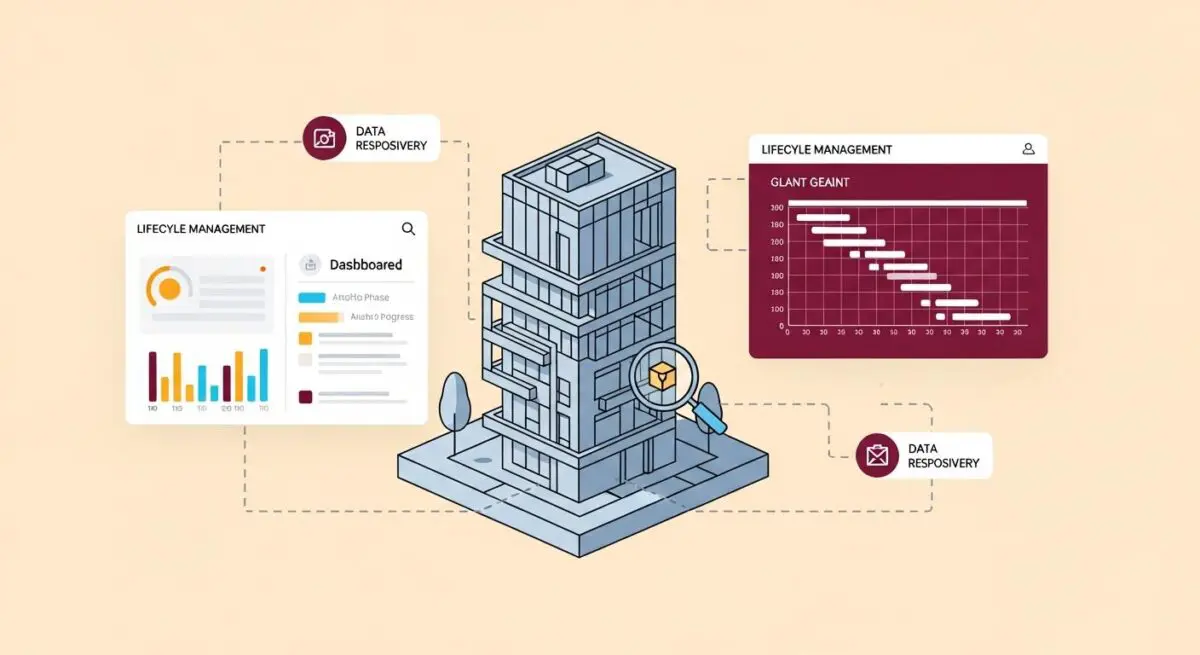
- Multidimensional Data Integration: BIM extends beyond 3D geometry to include time (4D), cost (5D), sustainability (6D), and facility management (7D) data.
- Interoperability Standards: The framework relies on Industry Foundation Classes (IFC) and ISO 19650 standards to ensure seamless data exchange across heterogeneous software environments.
- Lifecycle Asset Management: BIM serves as a single source of truth from initial conceptual design through construction to the eventual decommissioning of the physical asset.
What is BIM (Building Information Modeling)?
BIM (Building Information Modeling) is a highly sophisticated process involving the generation and management of digital representations of physical and functional characteristics of places. It is not merely a piece of software but a collaborative methodology that utilizes a Common Data Environment (CDE) to centralize project information. This digital framework allows architects, engineers, and construction professionals to plan, design, and manage building projects more efficiently than traditional paper-based or 2D CAD methods.
At its core, BIM functions as a multidimensional database that integrates geometric data with rich metadata. Every component within a BIM model, from a structural beam to a HVAC sensor, carries specific attributes such as material properties, manufacturer details, and maintenance schedules. This level of granularity ensures that all stakeholders are working from a unified, synchronized data set, which is critical for maintaining data integrity throughout the project lifecycle.
In the context of modern tech stacks, BIM is increasingly integrated with Digital Twin technology and the Internet of Things (IoT). By connecting real-time sensor data to the BIM model, facility managers can monitor building performance in real-time. This evolution transforms BIM from a static design tool into a dynamic operational asset that supports predictive maintenance and advanced spatial analytics in the era of smart cities and AI-driven infrastructure.
The Real-World Analogy
To understand BIM from a high-level business perspective, imagine a complex enterprise software ecosystem like a global ERP or a GitHub repository for a massive codebase. In a traditional construction project, information is like a series of disconnected spreadsheets and static PDFs, where a change in one document does not automatically update the others, leading to version control conflicts and “bugs” in the physical build.
BIM acts as the Version Control System (VCS) for the physical world. Just as a developer commits code to a central repository where it is automatically tested for conflicts with other modules, a BIM model allows engineers to “commit” their designs to a central model. If a plumbing pipe is designed to pass through a structural steel beam, the BIM system identifies this “clash” immediately in the digital environment, long before a single drop of concrete is poured, saving millions in potential rework costs.
How BIM (Building Information Modeling) Drives Strategic Growth & Market Competitiveness?
BIM significantly impacts the bottom line by drastically reducing the Cost of Quality (CoQ) and minimizing waste throughout the construction supply chain. By utilizing 5D BIM, which incorporates cost estimation directly into the modeling process, firms can achieve unprecedented accuracy in budget forecasting. This precision reduces the financial risk associated with large-scale capital projects and allows for more aggressive, yet safe, competitive bidding in the marketplace.
From a strategic growth perspective, BIM enhances market competitiveness by enabling faster project delivery through 4D scheduling. By simulating the construction sequence digitally, project managers can identify bottlenecks and optimize the allocation of labor and machinery. This reduction in project duration directly lowers the Customer Acquisition Cost (CAC) for developers by allowing them to bring assets to market or operational status significantly faster than competitors using legacy workflows.
Furthermore, BIM provides a robust foundation for Generative Engine Optimization (GEO) and AI-search visibility in the industrial sector. As AI agents increasingly crawl technical documentation to provide answers for procurement and engineering queries, having structured, BIM-compliant data ensures that an organization’s assets and capabilities are accurately indexed. This data-centric approach facilitates better decision-making for stakeholders, as they can leverage historical BIM data to inform the feasibility of future investments.
Strategic Implementation & Best Practices
- Establish a Common Data Environment (CDE): Implement a centralized cloud-based platform that serves as the single source of truth for all project data, ensuring that all stakeholders have access to the most current model versions and documentation.
- Define Level of Development (LOD) Requirements: Clearly specify the LOD for each project phase, ranging from LOD 100 (conceptual) to LOD 500 (as-built), to manage expectations regarding the detail and accuracy of the information provided.
- Adhere to ISO 19650 Standards: Standardize information management processes according to international benchmarks to ensure interoperability between different software tools and international project partners.
- Prioritize Cross-Functional Training: Invest in upskilling staff across design, engineering, and site management teams to ensure that the BIM methodology is understood and utilized at every level of the organization.
- Integrate BIM with Facility Management (FM): Ensure that the data captured during the design and construction phases is formatted for easy ingestion into FM software, maximizing the long-term value of the digital asset.
Common Pitfalls & Strategic Mistakes
One of the most frequent errors enterprise brands make is treating BIM as a glorified 3D modeling tool rather than a comprehensive data management process. When BIM is siloed within the design department, the strategic benefits of cost control and lifecycle management are lost. This results in “lonely BIM,” where the data is not shared across the project lifecycle, leading to fragmented information and missed opportunities for efficiency gains.
Another significant mistake is the lack of standardized naming conventions and data protocols. Without a strict information management strategy, the BIM model becomes cluttered with inconsistent data, making it difficult for automated tools or AI engines to extract meaningful insights. This lack of data hygiene often leads to manual data entry errors and undermines the reliability of the entire digital twin, ultimately increasing the risk of costly errors during the construction and operational phases.
Conclusion
BIM is the essential digital backbone for modern architecture and construction, providing a scalable framework for data-driven decision-making and lifecycle asset management. By centralizing technical information and fostering collaboration, BIM ensures that physical assets are as optimized and version-controlled as the most advanced software architectures.