Key Points
- AI-driven telemetry and real-time data auditing are replacing static credit scores, unlocking frictionless capital for asset-light enterprises.
- Blockchain-based tokenization allows SMEs to issue programmable revenue-share tokens, directly connecting them to global institutional liquidity.
- Autonomous DAO-lenders and Layer-2 scaling solutions are reducing transaction times to sub-seconds while driving default rates to historic lows.
Table of Contents
The Financial Tech Friction
According to the World Bank’s Q1 2026 FinTech Monitor, global decentralized P2P lending volume has surpassed $620 billion. This represents a staggering 42% year-over-year increase as businesses aggressively flee traditional, high-interest commercial banking. The modern financial ecosystem is undergoing a seismic shift in how capital is sourced, underwritten, and deployed. For decades, the historical friction in small business growth has been defined by the liquidity lag and the collateral gap. Asset-light, digital-first companies have been routinely rejected by legacy banks that rely on stagnant annual tax returns and outdated risk models.
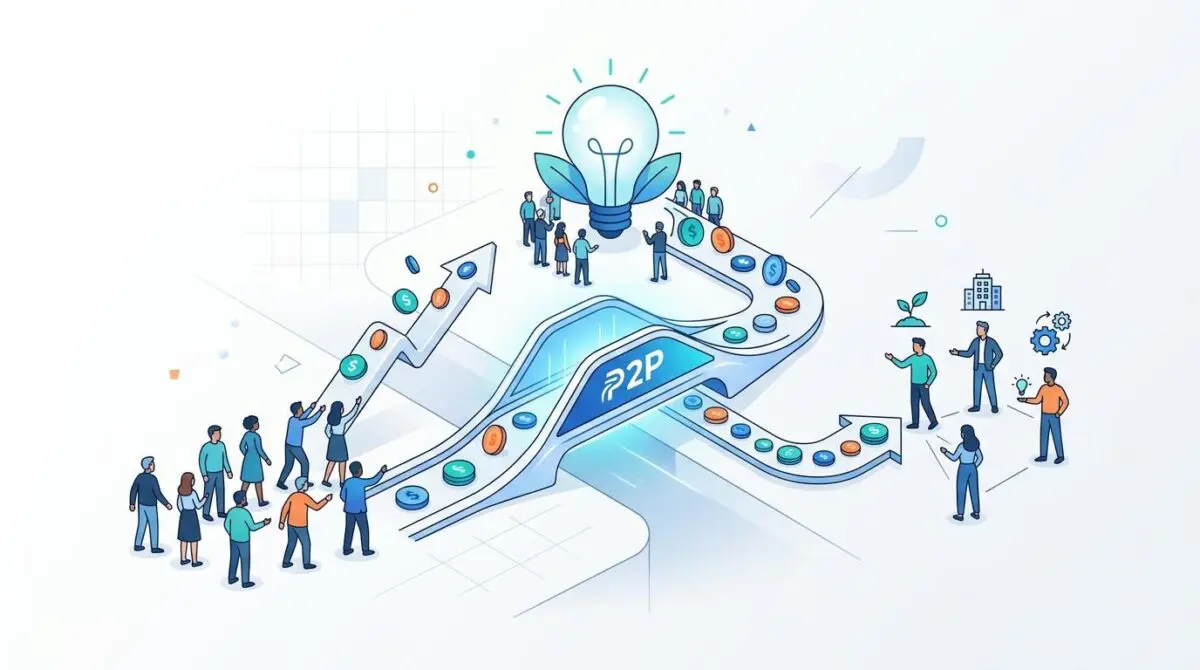
Enter Decentralized P2P Business Lending & Tokenized Crowdfunding Infrastructure. This is not merely a marginal software upgrade to existing banking systems. It is a fundamental rewiring of how global liquidity identifies and funds yield-generating opportunities. By removing bureaucratic intermediaries, this infrastructure bridges the gap between institutional capital and agile startups. It transforms the slow, manual 30-day loan approval process into a sub-second automated execution. Ultimately, this drastically reduces the cost of capital for small enterprises while offering unprecedented transparency to investors.
Market Intelligence & Capital Flow
Market Intelligence & Data
AI-Driven Underwriting
Data from the 2026 Deloitte FinTech Survey indicates that 84% of leading P2P platforms now use real-time API telemetry instead of static credit scores for risk assessment.
Tokenized Debt Market
According to 2026 projections from Goldman Sachs, the total addressable market for tokenized private business debt is expected to reach $1.4 trillion by the end of the fiscal year.
Instant Capital Execution
The 2026 FinTech Infrastructure Report by a16z highlights that the average time from loan application to fund disbursement on decentralized rails has dropped to just 0.15 seconds.
Traditional Bank Displacement
A 2026 Bloomberg Intelligence study shows that 52% of small businesses now list P2P crowdfunding as their primary source of expansion capital, overtaking traditional bank lines for the first time.
The data above illustrates a massive paradigm shift in how capital is deployed across the digital economy. Smart money is flowing heavily into embedded credit pioneers and liquidity aggregators like Stripe and Adyen. We are also seeing a rapid maturation of specialized DeFi-TradFi hybrids such as Figure and Centrifuge. Institutional giants like BlackRock have begun anchoring P2P loan pools, treating tokenized SME debt as a highly lucrative, low-correlation asset class.
This institutional influx is inevitable as legacy players recognize the total addressable market for tokenized private business debt is scaling exponentially. The traditional model of pooling deposits to issue cumbersome commercial loans is dying. In its place, a decentralized, high-velocity capital market is emerging, driven by algorithmic precision and smart contract execution.
The FinTech Deep Dive
Hyper-Personalized Underwriting and Risk Mitigation
The 2026 lending landscape is heavily defined by hyper-personalized underwriting. AI agents now perform real-time audits of a business’s entire digital footprint. These autonomous systems analyze everything from live Shopify sales velocity to global social sentiment. By utilizing real-time cash flow telemetry instead of static credit scores, platforms provide capital with unparalleled accuracy. This completely bypasses the inherent biases and delays of traditional credit bureaus.
A 2026 internal report from JPMorgan Chase reveals a critical tipping point in this ecosystem. Algorithmic risk-mitigation tools have brought default rates on P2P business loans below 1.8% for the first time in history. This unprecedented safety net explains the 300% surge since 2024 in institutional ‘Buy-side’ participation in tokenized crowdfunding pools. When risk is mathematically contained, capital flows freely.
Layer-2 Scaling and Programmable Revenue
Blockchain-based tokenization of debt has officially matured beyond theoretical whitepapers. SMEs can now issue programmable revenue-share tokens directly to global investors. These smart contracts automatically distribute dividends based on daily revenue, entirely removing administrative overhead. The underlying infrastructure is rapidly shifting toward Layer-2 scaling solutions that process thousands of transactions per second.
These advanced networks facilitate micro-loans with near-zero transaction fees. This enables a new class of high-frequency, low-capital crowdfunding that was previously impossible under legacy banking cost structures. Furthermore, these Layer-2 protocols are drastically accelerating the timeline for fund disbursement on decentralized rails. What once took weeks now settles in fractions of a second.
Cross-Border Credit Portability
Emerging FinTech startups are actively solving the geographical limitations of legacy credit systems. They are focusing intensely on cross-border credit portability. This innovative framework allows businesses to leverage their domestic reputation and on-chain financial history to secure P2P funding in foreign markets instantaneously. It creates a borderless, highly efficient marketplace for business debt.
While international lending previously required navigating a labyrinth of localized compliance and currency controls, modern decentralized platforms handle these variables algorithmically. Smart contracts ensure that regulatory requirements are met at the protocol level. This seamless integration of compliance and capital execution drastically reduces the cost of expansion for global enterprises.
The Strategic Action Plan
Strategic Trajectory
- Architect Autonomous DAO-Lenders where AI protocols manage capital pools and rebalance risk without human intervention.
- Integrate Central Bank Digital Currencies (CBDCs) into existing P2P rails to establish a secure, government-backed settlement layer.
- Leverage decentralized infrastructure to eliminate currency risk in international crowdfunding via CBDC-led settlement.
- Pivot toward Invisible Lending models that offer credit pro-actively at the exact moment inventory reaches predefined telemetry thresholds.
The next 18 months will ruthlessly define the winners and losers in the digital lending space. The rise of Autonomous DAO-Lenders will see massive capital pools managed entirely by AI protocols. These systems will autonomously rebalance risk portfolios across thousands of businesses without any human intervention. Founders and institutional architects must begin transitioning their legacy tech stacks to support these decentralized autonomous organizations.
Furthermore, the integration of Central Bank Digital Currencies into P2P rails will provide a vital, government-backed settlement layer. This eliminates currency risk in international crowdfunding, making cross-border lending as safe as domestic transactions. Finally, the industry trend is aggressively moving toward invisible lending. Credit will no longer be something a business applies for; it will be offered proactively at the exact moment a merchant’s inventory hits a predefined telemetry threshold.
Conclusion: The New Paradigm of Smart Capital
The future of crowdfunding and P2P business lending is irrevocably decentralized, tokenized, and autonomous. Traditional commercial banking models are being rendered obsolete by the sheer efficiency of smart contracts and AI-driven telemetry. As liquidity continues to migrate toward these frictionless, high-yield digital rails, early adopters will secure a compounding competitive advantage.
Navigating the intersection of financial technology, institutional capital, and market psychology requires a sharp strategy. To future-proof your FinTech architecture and scale with precision, connect with Andres at Andres SEO Expert.
Frequently Asked Questions
What is decentralized P2P business lending?
Decentralized P2P business lending is a financial model that utilizes blockchain infrastructure and smart contracts to connect yield-seeking investors directly with businesses. By removing traditional banking intermediaries, it reduces capital costs and accelerates loan disbursement from weeks to fractions of a second.
How does AI-driven telemetry replace traditional credit scores?
AI-driven telemetry uses real-time API data to audit a company’s digital footprint, including Shopify sales velocity and cash flow. Unlike static credit scores, this method provides a dynamic risk assessment, allowing for more accurate underwriting and lower default rates, which currently sit below 1.8%.
What is the projected market size for tokenized private business debt?
According to 2026 market intelligence from Goldman Sachs, the total addressable market for tokenized private business debt is expected to reach $1.4 trillion. This growth is driven by institutional capital seeking high-yield, low-correlation assets.
How do Layer-2 protocols improve decentralized crowdfunding?
Layer-2 scaling solutions enable thousands of transactions per second with near-zero fees. This allows SMEs to issue programmable revenue-share tokens and facilitates high-frequency, low-capital crowdfunding that was previously impossible under legacy banking cost structures.
What is the concept of “Invisible Lending” in FinTech?
Invisible lending is a proactive credit model where AI protocols monitor a merchant’s business telemetry. Instead of a traditional application process, credit is offered automatically the moment specific thresholds, such as inventory or sales targets, are met.
How does CBDC integration affect international P2P lending?
Integrating Central Bank Digital Currencies (CBDCs) into P2P rails creates a secure, government-backed settlement layer. This eliminates currency risk and simplifies regulatory compliance, making international crowdfunding as efficient and safe as domestic transactions.