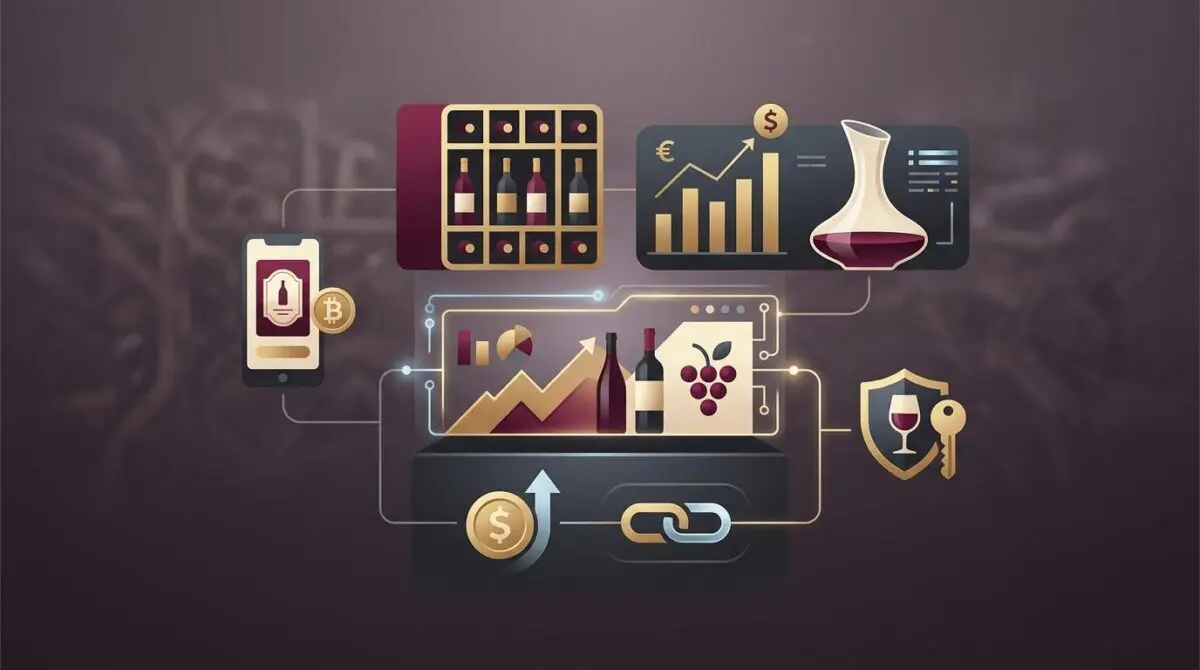
Key Points
- Fractionalized Liquidity: Layer 2 blockchain infrastructure has eliminated the traditional liquidity trap, allowing high-value assets like a 1945 Romanée-Conti to be fractionalized and traded instantly.
- DeFi Collateralization: IoT-enabled smart corks provide real-time Proof of Quality, enabling wine-backed tokens to be used as collateral in decentralized finance protocols for low-interest loans.
- Algorithmic Yield Management: Autonomous Sommelier AI and Terroir Algorithms now execute high-frequency trades and rebalance portfolios based on micro-climatic shifts and global auction data.
Table of Contents
The Financial Tech Friction: Breaking the Liquidity Trap
According to the 2026 Knight Frank Wealth Report, tokenized fine wine has outperformed the S&P 500 for three consecutive years. This alternative asset class posted a composite annualized return of 14.8% as investors actively flee traditional market volatility. They are seeking refuge in hard-asset backed digital securities that offer both stability and unprecedented alpha.
At the heart of this massive liquidity opportunity is Wine Asset Tokenization (RWA). Traditionally, fine wine suffered from a severe liquidity trap, often taking months to appraise, authenticate, and sell. The modern financial technology stack fundamentally disrupts this friction by transforming physical cellars into hyper-liquid digital instruments.
Through fractionalization, a single bottle of 1945 Romanée-Conti can now be owned by 10,000 investors holding tradeable shares. This democratization completely removes the $50,000 entry barrier for premier crus. It turns a historically gated luxury asset into a dynamic, programmable financial primitive.
Market Intelligence & Capital Flow
Market Intelligence & Data
Tokenized Wine Market Cap
The total market capitalization for wine-backed digital assets has surged past $6 billion in mid-2026, according to data from the World Economic Forum.
Provenance Accuracy
Adoption of IoT-enabled ‘Smart Corks’ has reduced fine wine fraud by 82% compared to 2022 levels, as reported by the International Wine & Spirits Record (IWSR).
VC Inflow to Wine-Tech
Venture capital investment into wine-specific financial infrastructure reached $1.2 billion in Q1 2026, per PitchBook’s Emerging Tech Research.
Market Liquidity Availability
The transition to decentralized exchanges (DEXs) has enabled 24/7 liquidity for wine assets, reducing exit times from 90 days to under 3 seconds, according to Bloomberg Finance.
The sheer volume of institutional capital flowing into this space signals a paradigm shift in how we define luxury assets. The total market capitalization for wine-backed digital assets reflects a broader movement toward the “Liquidity of Luxury.” We are witnessing a complete overhaul of the global supply chain.
Blockchain-based provenance ledgers have effectively eradicated the $3 billion counterfeit wine market. This technology creates a transparent, immutable paper trail from the vineyard directly to the digital wallet. Smart money is no longer simply buying bottles; it is acquiring the underlying financial infrastructure.
The FinTech Deep Dive: Architecting the Wine Stack
WaaS, Neobanks, and Autonomous Sommeliers
Institutional money is rapidly flowing into Wine-as-a-Service platforms like Vinovest and Vinsent. These platforms have evolved far beyond simple marketplaces into full-scale neobanks tailored for ultra-high-net-worth individuals. Major disruptors are leveraging massive institutional credit to scale these operations globally.
For instance, Alithea recently secured a staggering $450 million credit line from Goldman Sachs to back its wine-tokenized lending platform. Meanwhile, Cellar-Fi has launched the world’s first “Vintage Index” ETF, bridging the gap between traditional finance and decentralized assets.
Venture capital is currently obsessed with the deployment of “Autonomous Sommelier AI.” These advanced fintech bots execute high-frequency trades on fine wine futures. They base their predictive modeling on real-time yield data and global supply chain disruptions to maximize portfolio alpha.
Layer 2 Settlement and DeFi Collateralization
The true power of this stack lies in its underlying decentralized architecture. Cutting-edge platforms utilize Layer 2 blockchain scaling to ensure instantaneous settlement of fractional wine shares. This infrastructure is powered by AI-driven “Terroir Algorithms” that adjust asset valuations in real-time.
These algorithms ingest data on micro-climatic shifts and global auction heat-maps to price assets with unprecedented accuracy. Physical security is equally advanced, utilizing NFC-integrated corks and IoT-monitored storage vaults. These sensors provide a real-time “Proof of Quality” data feed directly to the blockchain.
This verifiable data allows wine-backed tokens to be utilized as collateral in decentralized finance (DeFi) protocols. Investors can now access low-interest liquidity without ever selling the underlying vintage. This powerful composability is exactly why these assets have outperformed traditional indexes according to the Knight Frank Wealth Report.
Furthermore, a 2026 study by the Digital Asset Research Group reveals a fascinating shift in generational wealth management. Nearly 15% of European family offices now utilize “Vintage-Linked Smart Contracts” to automate inheritance and wealth transfer. This bypasses traditional probate entirely through pre-programmed smart-cellar logic.
The Strategic Action Plan: Future-Proofing Luxury Assets
Strategic Trajectory
- Integrate ‘Wine Equity’ into mainstream retail banking infrastructure for daily transaction utility.
- Enable the direct use of accrued value from maturing wine tokens for consumer spending.
- Deploy AI-driven ‘Climate-Adaptive Portfolios’ to automate rebalancing based on shifting vineyard geographies.
- Standardize asset classification in accordance with the forthcoming SEC ‘Luxury Token Framework.’
The next 24 months will dictate the winners and losers in the luxury tokenization space. The integration of “Wine Equity” into mainstream retail banking apps is an inevitable progression. Users will soon pay for daily transactions using the accrued value of their maturing wine tokens.
Furthermore, the rise of “Climate-Adaptive Portfolios” will revolutionize asset management in the face of environmental changes. AI will automatically rebalance wine holdings based on the shifting geography of viable vineyards due to global warming.
As the market matures, executives must prepare for regulatory clarity to ensure seamless compliance. We expect the SEC to finalize the “Luxury Token Framework,” standardizing how these alternative assets are classified for tax purposes.
Conclusion
The tokenization of fine wine represents a masterclass in solving traditional market friction with decentralized technology. By transforming dormant physical cellars into hyper-liquid financial instruments, the FinTech industry has unlocked billions in previously inaccessible capital.
The “Liquidity of Luxury” is no longer a theoretical concept. It is a rapidly scaling ecosystem powered by artificial intelligence, Layer 2 settlement, and institutional backing.
Navigating the intersection of financial technology, institutional capital, and market psychology requires a sharp strategy. To future-proof your FinTech architecture and scale with precision, connect with Andres at Andres SEO Expert.
Frequently Asked Questions
What is wine asset tokenization (RWA)?
Wine asset tokenization (RWA) is the process of transforming physical wine cellars into digital financial instruments on a blockchain. Through fractionalization, high-value assets like a 1945 Romanée-Conti can be divided into tradeable shares, allowing multiple investors to own a portion of a luxury asset previously gated by high entry costs.
How has tokenized fine wine performed compared to the S&P 500?
According to the 2026 Knight Frank Wealth Report, tokenized fine wine has outperformed the S&P 500 for three consecutive years, delivering a composite annualized return of 14.8%. This alternative asset class is increasingly used by investors as a hedge against traditional market volatility.
How does blockchain technology solve the fine wine liquidity trap?
Traditionally, fine wine is an illiquid asset that can take months to authenticate and sell. By moving these assets to decentralized exchanges (DEXs) using Layer 2 settlement, market liquidity is available 24/7, reducing exit times from 90 days to under 3 seconds.
What role does AI play in wine-backed digital assets?
AI is used in two primary ways: through ‘Autonomous Sommelier AI’ for high-frequency trading of wine futures, and via ‘Terroir Algorithms’ that adjust asset valuations in real-time by analyzing micro-climatic data and global auction trends.
How is the authenticity of tokenized wine guaranteed?
Authenticity is maintained through a combination of blockchain-based provenance ledgers and IoT-enabled ‘Smart Corks.’ These technologies provide a real-time ‘Proof of Quality’ data feed, which has contributed to an 82% reduction in fine wine fraud since 2022.
Can wine-backed tokens be used as collateral in DeFi?
Yes. Because the digital tokens represent verifiable, high-value physical assets stored in IoT-monitored vaults, they can be utilized as collateral within decentralized finance (DeFi) protocols. This allows investors to access liquidity without having to sell their underlying vintage holdings.