Key Points
- AI-Integrated Circadian Scheduling: Top-tier enterprises are deploying Biological Digital Twins to predict and optimize an executive’s cognitive output based on real-time sleep architecture.
- Cognitive Load Balancing: Forward-thinking boards are utilizing AI to autonomously reschedule high-stakes meetings if collective leadership recovery scores fall below optimal thresholds.
- Autonomous Biorhythm Governance: The future of corporate structuring ties executive compensation and insurance premiums directly to verified biological recovery metrics.
Table of Contents
The Core Friction of Executive Burnout
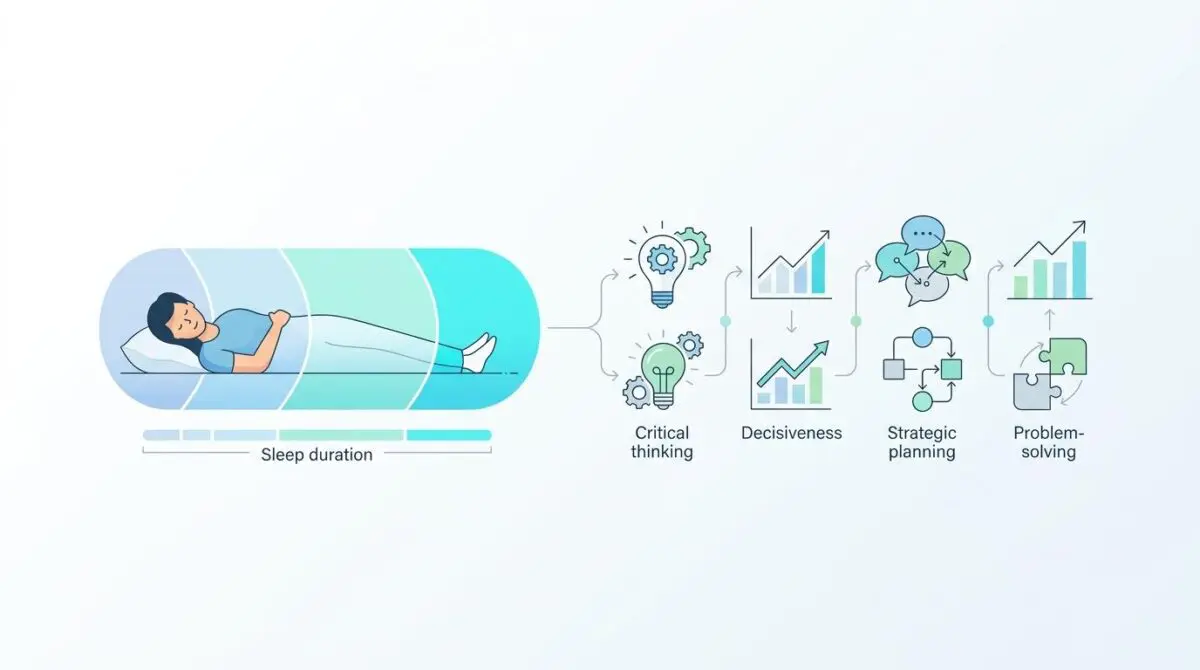
According to a 2025 McKinsey & Company report, executives who consistently achieve eight hours of sleep are 2.4 times more likely to demonstrate high-level strategic problem-solving. This data shatters the outdated illusion that grind culture equates to corporate dedication.
Chronic exhaustion is no longer a badge of honor in the modern business landscape. Instead, it is a critical vulnerability that exposes shareholders to immense financial risk.
Enter the era of Biometric Executive Optimization. This is not a fleeting wellness trend, but a rigorous, data-driven approach to human capital management at the highest levels of enterprise.
By treating the biological readiness of the C-suite as a measurable asset, companies are actively mitigating the friction of sleep-induced strategic errors.
The realization that cognitive output is directly tied to sleep architecture is forcing a massive shift in corporate governance. Founders and institutional investors now recognize that biological recovery is the ultimate competitive advantage in high-volatility markets.
Market Intelligence and Smart Capital
To understand the sheer scale of this shift, we must look at where the smart money is currently flowing. The transition from reactive healthcare to proactive cognitive optimization is creating entirely new asset classes within the enterprise SaaS sector.
Market Intelligence & Data
Sleep-Tech Market Valuation
The global sleep technology market is projected to reach this value by late 2026, driven by enterprise adoption of bio-wearables according to Grand View Research.
S&P 500 Tracker Adoption
As of mid-2026, Bloomberg Intelligence reports that over two-thirds of S&P 500 CEOs now use high-fidelity sleep trackers to manage their daily cognitive schedules.
The Fatigue Alpha
Research from Goldman Sachs in 2025 identified a ‘Fatigue Alpha,’ where companies with formal executive sleep protocols saw a 14% reduction in stock price volatility.
Annual Productivity Loss
An updated 2026 projection by the RAND Corporation estimates the US economy still loses this amount annually due to sleep-related productivity drops in the workforce.
Institutional capital is rapidly moving away from traditional corporate wellness programs and pivoting toward hard, biometric data. Investors understand that the human hardware running billion-dollar organizations requires meticulous maintenance.
This level of care mirrors the upkeep required for a high-frequency trading algorithm. Consequently, this shift is turning sleep hygiene into a measurable and highly lucrative enterprise sector.
The True Cost of Decision Fatigue
The numbers paint a stark picture of the macroeconomic impact of poor sleep hygiene across corporate America. A recent updated 2026 projection by the RAND Corporation estimates the US economy loses $411 billion annually due to sleep-related productivity drops.
This staggering figure is driving a massive reallocation of venture capital into neuro-performance technologies.
Smart money from top-tier firms like Sequoia and Andreessen Horowitz is actively backing non-invasive neuro-modulation startups. Companies like Somnee and Enera are pioneering targeted frequencies.
These innovations are designed to guarantee full, restorative eight-hour sleep cycles for high-stakes decision-makers.
This influx of capital proves that institutional investors now view executive sleep hygiene as a critical risk-mitigation factor rather than a personal perk. When billions of dollars are on the line, leaving the cognitive readiness of a CEO to chance is a fiduciary failure.
The Strategic Deep Dive into Precision Recovery
The foundational blueprint for this movement traces back to the “Sleep-First” leadership model pioneered by Jeff Bezos, who prioritizes a strict 8-hour sleep cycle. By 2026, this philosophy has evolved from a personal habit into a highly sophisticated enterprise framework known as Precision Recovery.
Modern enterprises are moving rapidly toward AI-integrated circadian scheduling. They are utilizing Biological Digital Twins to predict an executive’s cognitive output based on real-time sleep architecture.
This advanced technology specifically tracks the critical REM and Deep Sleep stages to ensure optimal performance.
A 2026 study by the Global Wellness Institute reveals that enterprise sleep technology has seen a 42% year-over-year increase in venture capital funding. Institutional investors now view executive sleep hygiene as a critical risk-mitigation factor in high-volatility markets.
This compelling data underscores the rapid institutionalization of biological performance metrics across the corporate landscape.
Cognitive Load Balancing in the Boardroom
One of the most disruptive strategies emerging from this space is Cognitive Load Balancing. In this model, high-stakes board meetings or critical product launches are autonomously rescheduled by AI systems.
This automated shift occurs if the leadership team’s collective recovery scores fall below a specific optimal threshold.
This effectively eliminates the psychological friction of ego-driven decision making. By removing human stubbornness from the scheduling process, companies ensure their most expensive human hardware operates at peak capacity.
This biometric-to-boardroom pipeline drastically reduces the historical risk of decision fatigue. It protects shareholder value by ensuring that every major strategic pivot is executed with maximum cognitive clarity.
The Rise of Biometric SaaS Platforms
The ecosystem is currently dominated by neuro-performance giants like Eight Sleep and Oura. These companies have successfully expanded their consumer models into enterprise-wide Sleep-as-a-Service platforms.
These innovative platforms provide real-time, anonymized readiness dashboards directly to corporate governance boards.
Furthermore, tech behemoths like Apple and Google have integrated Executive Health Dashboards into their 2026 enterprise suites. This seamless integration makes biometric data a core Key Performance Indicator for evaluating overall leadership effectiveness.
The psychology of leadership is fundamentally changing as a result. The modern executive is no longer evaluated solely by their raw output.
Instead, they are judged by the efficiency, sustainability, and biological resilience of their daily recovery routines.
The Executive Action Plan for Biorhythm Governance
The next evolution of corporate leadership is Autonomous Biorhythm Governance. Founders and C-suite executives must prepare for a landscape where biological readiness is inextricably linked to corporate valuation.
Strategic Trajectory
- Transition organizational structures toward ‘Autonomous Biorhythm Governance’ as the new standard.
- Restructure corporate insurance premiums to align with biological recovery metrics.
- Integrate biological performance data into executive compensation and bonus packages.
- Formalize the ‘Sleep-Performance Coefficient’ as a public-facing metric equivalent to quarterly earnings.
- Appoint ‘Chief Wellness Officers’ with strategic veto power over mission-critical timelines based on team readiness.
Implementing this strategic trajectory requires a fundamental rewiring of corporate culture at the board level. Companies must begin by formalizing the Sleep-Performance Coefficient.
This metric must become as transparent and vital as a quarterly earnings report to internal stakeholders.
Forward-thinking boards are already restructuring executive compensation packages to include biological recovery metrics. This ensures that leaders are financially incentivized to maintain essential cognitive bandwidth.
As a result, executives can focus on long-term strategic vision rather than burning out for short-term gains.
Ultimately, the appointment of a Chief Wellness Officer with true veto power represents the pinnacle of this integration. It signals to the market that a company values sustainable, high-fidelity decision-making over reactive, fatigue-induced market moves.
Securing the Future of C-Suite Performance
The era of the sleep-deprived, hero-CEO is officially dead. In its place, a new paradigm of precision recovery and biometric optimization has emerged, driven by smart capital and undeniable data.
Companies that fail to institutionalize these protocols will find themselves consistently outmaneuvered by competitors whose leadership teams are biologically optimized for high-stakes problem-solving.
By treating executive sleep hygiene as a non-negotiable pillar of corporate governance, organizations can unlock unprecedented levels of strategic clarity.
The future belongs to those who recognize that the human brain is the ultimate enterprise asset, requiring rigorous, data-backed maintenance to scale successfully.
Navigating the intersection of technology, capital, and market psychology requires a sharp strategy. To future-proof your business architecture and scale with precision, connect with Andres at Andres SEO Expert.
Frequently Asked Questions
What is Biometric Executive Optimization?
Biometric Executive Optimization is a rigorous, data-driven framework that treats C-suite biological readiness as a measurable enterprise asset. It utilizes bio-wearables and real-time biometric data to mitigate the financial risks associated with sleep-induced strategic errors and cognitive fatigue.
How does sleep deprivation impact high-level strategic problem-solving?
A 2025 McKinsey report indicates that executives who consistently achieve 8 hours of sleep are 2.4 times more likely to demonstrate high-level strategic problem-solving than those who are sleep-deprived. Biological recovery is now viewed as a primary competitive advantage in high-volatility markets.
What is the ‘Fatigue Alpha’ regarding stock price volatility?
Research from Goldman Sachs identified a ‘Fatigue Alpha,’ which showed that companies implementing formal executive sleep protocols experienced a 14% reduction in stock price volatility. This metric signals to investors that the leadership is optimized for stable, high-fidelity decision-making.
How does Cognitive Load Balancing function in modern boardrooms?
Cognitive Load Balancing is an emerging strategy where AI systems autonomously reschedule mission-critical meetings if the leadership team’s collective biometric recovery scores fall below a set threshold. This removes human ego from the scheduling process and ensures peak cognitive capacity for major pivots.
What is the annual economic cost of sleep-related productivity loss in the US?
According to 2026 projections by the RAND Corporation, the US economy loses approximately $411 billion annually due to sleep-related productivity drops. This staggering figure is driving the rapid institutionalization of sleep hygiene metrics across the enterprise sector.
How are companies integrating biological performance into executive compensation?
Forward-thinking organizations are restructuring compensation and bonus packages to include biological recovery metrics, such as the Sleep-Performance Coefficient. This incentivizes leaders to maintain the cognitive bandwidth necessary for long-term strategic vision rather than short-term output.