Key Points
- Agentic Data Orchestration: Enterprises are shifting from basic natural language translation to multi-agent systems that interpret complex business intent.
- Semantic Buffers: New metadata layers are solving the accuracy cliff by translating ambiguous corporate jargon into validated SQL joins.
- Autonomous Optimization: The trajectory is moving toward self-optimizing databases where AI agents proactively monitor anomalies and refactor schemas.
Table of Contents
The Core Friction: Legacy Data Meets Agentic Intelligence
According to a 2026 report from Gartner, over 80% of enterprises have moved generative AI from experimentation to core infrastructure. Furthermore, 40% of all enterprise applications now embed task-specific AI agents for seamless data interaction.
This massive shift highlights a critical evolution in enterprise architecture. We are rapidly moving away from basic natural language translation toward highly sophisticated agentic data orchestration.
The central challenge for modern enterprises is no longer generating code. Instead, it is translating ambiguous human intent into deterministic database logic, especially since legacy SQL databases remain inherently rigid.
Conversely, human executives ask questions laden with undocumented corporate jargon and contextual nuance. Bridging this divide requires much more than a simple API call to a frontier model.
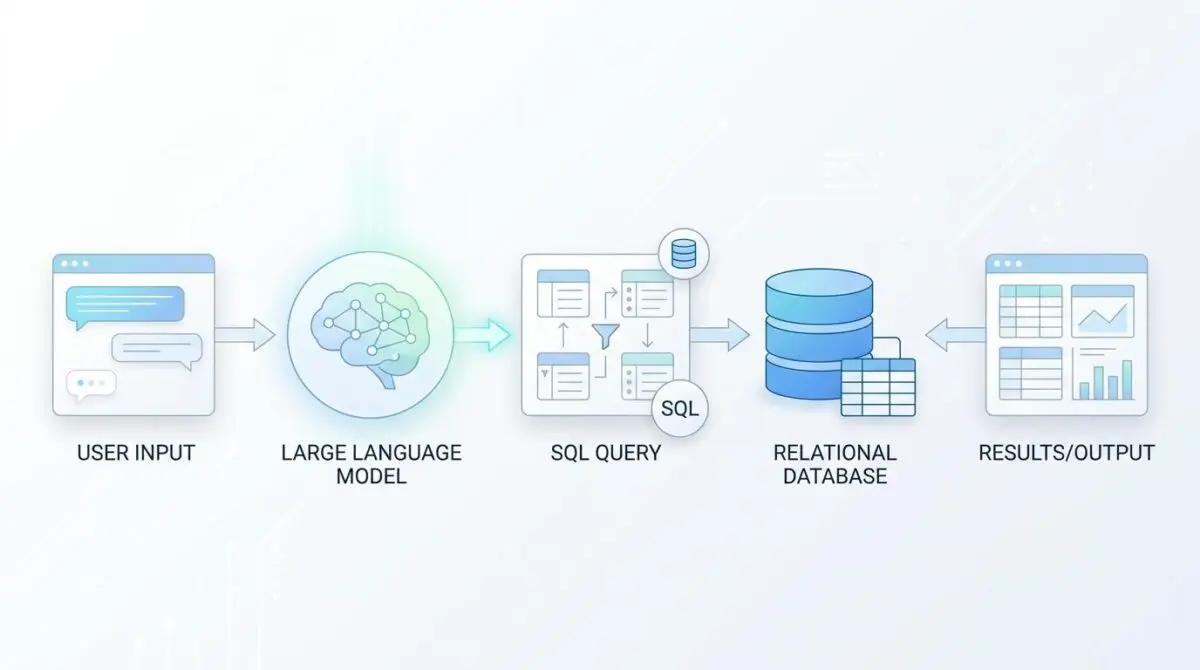
It demands agentic text-to-SQL and semantic data interfacing. This involves the strategic deployment of specialized LLMs acting as database liaisons, fully capable of non-deterministic reasoning and self-correction.
When an initial query returns a null result or a schema error, these agents do not simply fail. They autonomously iterate and re-evaluate the metadata to deliver precise, validated business intelligence.
Market Intelligence: The Flow of Smart Capital
Market Intelligence & Data
Enterprise Accuracy Peak
Data from the 2026 AI Standards Institute shows that agentic systems using semantic layers have boosted SQL generation accuracy from 65% to 92.4%.
North American Market
The North American LLM market is projected to reach $105.5 billion by 2030, driven largely by SQL-integration in the finance and IT sectors, according to Tenet Research.
Project Failure Risk
Gartner predicts that 60% of agentic analytics projects will fail by 2028 if they rely solely on LLM logic without a robust semantic foundation.
Efficiency ROI
A 2026 McKinsey study found that enterprises deploying ‘Agentic SQL’ interfaces see a 4.2x return on investment through reduced ad-hoc reporting requests.
The data clearly illustrates a market in aggressive transition. Smart capital is heavily focused on solving the friction points between raw compute power and legacy infrastructure.
The landscape is currently dominated by vertically integrated stacks like Snowflake Cortex Analyst, Databricks Genie, and Microsoft Fabric. These industry giants have embedded native natural language capabilities directly into their core engines.
However, specialized startups are capturing significant venture capital by addressing specific enterprise bottlenecks. Institutional money is flowing heavily into privacy-preserving SQL agents that allow querying of sensitive data through encrypted hybrid engines.
Inferact recently achieved an $800M valuation by commercializing high-efficiency vLLM inference for real-time database querying. Meanwhile, companies like Sierra are leading the charge in agentic business workflows.
This influx of capital proves that over 80% of enterprises have now moved GenAI from experimentation to infrastructure. The era of the isolated pilot project is officially over.
The Strategic Deep Dive: Bridging the Semantic Divide
Despite the massive influx of capital, a critical bottleneck remains in enterprise deployments. Modern LLMs are highly proficient at writing syntactically perfect SQL.
The problem arises when perfect syntax answers the wrong business question. This frequently occurs due to undocumented legacy logic and complex, idiosyncratic data models.
This systemic failure point is widely recognized as the ‘Context Gap’. It represents the friction between what a user asks and how the database actually stores that reality.
The Rise of Deterministic Validation Agents
To overcome this friction, forward-thinking architectures are implementing semantic buffers. These are real-time metadata layers that translate ambiguous corporate jargon into precise SQL joins.
When a CEO asks for active customers, the semantic buffer defines exactly what active means in the context of that specific database. This effectively eliminates the hallucination risk inherent in frontier models.
Firms are also deploying deterministic validation agents to ensure accuracy. These specialized protocols cross-reference LLM outputs against a centralized semantic model based on YAML metrics.
Furthermore, human-in-the-loop verification layers are being integrated for high-stakes queries. This ensures that the generated logic aligns perfectly with executive intent before execution.
Overcoming the Accuracy Cliff
A 2026 performance benchmark from TokenMix reveals that while frontier models achieve 96.5% accuracy on simple queries, they still face an accuracy cliff in enterprise environments. In fact, 85% of multi-join failures are caused by missing semantic metadata rather than poor SQL logic.
This insight fundamentally changes how tech leaders must allocate their infrastructure budgets. Throwing more compute power at the problem will not solve missing context.
Instead, the solution lies in leveraging the Model Context Protocol to facilitate secure, context-aware interactions. This allows agents to understand the shape of the data before they ever write a single line of code.
Additionally, specialized small language models fine-tuned on specific SQL dialects are emerging as a cost-effective alternative. They solve the high latency and compute costs associated with massive frontier models.
The Executive Action Plan: Autonomous Intent-to-Insight
Strategic Trajectory
- Transition toward ‘Autonomous Intent-to-Insight’ loops where AI agents operate without manual user prompting.
- Implement proactive monitoring systems that detect database anomalies in real-time.
- Enable agents to autonomously generate investigative queries to identify technical root causes.
- Automate the generation of comprehensive Root Cause Analysis (RCA) reports for executive review.
- Evolve infrastructure toward ‘Self-Optimizing Databases’ that require minimal manual intervention.
- Empower AI agents to autonomously suggest and implement schema refactoring and indexing based on natural language patterns.
For founders and C-level executives, the immediate priority must be establishing a robust semantic foundation. Without this critical layer, any agentic analytics project is essentially built on sand.
The next evolutionary step is moving away from reactive querying. The future belongs to intelligent systems that do not wait for a user prompt to deliver actionable value.
By 2027, the strategic focus will shift entirely toward self-optimizing databases. In this paradigm, AI agents will autonomously suggest schema refactoring based on historical natural language usage patterns.
This level of automation will drastically reduce the burden on data engineering teams. It allows human talent to focus on strategic data modeling rather than ad-hoc query fulfillment.
The Final Verdict: Self-Optimizing Architectures
The integration of LLMs with legacy SQL databases is no longer a novelty. It is a mandatory infrastructure upgrade for any enterprise looking to remain competitive in a data-driven economy.
Those who invest in semantic data interfacing and agentic orchestration will unlock unprecedented operational velocity. They will successfully transform their static databases into proactive, intelligent partners.
Conversely, those who ignore the context gap will find themselves drowning in perfectly formatted, yet entirely inaccurate, data reports.
Navigating the intersection of technology, capital, and market psychology requires a sharp strategy. To future-proof your business architecture and scale with precision, connect with Andres at Andres SEO Expert.
Frequently Asked Questions
What is Agentic Text-to-SQL in enterprise data architecture?
Agentic Text-to-SQL refers to the strategic deployment of specialized LLMs that act as database liaisons. These agents utilize non-deterministic reasoning and autonomous iteration to translate ambiguous human intent into deterministic database logic, self-correcting if a query returns errors or null results.
Why is the Context Gap a major barrier for AI-driven analytics?
The Context Gap occurs when AI generates syntactically correct SQL that answers the wrong business question. This usually happens due to undocumented legacy logic and complex, idiosyncratic data models that a frontier model cannot understand without a robust semantic foundation.
How do semantic buffers prevent AI hallucinations in data reporting?
Semantic buffers act as real-time metadata layers that translate corporate jargon into precise SQL joins. By defining metrics like ‘active customers’ within the context of a specific database, they eliminate the hallucination risks inherent in LLMs and ensure validated business intelligence.
What is the projected ROI for enterprises using Agentic SQL interfaces?
According to a 2026 McKinsey study, enterprises deploying Agentic SQL interfaces see a 4.2x return on investment. This ROI is primarily driven by a significant reduction in ad-hoc reporting requests and the increased speed of obtaining precise insights from legacy infrastructure.
What is the importance of the Model Context Protocol (MCP) in SQL agents?
The Model Context Protocol facilitates secure, context-aware interactions between AI agents and databases. It allows agents to understand the shape and metadata of the data environment before writing code, effectively bridging the gap between raw compute and legacy infrastructure.
How will self-optimizing databases change data engineering by 2027?
Self-optimizing databases will leverage AI agents to autonomously suggest and implement schema refactoring and indexing based on natural language usage patterns. This shift reduces the manual burden on data engineering teams, allowing them to focus on high-level strategic data modeling.