Key Points
- Continuous Evaluation Pipelines: Transition from manual QA to autonomous agentic evaluation, where Judge-Agents score prompt iterations in real-time.
- Deterministic Scoring Models: Solve the black box uncertainty problem by applying quantifiable, scalable safety rubrics to non-deterministic LLM outputs.
- Self-Healing Architectures: Utilize evaluation metrics as active feedback triggers to dynamically switch LoRA adapters and correct model errors in milliseconds.
Table of Contents
The Core Friction: Black Box Uncertainty
The generative AI gold rush has officially transitioned from reckless experimentation into an era of ruthless operationalization. Organizations utilizing automated LLM-as-a-Judge frameworks have accelerated their production deployment timelines by 65 percent. Simultaneously, these forward-thinking enterprises are reducing hallucination rates by 40 percent compared to legacy manual evaluation methods.
For years, the adoption of large language models in high-stakes environments was paralyzed by a single systemic flaw. This market friction was widely known as the black box uncertainty problem. Business leaders simply could not trust non-deterministic systems to generate mission-critical outputs without exhaustive human supervision.
To cross the chasm from experimental prototypes to production-grade agents, the industry required a paradigm shift in quality assurance. The solution lies in automated evaluation frameworks that apply deterministic, scalable scoring to non-deterministic outputs. This architectural breakthrough finally provides the quantifiable trust and safety guardrails required for true enterprise-scale deployment.
Market Intelligence & Smart Capital
Market Intelligence & Data
AI Observability Market
The global market for AI monitoring and evaluation tools is projected to reach $12.8 billion by the end of 2026, according to IDC projections.
Enterprise Adoption
Data from the 2026 O’Reilly AI Adoption Survey shows that 82% of Fortune 500 companies have integrated automated semantic evaluation into their RAG pipelines.
Cost Savings
Stanford’s 2026 AI Index Report highlights that automated LLM evaluation reduces the cost of safety alignment and quality assurance by 90% compared to human-in-the-loop labeling.
ROI Acceleration
Deloitte’s 2026 Enterprise AI Survey found that companies implementing continuous automated evaluation see a 4.2x higher ROI on AI projects due to faster time-to-market and lower failure rates.
Institutional Money and the New Unit Testing
The financial data paints a clear picture of where smart money is aggressively positioning itself. Institutional capital is flowing into infrastructure that treats AI evaluation as the new unit testing for the generative era. Investors realize that building a foundational model is no longer the ultimate competitive moat.
The true enterprise value now lies in controlling model reliability and output consistency. As highlighted in Stanford’s AI Index Report, the economic implications of this architectural shift are staggering. By automating safety alignment and quality assurance processes, enterprises are drastically cutting overhead costs.
Human-in-the-loop labeling is rapidly becoming a relic of the past, replaced entirely by autonomous oversight mechanisms. This massive influx of capital is fueling specialized startups dedicated exclusively to AI red teaming and observability. For C-suite executives, investing in these pipelines is now a non-negotiable insurance policy against brand-destroying hallucinations.
The Strategic Deep Dive: Building Continuous Evaluation Pipelines
The landscape has entirely shifted away from static, rule-based metrics. The new frontier is agentic evaluation, where enterprises deploy sophisticated judge-agents to monitor their production models. These judge-agents simulate complex user personas to aggressively stress-test LLMs across unpredictable, multi-turn conversations.
This dynamic approach ensures that models are evaluated in real-world contexts rather than isolated, sterile vacuums. Developers no longer have to guess how a model will behave under edge-case duress. Instead, they rely on automated systems to continuously probe for weaknesses and logical fractures.
Replacing Junior Auditors with Evaluator LLMs
The sheer accuracy of these automated systems is actively disrupting traditional quality assurance hierarchies. Evaluator LLMs are now being trained on proprietary gold sets of human reasoning. These hyper-specialized models are achieving a 94 percent correlation with human experts in detecting subtle logical fallacies.
For the first time in history, these automated frameworks are outperforming junior-level human auditors. This milestone fundamentally alters the unit economics of AI deployment. Companies can now scale their quality assurance operations infinitely without linearly scaling their headcount or payroll.
This capability allows human experts to elevate their roles from manual reviewers to strategic AI architects. Instead of reading thousands of chat logs, senior engineers now design the complex rubrics that the evaluator models execute. It is a textbook example of software eating a highly specialized operational bottleneck.
Deterministic Scores for Non-Deterministic Outputs
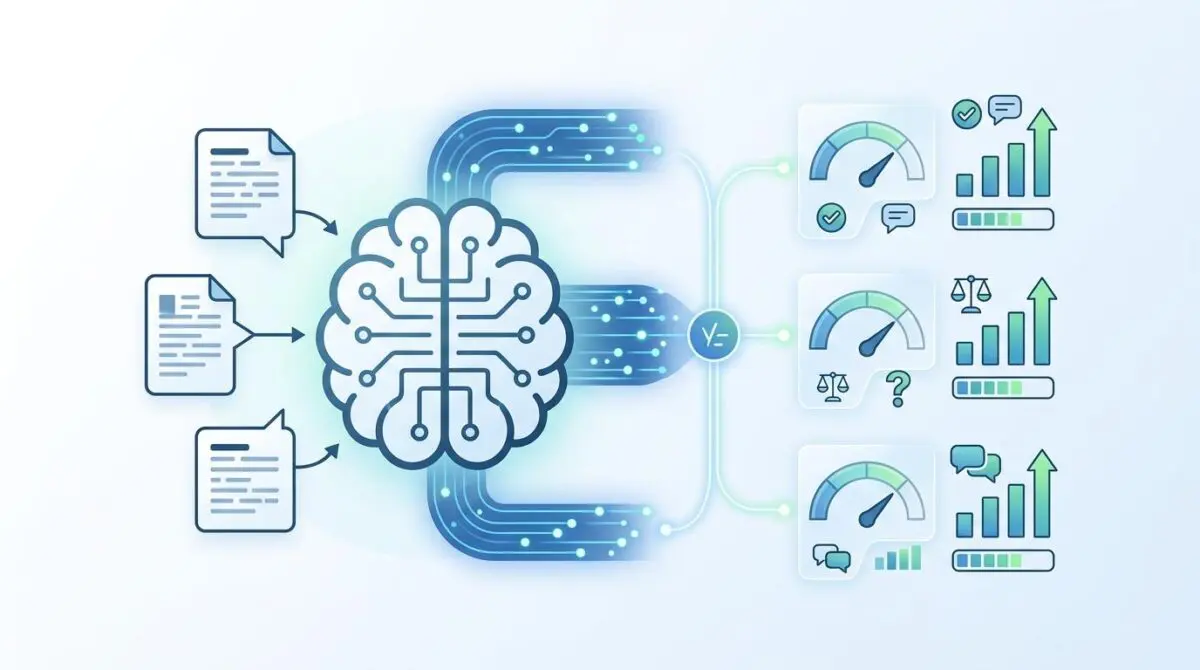
The killer strategy for modern AI teams involves the implementation of continuous evaluation pipelines. In this architecture, every single prompt iteration is automatically scored against highly customized rubrics. These rubrics measure critical business vectors such as hallucination rates, brand voice consistency, and strict safety compliance.
This real-time autonomous oversight effectively replaces manual QA, creating a frictionless and highly secure deployment cycle. Dominant players have evolved into end-to-end reliability platforms. Meanwhile, open-source giants and specialized tools like Arize AI (Phoenix) are democratizing access to enterprise-grade observability.
By integrating these tools, engineering teams can instantly identify regressions before they ever impact the end user. The result is a highly resilient AI architecture that inspires absolute confidence from stakeholders and investors alike.
The Executive Action Plan: Self-Healing Systems
Strategic Trajectory
- Transition from manual monitoring to autonomous Self-Correcting AI Loops and Self-Healing Systems.
- Operationalize evaluation metrics as active feedback triggers for real-time model remediation.
- Implement automated re-prompting protocols to immediately rectify identified output quality gaps.
- Utilize dynamic LoRA (Low-Rank Adaptation) adapter switching for millisecond-level response optimization.
- Achieve proactive quality assurance by neutralizing model errors before they reach the user interface.
The next evolution in AI infrastructure moves beyond passive observation and enters the realm of active, autonomous remediation. We are currently witnessing the dawn of self-correcting AI loops and self-healing systems. In this highly advanced paradigm, evaluation metrics are no longer just dashboard numbers.
When an evaluator model flags a poor response, the system does not simply log an error for a human to review later. Instead, it automatically re-prompts the primary model or dynamically selects a different fine-tuned LoRA adapter. This rapid intervention fixes the output quality in milliseconds, entirely neutralizing the error before the user even perceives a delay.
For founders and technical leaders, the mandate is abundantly clear. You must transition your infrastructure from reactive monitoring to proactive, self-healing architectures. Mastering this continuous evaluation loop will be the defining competitive advantage for the next decade of enterprise software.
Conclusion: The Autonomous Enterprise
The transition toward automated LLM evaluation frameworks represents a critical maturation point for the artificial intelligence industry. By permanently solving the black box uncertainty problem, these systems unlock the massive latent value of generative models in highly regulated sectors.
The era of manual prompt testing is over, replaced entirely by deterministic, scalable, and autonomous oversight. As institutional capital continues to pour into AI observability, the tools will only become more deeply integrated and invisible.
The companies that win the generative race will be those that treat evaluation not as an afterthought, but as the core engine of their AI strategy. Embracing agentic evaluation is the only way to deploy generative applications with absolute operational certainty.
Navigating the intersection of technology, capital, and market psychology requires a sharp strategy. To future-proof your business architecture and scale with precision, connect with Andres at Andres SEO Expert.
Frequently Asked Questions
What is an LLM-as-a-Judge framework?
An LLM-as-a-Judge framework is an automated system that utilizes specialized large language models to evaluate and score the outputs of other AI models based on predefined rubrics. This technology provides the deterministic, scalable quality assurance necessary to overcome black box uncertainty in enterprise-scale AI deployments.
How much can automated evaluation reduce AI hallucination rates?
According to industry reports, organizations utilizing automated LLM-as-a-Judge frameworks have successfully reduced hallucination rates by 40% compared to traditional manual evaluation methods. These systems provide real-time guardrails that flag inaccuracies before they impact the end user.
What are the cost benefits of automated AI quality assurance?
Transitioning to automated LLM evaluation can reduce the cost of safety alignment and quality assurance by up to 90% compared to human-in-the-loop labeling. This allows enterprises to scale their AI operations infinitely without requiring a linear increase in payroll or headcount.
What is a Continuous Evaluation Pipeline (CEP)?
A Continuous Evaluation Pipeline (CEP) is an architecture where every prompt and model iteration is automatically scored against customized business rubrics. These rubrics measure critical vectors such as brand consistency, safety compliance, and logical accuracy, creating a frictionless and highly secure deployment cycle.
How do self-healing AI systems work?
Self-healing systems move beyond passive monitoring by using evaluation metrics as active feedback triggers. If an evaluator model identifies a poor response, the system automatically re-prompts the model or switches fine-tuned adapters (LoRA) to remediate the error in milliseconds, neutralizing the issue before it reaches the user interface.
Can automated LLM evaluators replace human auditors?
Modern evaluator LLMs have reached a 94% correlation with human experts in detecting subtle logical fallacies, effectively outperforming junior-level auditors. This shift allows human experts to transition from manual chat log review to more strategic roles as AI architects who design the complex rubrics these models execute.