Key Points
- Contextual Synthetic Injection: Replacing static redaction with statistically accurate placeholders preserves the semantic reasoning of advanced LLMs.
- The AI Security Gap: Unified governance platforms and AI gateways are rapidly consolidating to intercept PII before it reaches third-party API providers.
- Agentic Governance: Autonomous privacy agents residing on the local edge will soon negotiate real-time data disclosure to meet strict regulatory frameworks.
Table of Contents
The Core Friction: Prompt-Based Exfiltration
According to the 2026 Cloud Security Report by Check Point Software, 78% of global organizations have reported confirmed or suspected AI-related security incidents. This creates a critical demand for real-time PII interception before data leaves the enterprise perimeter.
This staggering statistic exposes a fundamental market friction within modern enterprise architecture. As organizations rush to deploy generative models, the lack of robust PII anonymization for LLM integration has become the ultimate bottleneck for corporate innovation.
We are witnessing a paradigm shift where data protection is no longer just a defensive compliance checkbox. It is the critical infrastructure required to unlock the full cognitive power of artificial intelligence without sacrificing intellectual property.
The core issue lies in the tension between model utility and data privacy. Feeding raw, unfiltered customer data into public cloud LLMs inevitably leads to prompt-based data exfiltration.
Conversely, relying on legacy masking techniques destroys the contextual fabric that these advanced models need to function. The enterprise market is desperately seeking a middle ground that balances ironclad security with high-fidelity model reasoning.
Market Intelligence & Smart Capital
Market Intelligence & Data
PET Market Valuation
The global Privacy-Enhancing Computation market is valued at $5.51 billion in 2026, driven by massive enterprise AI adoption according to Research Nester.
AI Security VC Inflow
Venture capital funding for AI security and PII protection startups tripled in 2025, reaching $6.34 billion, as reported by Software Strategies Blog.
Compliance Adoption
A 2026 FEDMA survey indicates that 92% of organizations now utilize PETs like anonymization to meet the strict auditing requirements of global data regulations.
Projected CAGR
The Privacy Enhancing Technology market is projected to expand at a CAGR of 25.6% through 2034 as businesses formalize AI governance, per Fortune Business Insights.
Smart money is aggressively flowing toward infrastructure that solves this exact friction. Venture capital is currently obsessed with what the industry calls AI Defense Planes.
Startups like Protect AI, CalypsoAI, and Immuta are leading this charge by shifting from isolated point solutions to unified governance platforms. These platforms integrate seamlessly into the AI orchestration layer, intercepting data flows before they reach external APIs.
The urgency driving this capital allocation is clear when we look at the broader threat landscape, where 78% of organizations reported AI-related security incidents. This reality is forcing massive market consolidation at the enterprise level.
Notably, ServiceNow spent $11.6 billion on security acquisitions in 2025 alone to dominate the AI governance lifecycle. Simultaneously, specialized deep-tech firms like Zama are attracting massive rounds to pioneer homomorphic encryption for real-time inference.
The Strategic Deep Dive: Contextual Synthetic Injection
By 2026, the industry has firmly transitioned away from the primitive approach of static masking. Simply redacting sensitive fields with brute-force tokens inevitably breaks the semantic reasoning of advanced models like GPT-5 and Claude 4.
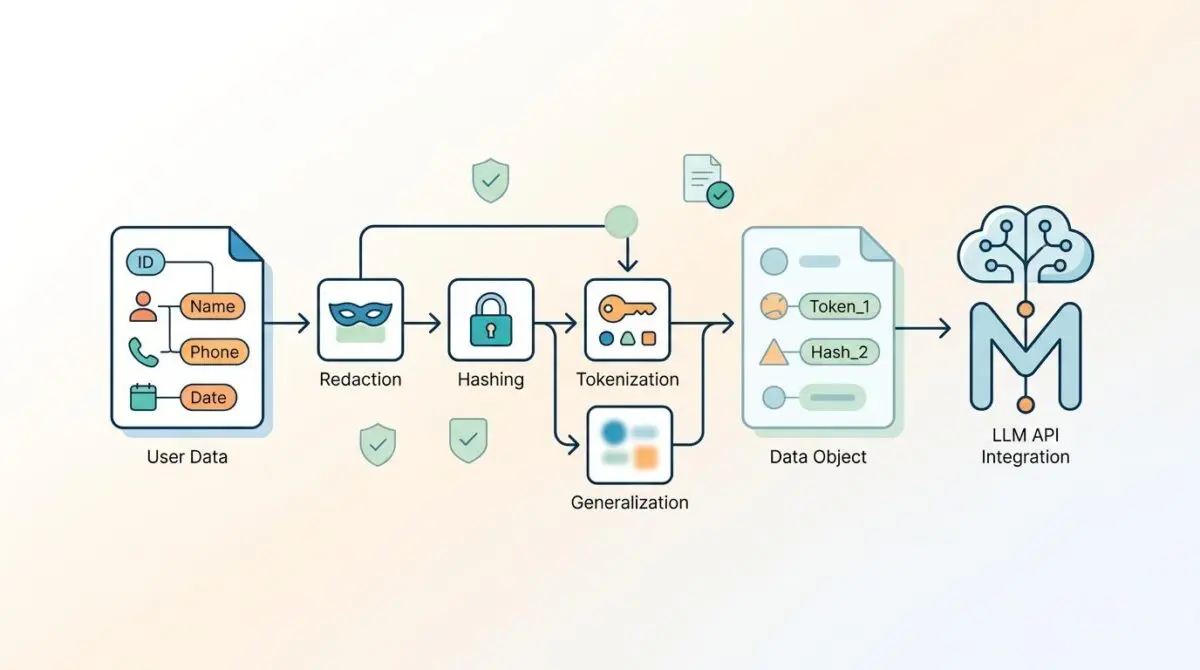
Instead, visionary enterprises are deploying intelligent AI gateways that utilize contextual synthetic injection. This mechanism replaces real PII with statistically accurate, synthetic placeholders that maintain the grammatical and logical flow of the original prompt.
This utility-preserving strategy is nothing short of revolutionary for highly regulated sectors. It ensures zero exposure of actual customer data to third-party API providers while allowing the LLM to operate at peak cognitive capacity.
Bridging the AI Security Gap
The primary friction solved by these advanced anonymization layers is the notorious AI security gap. A staggering reality of the modern enterprise is that while formal privacy policies exist, only 26% have the technical architecture to enforce them.
PII anonymization layers serve as the missing enforcement mechanism for these vulnerable organizations. They prevent inadvertent prompt-based data exfiltration, allowing sectors like BFSI and healthcare to utilize public cloud LLMs safely.
Without this architecture, companies risk severe violations of strict GDPR or HIPAA mandates. The integration of synthetic injection bridges the gap between legal compliance and technical execution.
The Utility-Preserving Paradigm
The psychological shift here is moving from data redaction to data simulation. A 2025 study by Amazon Bedrock researchers revealed that using teacher models to generate high-fidelity synthetic PII replacements improves fine-tuned LLM performance by 84.8%.
This massive improvement is compared to models trained on traditional redacted datasets, which often suffer from semantic fragmentation. This insight proves that security and performance are no longer mutually exclusive.
By simulating the context of the data rather than destroying it, businesses can train and prompt models with unprecedented accuracy. The synthetic tokens act as a cryptographic mirror, reflecting the exact statistical properties required for the model to reason without exposing human identity.
The Executive Action Plan
Strategic Trajectory
- Transition core strategy toward Agentic Privacy Governance models by late 2026.
- Deploy autonomous Privacy Agents on the local edge for secure data handling.
- Implement zero-knowledge redaction and real-time re-identification capabilities.
- Establish negotiation protocols for data disclosure with external AI models.
- Ensure organizational compliance with the EU AI Act enforcement for high-risk systems by August 2026.
The next evolution in this space is agentic privacy governance. Forward-thinking executives must prepare for a landscape where data protection is entirely autonomous.
By late 2026, businesses will rely on specialized privacy agents residing directly on the local edge. These agents will perform zero-knowledge redaction and re-identification in real-time, remaining completely invisible to the end-user.
More importantly, these agents will dynamically negotiate data disclosure with external AI models. They will evaluate the specific requirements of frameworks like the EU AI Act before allowing a single byte of telemetry to leave the internal network.
Conclusion: Governing the Autonomous Edge
The integration of generative AI into the enterprise is no longer constrained by the capabilities of the models themselves. The true frontier is mastering the secure orchestration of the data that feeds them.
PII anonymization for LLM integration is the definitive bridge between disruptive AI innovation and sustainable corporate governance. Those who master contextual synthetic injection will outpace competitors still relying on brittle, static defense mechanisms.
As regulatory enforcement tightens globally, deploying autonomous privacy agents will transition from a strategic advantage to a baseline requirement for survival.
Navigating the intersection of technology, capital, and market psychology requires a sharp strategy. To future-proof your business architecture and scale with precision, connect with Andres at Andres SEO Expert.
Frequently Asked Questions
What is PII Anonymization for LLM integration?
PII Anonymization for LLM integration is a security framework that intercepts Personally Identifiable Information before it leaves the enterprise perimeter. It prevents prompt-based data exfiltration by replacing sensitive data with secure alternatives, ensuring that third-party AI providers never receive raw customer or corporate data.
What is Contextual Synthetic Injection in AI security?
Contextual Synthetic Injection is an advanced privacy technique that replaces real data with statistically accurate synthetic placeholders. Unlike traditional masking, this method preserves the semantic and logical fabric of the prompt, allowing models to maintain high-fidelity reasoning and performance without compromising privacy.
Why is traditional data masking ineffective for advanced LLMs?
Legacy masking often causes semantic fragmentation by redacting data with brute-force tokens that break a model’s contextual understanding. Research indicates that using synthetic replacements can improve fine-tuned LLM performance by up to 84.8% compared to traditional redaction methods.
How does the AI Security Gap affect enterprise compliance?
The AI Security Gap refers to the disconnect where 92% of organizations aim for compliance, yet only 26% possess the technical architecture to enforce privacy policies. Bridging this gap is essential for meeting strict mandates like the GDPR, HIPAA, and the EU AI Act.
What is the role of Privacy-Enhancing Technologies (PETs) in 2026?
PETs, including homomorphic encryption and synthetic data injection, have become a $5.51 billion market. They serve as the critical infrastructure for AI governance, enabling organizations to utilize the cognitive power of generative models while maintaining ironclad security and auditing standards.
What is Agentic Privacy Governance?
Agentic Privacy Governance is an autonomous approach to data protection where localized Privacy Agents manage data disclosure. These agents perform zero-knowledge redaction and real-time re-identification at the edge, dynamically negotiating how much data is shared with external AI models based on risk and regulation.