




Key Points
- The industry is shifting from passive wearable tracking to AI-Powered Hyper-Personalized Health Intelligence (HPHI) to eliminate biometric fatigue.
- Multi-Modal Large Language Models now utilize Contextual Synthesis to cross-reference physiological data with daily workflows for proactive intervention.
- Future market dominance relies on Autonomous Health Agents operating in closed-loop systems to automatically fulfill health and recovery needs.
Table of Contents
The Core Friction of Biometric Fatigue
According to Silicon Valley Bank’s H1 2026 Report, venture capital investment in healthcare AI reached a staggering $18 billion in 2025. AI-focused startups are now capturing 46% of all health-sector funding. This massive influx of capital signals a fundamental shift in how executives approach human performance.
The legacy model of passive wearable tracking is now officially dead. The modern enterprise is rapidly pivoting toward AI-Powered Hyper-Personalized Health Intelligence (HPHI). This evolution transforms raw, overwhelming data into actionable, real-time physiological strategy.
For years, high-performing professionals suffered from biometric fatigue. They were bombarded with fragmented data points across sleep trackers, glucose monitors, and heart rate sensors. This created cognitive overload rather than generating actionable health outcomes.
Current HPHI solutions solve this friction by acting as your digital Chief Health Officer. They distill millions of physiological data points into single, conversational directives. This proactive intervention mitigates executive burnout and prevents chronic metabolic decline before symptoms ever manifest.
Market Intelligence and Smart Capital
Financial markets are heavily rewarding platforms that seamlessly integrate generative AI with biometric hardware. Dominance is shifting rapidly toward platform-agnostic health intelligence layers. Institutional capital is currently flooding into preventative AI platforms that combine genomic data with daily biometrics.
Market Intelligence & Data
AI Fitness Market Valuation
Future Data Stats reports the global AI in fitness and wellness market is valued at $13.9 billion in 2026, driven by a 23% CAGR in personalized coaching subscriptions.
Dropout Rate Reduction
Research from WifiTalents in February 2026 indicates that AI-powered feedback loops can cut fitness program dropout rates by 25% while lifting total adherence by 30%.
Enterprise Adoption Intent
A 2026 survey by WTW (Willis Towers Watson) found that 75% of U.S. employers plan to embed AI into their health and benefits programs by 2028.
AI Funding Dominance
According to Bessemer Venture Partners’ State of Health AI 2026, AI-centric companies now capture 55% of all health tech venture capital, up from 37% in 2024.
The Rise of Healthspan Tech
Smart money is no longer interested in isolated fitness applications. Investors are backing vertically integrated ecosystems that link gym hardware directly to AI-driven corporate wellness accounts. A prime example is the recent $785 million merger between EGYM and Playlist in January 2026.
This consolidation proves that the future belongs to interconnected health data. You can explore the broader venture trends in Bessemer Venture Partners’ State of Health AI 2026. The report highlights how AI-centric companies are aggressively capturing market share from legacy health tech incumbents.
The Strategic Deep Dive
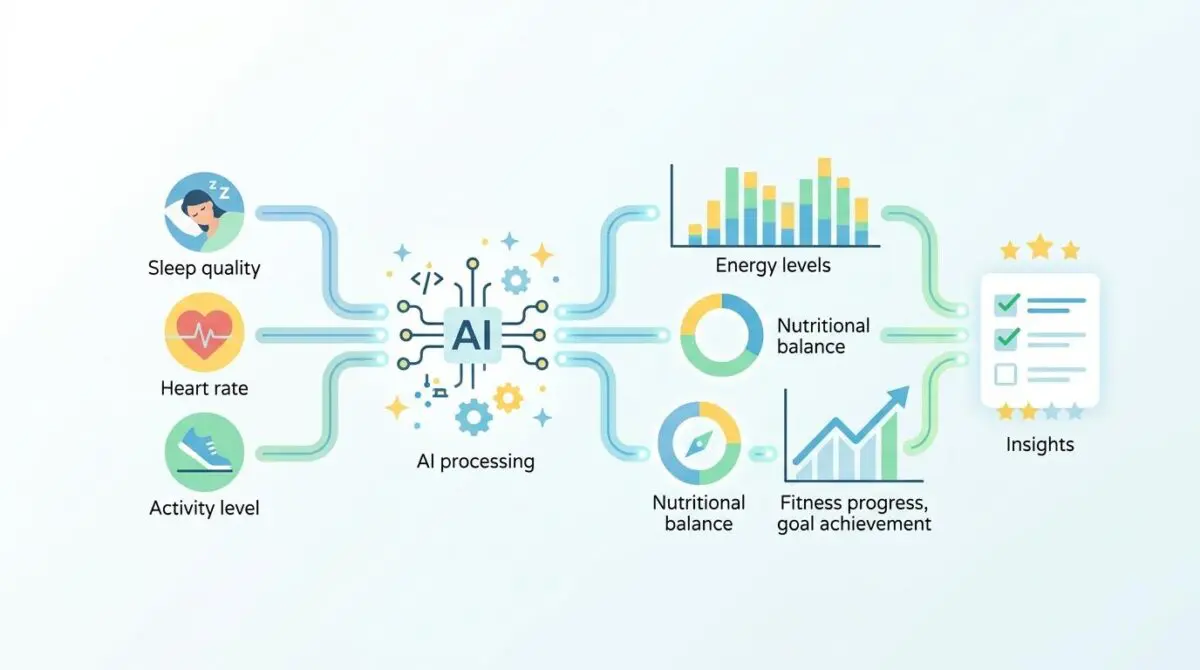
To understand how to use AI to track your health and fitness goals effectively, we must examine the underlying technology. Real-world applications now center on Biometric Digital Twins. These systems utilize Multi-Modal Large Language Models to ingest continuous streams from glucose monitors, cortisol sensors, and sleep trackers.
The killer strategy for 2026 is Contextual Synthesis. Your AI does not just report a high heart rate in isolation. It cross-references that physiological spike with your Outlook calendar to suggest rescheduling a high-stress meeting.
- Biometric Digital Twins provide a real-time, virtual representation of your metabolic state.
- Contextual Synthesis cross-references physiological data with external stressors like meeting schedules.
- Multi-Modal Ingestion processes disparate data streams from continuous glucose monitors and sleep trackers simultaneously.
Contextual Synthesis and MLLMs
This level of generative coaching is fundamentally altering human behavior. As of May 2026, data from Whoop reveals that users of its OpenAI-powered AI Coach exercise an average of 90 additional minutes per week. These same users achieve a 10% higher heart rate variability compared to non-AI-assisted users.
This insight demonstrates that generative coaching is actively improving physiological outcomes, not just tracking them. Market leaders are doubling down on this autonomous coaching engine. In fact, Whoop recently closed a $575 million Series G at a $10.1 billion valuation in April 2026 to expand these exact capabilities.
The Platform-Agnostic Ecosystem
Enterprise adoption is accelerating as these platforms prove their ROI by reducing corporate healthcare costs. The shift toward preventative healthspan tech is a massive business opportunity. For a deeper look at the capital driving this innovation, review Silicon Valley Bank’s latest healthcare investment report.
Founders must recognize that true value lies in the intelligence layer, not the hardware. The AI that successfully aggregates, interprets, and acts upon cross-platform biometric data will ultimately own the consumer relationship.
The Executive Action Plan
The next evolution in this space is the Autonomous Health Agent. Founders and executives are moving rapidly toward a closed-loop system. In this environment, your health AI operates with authorized autonomy to manage your physical longevity.
Strategic Trajectory
- Transition to Autonomous Health Agents to oversee personal health intelligence.
- Implement Closed-Loop systems that move beyond insights into automated fulfillment.
- Authorize AI to automatically order personalized supplements based on real-time blood-work biomarkers.
- Deploy smart scheduling to book recovery sessions during peak periods of physical strain.
- Utilize verified lifestyle ‘proof-of-health’ data to negotiate health insurance premiums in real-time.
Implementing these closed-loop systems requires a fundamental shift in technical infrastructure. Executives must prioritize APIs that allow their health platforms to communicate seamlessly with external vendors. This includes integrating with diagnostic labs for blood-work and partnering with insurance providers for dynamic premium adjustments.
The ultimate goal is to remove all user friction from the health optimization process. When your AI can automatically order personalized supplements or book recovery sessions during physical strain peaks, adherence skyrockets. This is the ultimate deployment of hyper-personalized health intelligence.
Securing the Autonomous Future
The transition from passive tracking to proactive, autonomous intervention is the most significant health tech disruption of our decade. Companies that fail to integrate generative AI into their wellness ecosystems will quickly face obsolescence. The market demands hyper-personalized, context-aware health intelligence.
By leveraging Biometric Digital Twins and contextual synthesis, executives can eliminate biometric fatigue and unlock unprecedented levels of human performance. The capital is already deployed, and the technological infrastructure is rapidly maturing.
Navigating the intersection of technology, capital, and market psychology requires a sharp strategy. To future-proof your business architecture and scale with precision, connect with Andres at Andres SEO Expert.
Frequently Asked Questions
What is AI-Powered Hyper-Personalized Health Intelligence (HPHI)?
HPHI is an advanced health model that evolves beyond passive wearable tracking by transforming raw physiological data into actionable, real-time strategy. It acts as a digital Chief Health Officer, distilling complex metrics into conversational directives to prevent executive burnout and chronic metabolic decline.
How do Biometric Digital Twins improve health management?
Biometric Digital Twins use Multi-Modal Large Language Models to create a virtual metabolic representation of a user. By ingesting continuous data from glucose monitors and sleep trackers, these systems provide a real-time understanding of a person’s metabolic state for precise health optimization.
What is Contextual Synthesis in the context of biometric data?
Contextual Synthesis is a strategy where AI cross-references physiological spikes with external stressors, such as a high-stress calendar event. This allows the system to provide situational advice, such as recommending a meeting be rescheduled if biometric data indicates excessive strain.
How does AI reduce fitness program dropout rates?
According to 2026 market intelligence, AI-powered feedback loops can reduce fitness program dropout rates by 25% while increasing total adherence by 30%. This is achieved through hyper-personalized coaching that actively improves physiological outcomes rather than just tracking them.
What is an Autonomous Health Agent?
An Autonomous Health Agent is a closed-loop system authorized to manage a user’s physical longevity. These agents move beyond insights to automated fulfillment, such as ordering personalized supplements based on blood-work or booking recovery sessions during periods of high physical stress.
How are enterprises utilizing AI in health and benefits programs?
Enterprise adoption is accelerating, with 75% of U.S. employers planning to embed AI into health programs by 2028. These platforms prove ROI by reducing corporate healthcare costs and using verified ‘proof-of-health’ data to negotiate insurance premiums in real-time.