Key Points
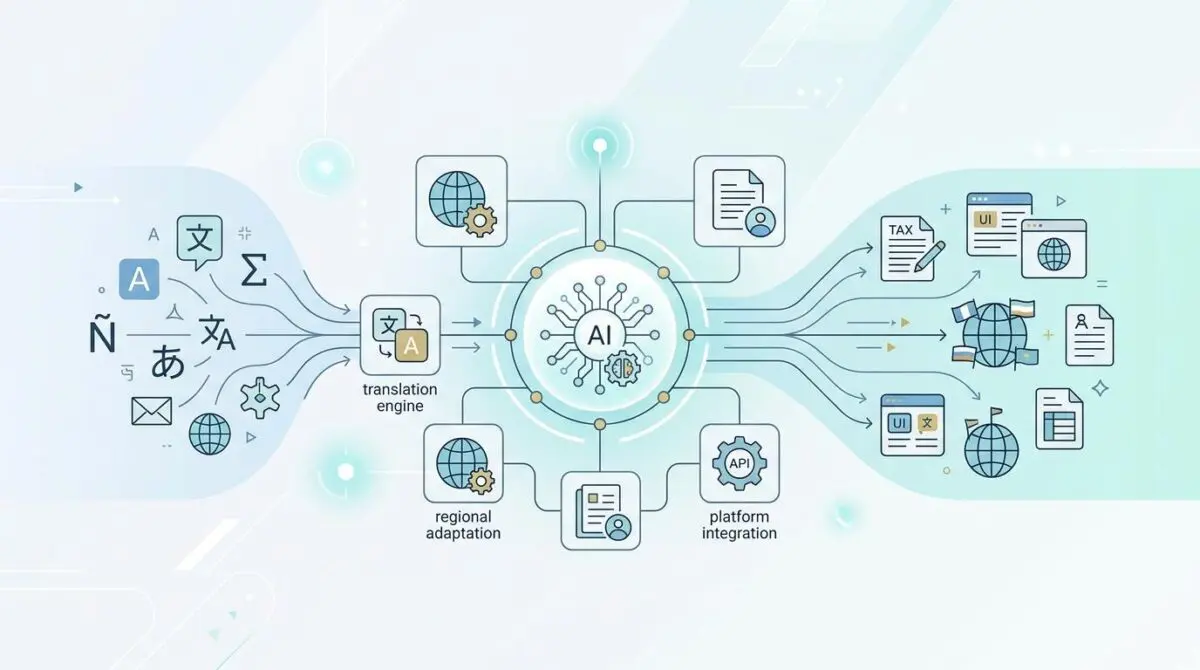
- Continuous Localization: AI embedded directly into development workflows translates UI and documentation in real-time, eliminating traditional translation bottlenecks.
- Agentic Compliance: Advanced AI agents autonomously research local laws to ensure translated marketing copy remains legally compliant across diverse global jurisdictions.
- Dynamic UI Adaptation: Next-generation platforms generate unique, real-time interfaces tailored to an individual user’s specific dialect, education level, and cultural context.
Table of Contents
The Core Friction of Global Expansion
According to a 2026 report by Gartner, enterprises that have fully integrated AI-powered localization into their digital supply chains have achieved an 85% reduction in time-to-market for international product launches compared to 2024 benchmarks. This staggering acceleration is completely redefining how modern corporations approach international expansion. Traditional barriers to entering foreign markets are now dissolving at an unprecedented rate.
For decades, scaling a business across borders meant navigating a painful bottleneck of manual translation and cultural misalignment. Companies were routinely forced to choose between the rapid deployment of low-quality machine translation and the agonizingly slow, expensive precision of human agencies. This created massive operational friction, stifling global growth for all but the most well-funded multinational conglomerates.
Today, AI-powered translation and localization platforms have entirely shattered this binary constraint. They represent a fundamental shift in how businesses communicate, turning language barriers from a formidable market friction into a seamless operational advantage. By leveraging deep learning and neural networks, these platforms are democratizing global reach for mid-market enterprises.
This is no longer a conversation about simple word replacement or basic syntax correction. The technology has evolved into a strategic business asset that drives revenue, enhances user retention, and secures brand loyalty in previously inaccessible territories. Executives who fail to recognize this shift risk permanent marginalization in a borderless digital economy.
Market Intelligence and Capital Flow
The financial ecosystem surrounding linguistic technology has rapidly evolved into a high-stakes arena for institutional investors. Smart money is aggressively targeting infrastructure that eliminates the traditional translation phase of the product lifecycle. Venture capitalists recognize that whoever controls the flow of localized information will dominate the next era of global commerce.
Market Intelligence & Data
Total Market Valuation
The global AI-driven language and localization market size is projected to reach this milestone by the end of 2026, according to data from Statista.
Enterprise Adoption Rate
According to CSA Research, 92% of Fortune 500 companies now prioritize AI-first localization workflows over traditional human-led agency models as of mid-2026.
Video Localization Growth
Demand for AI-powered real-time video dubbing and lip-syncing has increased fourfold since 2024, as reported in McKinsey & Company’s 2026 Tech Trends analysis.
VC Inflow
Data from PitchBook indicates that venture capital investment into ‘Context-Aware’ localization startups hit a record high in the first quarter of 2026.
This massive influx of capital highlights a broader realization among venture capitalists regarding the value of linguistic infrastructure. The total market valuation is projected to reach this milestone by the end of 2026, driven by the urgent need for context-aware systems. Investors are pouring billions into startups that can execute complex cultural adaptations at scale.
Enterprise adoption rates further solidify this technological shift as a permanent market reality. With 92% of Fortune 500 companies transitioning to AI-first localization workflows, the traditional human-led agency model is rapidly becoming obsolete. Corporations are demanding unprecedented speed and accuracy that only machine intelligence can deliver.
Furthermore, the explosive 400% growth in video localization demand signals a shift in how global consumers consume content. Text alone is no longer sufficient to capture international market share. Brands must now communicate through dynamic, localized multimedia experiences to maintain engagement and drive conversions.
The Strategic Deep Dive
Autonomous Cultural Adaptation
By mid-2026, the industry definitively shifted away from basic machine translation toward Autonomous Cultural Adaptation. Leading platforms utilize hyper-contextual large language models that do much more than swap vocabulary. They deeply analyze the intent, tone, and emotional resonance of the source material.
These advanced systems rewrite entire marketing narratives to perfectly align with local psychological profiles and cultural nuances. The current killer strategy among elite tech teams is Continuous Localization, a methodology that fundamentally alters the software development lifecycle. It removes the friction of waiting weeks for translated assets before a product launch.
This approach embeds artificial intelligence directly into design and development workflows like Figma and GitHub. Product interfaces and technical documentation are translated in real-time as developers write code, effectively erasing the translation phase from the product lifecycle entirely. The result is a seamless, agile deployment pipeline that scales globally without hesitation.
Solving the Global-Local Friction
Historically, global-local friction paralyzed mid-market companies attempting to expand overseas due to prohibitive translation costs. Current AI platforms solve this dilemma by deploying neural feedback loops that learn from a company’s previous edits in real-time. The system becomes smarter, more accurate, and more aligned with the brand’s unique voice with every interaction.
This continuous learning mechanism dramatically improves accuracy without requiring constant, expensive human oversight. Consequently, the cost of entry for new global markets has plummeted by approximately 90 percent. This financial shift is a massive disruptive force, leveling the playing field for emerging enterprises.
This unprecedented cost reduction allows ambitious mid-market companies to compete aggressively with multinational giants. Founders can now launch products in fifty countries simultaneously instead of relying on slow, phased regional rollouts. Linguistic agility has become the ultimate competitive moat in the modern business landscape.
Multimodal Orchestration and Video
The technological landscape is currently dominated by specialized localization operating systems like Smartling and Phrase. These operate alongside generative video disruptors like ElevenLabs and HeyGen. Venture capital firms, notably Andreessen Horowitz, have shifted their focus toward startups specializing in multimodal orchestration to create a unified ecosystem for all localized corporate communication.
These cutting-edge platforms can synchronize text, voice, and lip-synced video localization simultaneously across various media formats. Furthermore, investors are prioritizing brand-aware AI startups that guarantee a flawless match to a corporation’s unique voice across hundreds of languages without human intervention. This ensures absolute brand consistency regardless of the target geography.
A 2026 study by Forrester reveals that ‘Agentic Translation’ is now the fastest-growing feature set in the $22 billion language services market. This involves AI agents autonomously researching local laws to ensure translated marketing copy is legally compliant in the target jurisdiction. This convergence of legal compliance and linguistic adaptation represents the next frontier of enterprise risk mitigation.
The Executive Action Plan
To remain competitive in a borderless digital economy, executive leadership must adopt a proactive stance on linguistic infrastructure. The future belongs to organizations that treat localization as a dynamic, real-time user experience rather than an afterthought. Delaying the integration of these AI systems will result in severe market share erosion.
Strategic Trajectory
- Phase out fixed translations in favor of ‘Dynamic UI Localization’ that adapts to individual user sessions.
- Implement AI-driven terminology generation based on user-specific dialects, education levels, and cultural contexts.
- Architect infrastructure for ‘Zero-Latency Voice-to-Voice’ systems to support instantaneous global communication.
- Ensure native language audio outputs preserve the original speaker’s emotional inflection and nuanced tone.
- Transition toward real-time, context-aware interface transformation for personalized user experiences.
The next evolution in this space is Dynamic UI Localization, where digital interfaces no longer rely on static, fixed translations. Instead, the AI generates a unique interface and terminology set for each individual user based on their specific dialect, education level, and cultural context. This creates a hyper-personalized digital environment that maximizes user engagement and conversion rates.
Forward-thinking founders are already preparing their enterprise infrastructure for zero-latency voice-to-voice systems. These innovations will soon allow global teams to conduct live meetings where every participant hears their native language, complete with the speaker’s original emotional inflection and tone. The elimination of real-time language barriers will radically accelerate international deal flow and corporate collaboration.
Conclusion
The era of treating language as a barrier to entry is officially over. AI-powered localization has evolved into a core strategic pillar for any enterprise aiming for global market dominance. The friction that once protected legacy multinational corporations has been entirely erased by intelligent algorithms.
By embracing autonomous cultural adaptation and multimodal orchestration, businesses can scale their operations with unprecedented speed and cultural resonance. The technology is here, the infrastructure is robust, and the capital markets have clearly signaled their confidence in its transformative power. The only remaining variable is executive execution.
Navigating the intersection of technology, capital, and market psychology requires a sharp strategy. To future-proof your business architecture and scale with precision, connect with Andres at Andres SEO Expert.
Frequently Asked Questions
What are the primary benefits of AI-powered localization for global enterprises?
AI-powered localization significantly reduces time-to-market by up to 85% and lowers the cost of entering new international markets by approximately 90%. By replacing manual translation processes with autonomous workflows, enterprises can scale globally with greater speed and cultural precision.
How does Autonomous Cultural Adaptation differ from standard machine translation?
Standard machine translation focuses on word-for-word replacement, whereas Autonomous Cultural Adaptation uses hyper-contextual large language models to analyze intent, emotional resonance, and tone. This ensures marketing narratives are rewritten to align perfectly with local cultural nuances and psychological profiles.
What is Continuous Localization in modern software development?
Continuous Localization is a methodology that embeds AI directly into design and development platforms like GitHub and Figma. It enables real-time translation of interfaces and documentation as code is written, effectively removing the traditional translation bottleneck from the product lifecycle.
Why is video localization demand experiencing such rapid growth?
Video localization demand has grown 400% as global consumers increasingly prioritize multimedia engagement. AI-powered real-time dubbing and lip-syncing technologies now allow brands to create consistent, high-quality audio-visual experiences across hundreds of languages without human intervention.
What is Agentic Translation and how does it mitigate enterprise risk?
Agentic Translation involves AI agents autonomously researching local laws and regulations to ensure that translated marketing materials are legally compliant. This convergence of linguistic adaptation and legal research represents a critical new frontier for enterprise risk mitigation in international markets.
What is Dynamic UI Localization?
Dynamic UI Localization is an advanced approach where digital interfaces adapt in real-time to individual user sessions. Instead of static translations, AI generates unique terminology and interface elements tailored to a user’s specific dialect, education level, and cultural context to maximize engagement.