




Key Points
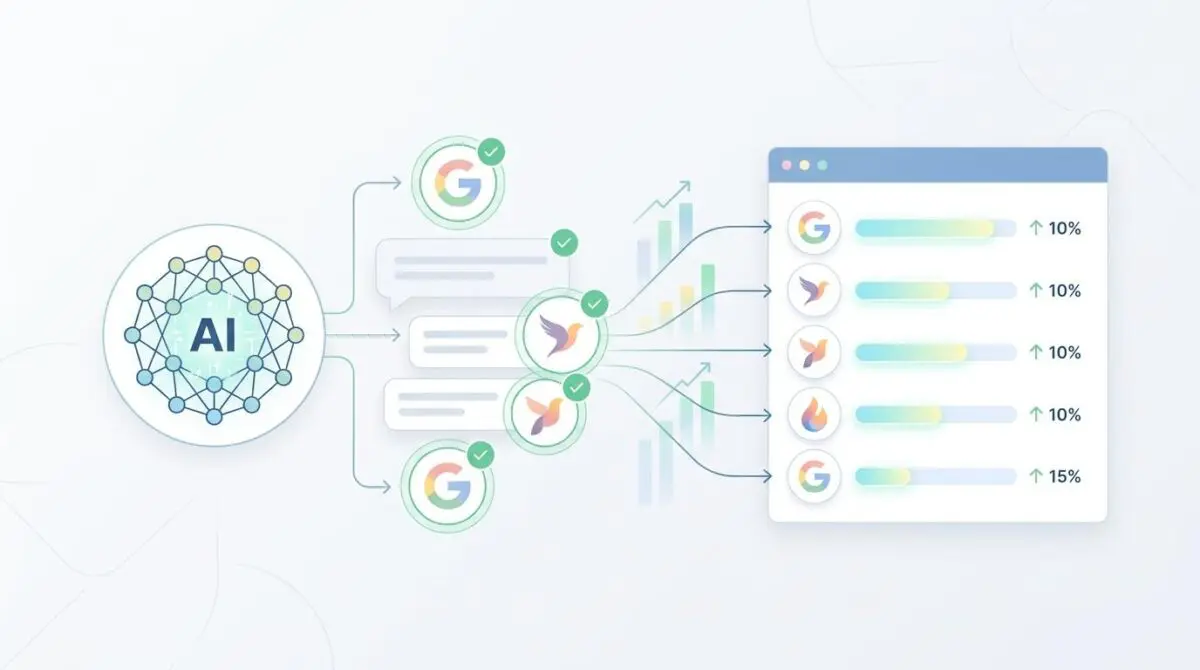
- Share of Model Focus: Transitioning from traditional keyword tracking to semantic cluster tracking and attribution auditing to measure inclusion probability.
- RAG Attribution Mapping: Identifying the specific vectorized data corpus the AI retrieval layer selects to ground its generative responses.
- Zero-Click Citation Density: Measuring AI answers that mention the brand without direct links to establish a higher tier of GEO authority.
Table of Contents
The AI Search Context
By May 2026, 72 percent of users trust AI-synthesized summaries more than traditional organic search results, shifting the primary goal of SEO from clicks to citation dominance. This data from the Statista 2026 Global AI Consumer Report underscores a massive paradigm shift in digital visibility. Operating without a strategy to measure your presence in these synthesized answers means operating in a data vacuum.
Your brand might rank high in traditional blue links but remain semantically invisible to the underlying models powering modern search. Tracking brand visibility in AI-generated answers is the process of measuring how often and in what context a brand is cited by Large Language Models and Retrieval-Augmented Generation systems.
This requires a fundamental pivot toward AI Visibility Attribution and Share of Model metrics. Share of Model calculates the probability of your brand being included in a synthesized response across engines like Google AI Overviews, Perplexity, and other generative interfaces.
In 2026, Share of Model is the definitive metric for digital authority because AI now mediates the vast majority of commercial intent. The impact of high AI visibility is profound and highly lucrative. Brands cited as primary sources in RAG outputs see a 3.5x higher conversion rate than those appearing only in traditional search engine result pages.
This shift necessitates a complete departure from archaic keyword tracking methodologies. Instead, technical SEOs must embrace semantic cluster tracking and attribution auditing. This involves mapping how models ingest, vectorize, and retrieve your content during the generation phase.
Failing to adapt to this architecture leaves your enterprise vulnerable to competitors who are actively optimizing their nodes within the semantic index.
Core Architecture and Pillars
Core Architecture & Pillars
RAG Attribution Mapping
This involves identifying which specific corpus of data—vectorized from your site or third-party platforms—the AI’s retrieval layer selects to ground its generative response. It requires analyzing the ‘Source Citations’ provided in AI Overviews to determine the weight of your site’s nodes in the model’s semantic index.
Sentiment and Latent Association
LLMs do not just cite brands; they associate them with specific adjectives and categories within their latent space. Tracking involves ‘probing’ models via API to measure the probability of your brand name appearing next to target industry keywords (e.g., ‘most reliable cloud provider’).
Zero-Click Citation Density
This metric tracks the ratio of AI answers that mention the brand without a direct link versus those with a citation. High-density citation without links indicates the model has internalized the brand as a ‘fact’ rather than a ‘source,’ which is a higher tier of GEO authority.
Competitive Semantic Gap Analysis
This strategy involves comparing the vector distance between your brand’s content and a competitor’s content in a model’s embedding space. If a competitor is consistently cited for a query where you are absent, a semantic gap exists in your content’s technical depth or structure.
RAG Attribution Mapping Dynamics
RAG Attribution Mapping is the cornerstone of understanding how models interact with your corpus. In WordPress environments, this is managed by ensuring that your XML sitemaps and API-delivered content are structured to be easily ingested by AI crawlers like GPTBot or Google-Other. You must avoid heavy JavaScript execution that obscures the raw text from vectorization processes.
The retrieval layer relies on clean, high-entropy text to calculate cosine similarity against user queries. When a user inputs a query, the RAG system searches its vector database for the most relevant informational nodes.
If your content is poorly structured, the retrieval layer will bypass it in favor of a competitor’s well-formatted documentation. Analyzing Source Citations in AI Overviews helps determine the exact weight of your site’s nodes within the model’s semantic index.
Sentiment and Latent Association Tracking
LLMs do not merely retrieve links; they synthesize concepts based on latent associations formed during their pre-training and fine-tuning phases. Tracking this involves probing models via API to measure the probability of your brand name appearing next to target industry keywords.
Plugin-driven SEO often focuses on meta tags, but for AI sentiment, the context within your About Us and Customer Reviews sections must be optimized for semantic consistency. In early 2026, OpenAI launched Brand Insights for SearchGPT, a dedicated portal allowing verified companies to see direct attribution metrics and real-time retrieval frequency within the SearchGPT ecosystem.
Utilizing these advanced attribution features allows SEO architects to monitor latent associations directly. This prevents hallucinated negative associations from taking root in the model’s weights.
Zero-Click Citation Density Measurement
Zero-Click Citation Density measures the ratio of AI answers that mention your brand without a direct link versus those with a hyperlinked citation. High-density citation without links indicates the model has internalized your brand as a foundational fact rather than a mere source.
This represents the highest tier of Generative Engine Optimization authority. By utilizing the RankMath or Yoast Schema API, brands can inject structured data that defines sameAs relationships.
This helps models consolidate various brand mentions across the web into a single high-authority entity. When the model recognizes your brand as an entity rather than just a string of text, your zero-click citation density increases dramatically.
Competitive Semantic Gap Analysis
Competitive Semantic Gap Analysis compares the vector distance between your brand’s content and a competitor’s content within a model’s embedding space. If a competitor is consistently cited for a query where you are absent, a measurable semantic gap exists in your content’s technical depth.
This requires immediate remediation through content restructuring. Using specialized WordPress blocks to create Technical Specification tables ensures that structured, high-entropy data is available for models to extract.
This closes the gap against competitors who rely on fluff-heavy blog posts. Models prefer dense, factual data formatted in tables or lists because it reduces the computational load required during the retrieval phase.
The Execution Roadmap
Implementation Roadmap
Integrate AI-Specific Schema
Add specialized JSON-LD schema to your WordPress header.php or via a custom function that uses ‘mentions’ and ‘about’ properties to explicitly link your brand to core industry entities.
Set Up an LLM Probing Script
Deploy a Python script using OpenAI’s GPT-5 API or Anthropic’s Claude 4 API to run periodic prompts (e.g., ‘What are the top 5 brands for X?’) and log the frequency and sentiment of your brand’s appearance.
Audit GSC AI Overview Data
Access the ‘AI Overviews’ tab in Google Search Console (available in the 2026 dashboard) to identify which URLs are being used as ‘Source Cards’ and cross-reference this with your high-conversion pages.
Optimize for Retrieval Density
Refactor top-performing content into ‘Atomic Insights’—short, factual, and data-rich paragraphs—that are easily ‘chunked’ by RAG systems, ensuring your content is the preferred grounding source.
Integrating AI-Specific Schema
The first step in dominating AI visibility is integrating specialized JSON-LD schema directly into your WordPress architecture. This goes beyond standard Article or Organization schema. You must utilize the mentions and about properties to explicitly link your brand to core industry entities recognized by the Knowledge Graph.
This structured data acts as a direct map for AI crawlers. It explicitly defines the relationship between your brand entity and the broader semantic concepts you wish to rank for.
Implementing this via a custom function ensures that the schema is injected cleanly without plugin bloat interfering with the payload delivery.
Setting Up an LLM Probing Script
To measure Share of Model accurately, you must deploy custom Python scripts utilizing modern LLM APIs. By connecting to the OpenAI or Anthropic API endpoints, you can automate the process of querying the models with high-value industry prompts.
This script should log the frequency, position, and sentiment of your brand’s appearance in the generated responses. This probing mechanism provides raw, unfiltered data on how the model perceives your brand in its current state.
By running these scripts periodically, you can track the impact of your GEO campaigns over time. It transforms qualitative brand perception into a quantifiable, trackable metric.
Auditing GSC AI Overview Data
Google Search Console provides critical insights through its dedicated AI Overviews tab. This dashboard allows technical SEOs to identify exactly which URLs are being selected as Source Cards by Google’s generative engine.
You must cross-reference these URLs with your high-conversion pages to ensure alignment between visibility and revenue generation. If informational pages are being cited but commercial pages are ignored, you must adjust your internal linking architecture.
Passing semantic PageRank from your highly cited informational nodes to your commercial nodes helps the model understand the relationship between the two. This increases the probability of commercial pages being retrieved for bottom-of-funnel queries.
Optimizing for Retrieval Density
RAG systems process information in chunks. If your content consists of massive, unbroken walls of text, the retrieval system will struggle to extract the specific facts needed to ground its response.
You must refactor top-performing content into Atomic Insights. Atomic Insights are short, factual, and data-rich paragraphs designed specifically for machine consumption.
They should be highly concise and devoid of marketing fluff. By structuring your content this way, you ensure that your pages become the preferred grounding source for AI engines seeking precise, verifiable data points.
Technical Implementation
Implementing Brand Entity Schema
To explicitly define your brand entity and its relationship to Generative Engine Optimization, you must deploy advanced JSON-LD schema. This code should be injected into the head of your document.
It leverages the mainEntity, sameAs, and mentions properties to build a robust semantic profile for AI crawlers to ingest.
{"@context": "https://schema.org", "@type": "WebPage", "mainEntity": {"@type": "Brand", "name": "YourBrandName", "sameAs": ["https://twitter.com/brand", "https://linkedin.com/company/brand"], "description": "Industry leading provider of AI-integrated logistics solutions."}, "mentions": [{"@type": "Thing", "name": "Generative Engine Optimization"}]}This payload ensures that whenever an AI crawler accesses your page, it immediately understands the exact nature of your business entity. The sameAs array is critical for entity consolidation, preventing the model from fragmenting your brand authority across different social profiles or web properties.
Validation and Future-Proofing
Validation & Monitoring
- Monitor Synthetic Share of Voice (SSoV) using tools like BrightEdge Generative Parser or SEOClarity’s AI-SIGHT.
- Execute ‘Temperature Tests’ by setting model temperature to 0.0 to verify if the brand remains the primary citation across iterations.
- Audit the persistence of brand nodes within the LLM’s latent association maps for target industry keywords.
- Cross-reference high-conversion pages against ‘Source Cards’ in the Google Search Console AI Overview dashboard.
Validation in the GEO era requires continuous monitoring of your Synthetic Share of Voice. Utilizing platforms like the BrightEdge Generative Parser allows enterprise teams to detect patterns in new AI search experiences at scale.
This telemetry is vital for understanding whether your optimization efforts are actually altering the model’s retrieval behavior. Executing Temperature Tests is another crucial validation technique.
By setting the model API temperature to absolute zero, you force the LLM to output its most statistically probable response without creative variance. If your brand remains the primary citation under these strict deterministic conditions, you have successfully secured foundational authority within the model’s architecture.
Continuous auditing of brand node persistence ensures that your visibility does not degrade as models are updated or retrained. As the vector space evolves, your content must evolve with it.
Monitoring Source Cards in GSC provides the final layer of validation, connecting theoretical model dominance to actual organic traffic acquisition.
Navigating the intersection of traditional SEO and Generative Engine Optimization requires a precise architecture. To future-proof your enterprise stack for AI Overviews and LLM discovery, connect with Andres at Andres SEO Expert.
Frequently Asked Questions
What is Share of Model in the context of AI search?
Share of Model is a metric that calculates the probability of a brand being included in synthesized AI responses across engines like Google AI Overviews and Perplexity. By 2026, it has become the definitive measure of digital authority, replacing traditional organic rankings as AI mediates the majority of commercial intent.
How does RAG Attribution Mapping work?
RAG (Retrieval-Augmented Generation) Attribution Mapping involves identifying which specific data nodes the AI’s retrieval layer selects to ground its response. This process requires analyzing source citations to determine the weight of a site’s content within the model’s semantic index and ensuring content is formatted for easy vectorization.
What is Zero-Click Citation Density?
Zero-Click Citation Density tracks the frequency at which an AI model mentions a brand as a fact without providing a direct link. A high density suggests the model has internalized the brand as a core entity within its latent space, representing a high tier of Generative Engine Optimization (GEO) authority.
How can I optimize content for AI retrieval density?
To optimize for retrieval density, content should be refactored into ‘Atomic Insights’—short, factual, and data-rich paragraphs. This structure allows RAG systems to easily ‘chunk’ and ingest the data, making it the preferred grounding source over long-form, fluff-heavy content.
What tools are used to measure brand visibility in AI-generated answers?
Visibility is measured using the AI Overviews dashboard in Google Search Console, custom LLM probing scripts via APIs like GPT-5 or Claude 4, and specialized platforms such as the BrightEdge Generative Parser or SEOClarity’s AI-SIGHT to monitor Synthetic Share of Voice.
What is a Competitive Semantic Gap Analysis?
Competitive Semantic Gap Analysis compares the vector distance between your brand’s content and competitors in a model’s embedding space. It identifies missing technical depth or structural weaknesses in your content that cause AI models to favor a competitor’s data for specific user queries.