Key Points
- Agentic Finance Automation: The transition from monolithic banking to modular microservices enables autonomous treasury management driven by specialized financial AI models.
- Eradicating the Latency Tax: Composable APIs and stablecoin settlement layers bypass legacy batch-processing to unlock instant liquidity for generalist enterprises.
- Verticalized B2B Ecosystems: Tech giants are embedding high-margin lending and insurance modules directly into core operating systems to capture unprecedented transaction value.
Table of Contents
The Financial Tech Friction
According to Bain & Company, global embedded finance transaction value is projected to exceed $7 trillion by the end of 2026. This represents over 10% of the total value of all financial transactions worldwide. This staggering metric underscores a fundamental shift in how non-financial entities interact with capital.
We are witnessing the death of traditional banking silos and the rapid ascent of borderless liquidity networks. At the core of this revolution is Composable FinTech Infrastructure. This is not merely a theoretical software concept, but a profound technological disruption.
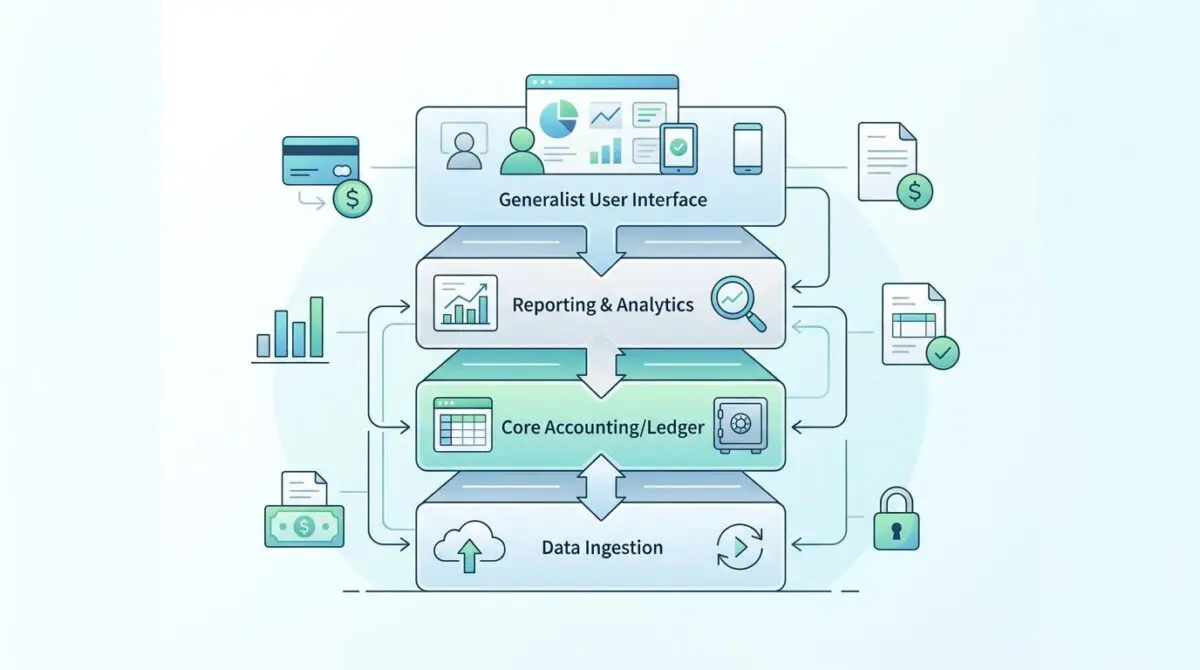
It allows generalist businesses to operate as decentralized financial nodes. By leveraging modular building blocks, enterprises can snap together complex financial services without the burden of building them from scratch.
The ultimate fintech stack for a generalist is no longer about patching together disparate software tools. It is about deploying a unified, interoperable ecosystem that turns everyday business operations into high-margin revenue engines. This infrastructure transforms passive treasury into an active, programmable asset.
Market Intelligence and Capital Flow
Market Intelligence & Data
Real-Time Payment Scale
Research and Markets estimates the global real-time payments market will reach $65.82 billion in 2026, expanding at a massive 35.4% CAGR.
Tokenized Asset Potential
Boston Consulting Group (BCG) projects that the tokenized real-world asset market will hit $16 trillion by 2030, with 2026 acting as the structural tipping point for institutional adoption.
AI-Led Model Reinvention
IDC predicts that by 2026, 40% of A1000 CEOs will focus their AI ROI on revenue growth and reinventing business models rather than mere headcount reduction.
Embedded Banking Share
Future Market Insights reports that embedded banking will command a 47.3% share of the total embedded finance market in 2026, driven by the rapid platformization of B2B commerce.
The data presented above paints a clear picture of where smart money is aggressively positioning itself. As platformization accelerates, embedded finance volumes are projected to exceed $7 trillion by the end of 2026. This growth is fundamentally rewiring B2B commerce.
This massive influx of capital is moving away from legacy institutions. It is flowing directly into the hands of agile, tech-forward generalists. Simultaneously, the race to digitize illiquid assets is gaining unprecedented momentum.
Boston Consulting Group predicts that the tokenized real-world asset market will hit $16 trillion by 2030. This will create massive structural shifts in institutional portfolios. Generalist platforms that integrate these tokenization layers will capture immense value by offering fractionalized ownership and instant liquidity.
The FinTech Deep Dive
Modular Agentic Finance Architectures
The modern fintech stack has fully transitioned from monolithic banking-as-a-service to modular Agentic Finance architectures. Cutting-edge tech stacks now leverage Golang-driven microservices to ensure maximum throughput and minimal downtime. This allows generalist platforms to handle institutional-grade transaction volumes with consumer-grade simplicity.
Furthermore, the integration of specialized financial language models is enabling fully autonomous treasury management. These models can analyze cash flow patterns, predict liquidity crunches, and execute complex hedging strategies in real time. The result is a financial nervous system that anticipates market movements before they happen.
Eliminating the Latency Tax
Traditional batch-processing and delayed settlement cycles impose a severe latency tax on global commerce. Composable FinTech Infrastructure eliminates this friction by providing a stack of APIs designed for instant liquidity and cross-border agility. Tech strategies now prioritize sub-second payment processing via modern standards to ensure seamless global interoperability.
Stablecoin-based settlement layers are also bypassing legacy cross-border friction entirely. This solves the siloed capital problem, where enterprise treasury is often trapped in fragmented regional accounts. By democratizing these institutional-grade tools, businesses can now mitigate inflationary risk through automated asset tokenization.
Verticalized Infrastructure and AI Factories
Market dominance is rapidly shifting toward verticalized infrastructure players and emerging ledger-as-a-service providers. Tech giants and vertical SaaS platforms are the primary disruptors in this space. They capture immense value by embedding high-margin lending and insurance modules directly into their core B2B operating systems.
To power this disruption, smart money is flowing heavily into specialized AI factories. These are private, compliance-heavy data centers designed specifically for agentic commerce and high-frequency financial modeling. Global spending on AI agent software is surging as the financial sector moves toward multi-step autonomous workflows.
While the evolution of these autonomous systems demands robust governance, the industry is solving this through programmable compliance. This approach embeds real-time regulatory auditing directly into every transaction layer. It ensures strict adherence to global standards without sacrificing execution speed or increasing manual overhead.
The Strategic Action Plan
Strategic Trajectory
- Orchestrate the rise of Fully Autonomous Business Units utilizing AI agents to negotiate, authorize, and settle B2B supply chain contracts without manual intervention.
- Prioritize the integration of Programmable Compliance to embed real-time regulatory auditing directly into every transaction layer.
- Transition strategically from simple embedded payments toward comprehensive Embedded Ecosystems.
- Operationalize tokenized receivables and instant credit-scoring capabilities at the point of sale to optimize B2B liquidity.
The next few years will dictate the winners and losers of the decentralized economy. Founders and CEOs must move beyond basic payment gateways and embrace the rise of fully autonomous business units. This means deploying AI agents that can negotiate, authorize, and settle B2B supply chain contracts entirely without human intervention.
The logical evolution for enterprise architecture is the transition from embedded payments to embedded ecosystems. By operationalizing tokenized receivables and instant credit-scoring at the point of sale, generalist platforms can optimize B2B liquidity on a global scale. Executing this trajectory requires a ruthless commitment to composability and technological agility.
Conclusion
Composable FinTech Infrastructure is not just an operational upgrade. It is a fundamental reimagining of how enterprise value is created, stored, and transferred. Generalist businesses that adopt this modular stack will no longer be at the mercy of legacy banking bottlenecks.
They will become sovereign financial ecosystems capable of generating compounding transaction revenue.
Navigating the intersection of financial technology, institutional capital, and market psychology requires a sharp strategy. To future-proof your FinTech architecture and scale with precision, connect with Andres at Andres SEO Expert.
Frequently Asked Questions
What is Composable FinTech Infrastructure?
Composable FinTech Infrastructure is a modular architectural approach that allows non-financial businesses to integrate complex financial services—such as lending, payments, and insurance—using interoperable software “building blocks.” This enables enterprises to function as decentralized financial nodes without the burden of building legacy systems from scratch.
What is the projected market size for embedded finance by 2026?
Global embedded finance transaction value is projected to exceed $7 trillion by the end of 2026, representing over 10% of all financial transactions worldwide. This growth is driven by the rapid platformization of B2B commerce and the integration of financial services into non-financial software ecosystems.
How do AI agents and Fin-LLMs optimize corporate treasury management?
Fin-LLMs and Agentic Finance architectures enable autonomous treasury management by analyzing cash flow patterns and predicting liquidity crunches in real-time. These AI agents can execute multi-step workflows, such as negotiating and settling B2B supply chain contracts, without human intervention.
What is the role of tokenization in real-world assets (RWA)?
Tokenization involves digitizing illiquid assets to enable fractionalized ownership and instant liquidity. The tokenized real-world asset market is projected to reach $16 trillion by 2030, allowing generalist platforms to offer automated investment and hedging strategies based on tangible assets.
What is Programmable Compliance in fintech?
Programmable Compliance is an approach that embeds real-time regulatory auditing directly into every transaction layer. This ensures that financial operations automatically adhere to global standards like ISO 20022, reducing manual overhead while maintaining sub-second execution speeds.
How does modular architecture eliminate the “latency tax”?
By moving away from traditional T+2 settlement cycles and batch-processing, modular microservices use specialized APIs and stablecoin-based settlement layers to achieve instant liquidity. This eliminates the latency tax imposed by legacy banking silos and enables seamless cross-border agility.