Executive Summary
- Multimodal AI facilitates the simultaneous processing of disparate data formats, including text, imagery, and audio, within a shared neural framework.
- This technology enhances Generative Engine Optimization (GEO) by allowing AI models to verify information across multiple media types, increasing source credibility.
- Implementation requires precise alignment between visual assets and textual descriptions to ensure high-fidelity indexing by multimodal LLMs.
What is Multimodal AI?
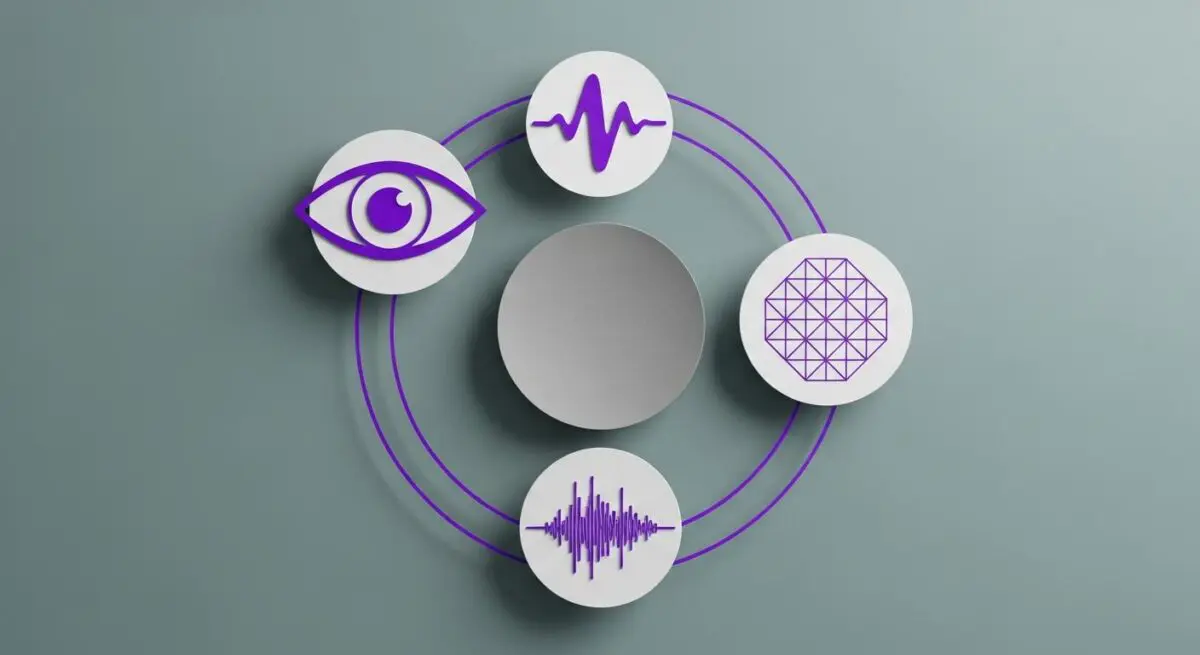
Multimodal AI refers to a class of machine learning models designed to process, understand, and generate information across multiple “modalities” or types of data, such as text, images, audio, and video. Unlike traditional unimodal systems—which are restricted to a single input type like Natural Language Processing (NLP) for text—multimodal architectures utilize joint embeddings to map different data types into a unified latent space. This allows the model to recognize that a textual description of an object and a photograph of that same object represent the same underlying entity.
At its core, Multimodal AI leverages advanced neural network architectures, such as Transformers with cross-attention mechanisms, to synthesize information from various sources. By training on massive datasets containing paired media (e.g., images with captions or videos with transcripts), these models develop a sophisticated level of contextual awareness. This enables them to perform complex tasks like visual question answering (VQA), image-to-text generation, and audio-driven sentiment analysis with high precision.
The Real-World Analogy
Imagine a world-class diagnostic physician. If this doctor only read a patient’s written medical history (text), they would have a limited understanding of the situation. To provide a truly accurate diagnosis, the doctor must also examine X-rays and MRIs (images), listen to the patient’s heart and lungs (audio), and observe the patient’s physical movements and skin tone (video). Multimodal AI acts as this comprehensive expert, synthesizing diverse sensory inputs to form a complete, high-fidelity understanding of a subject that no single data type could provide alone.
Why is Multimodal AI Important for GEO and LLMs?
In the era of Generative Engine Optimization (GEO), Multimodal AI is a critical factor in how AI search engines like Perplexity, Gemini, and SearchGPT determine Entity Authority and Source Attribution. These engines no longer rely solely on keyword density; they evaluate the consistency of information across different formats. If a brand provides a technical guide in text but accompanies it with a contradictory or low-quality image, the multimodal model may perceive a lack of topical depth, negatively impacting the content’s visibility.
Furthermore, multimodal capabilities allow AI agents to “see” and “hear” the web. This means that visual assets, such as infographics and video demonstrations, are now directly indexable and contribute to the overall relevance score of a page. Content that successfully aligns text with high-quality visual and auditory data is more likely to be cited as a primary source in generative AI responses, as the model can cross-reference the data points to ensure factual accuracy.
Best Practices & Implementation
- Semantic Visual Alignment: Ensure all images and videos are contextually relevant to the surrounding text. Use descriptive, keyword-rich alt-text and captions that provide technical detail rather than generic descriptions.
- Structured Data for Media: Implement advanced Schema.org markup (e.g., ImageObject, VideoObject) to provide explicit metadata to AI crawlers, facilitating easier mapping within the model’s latent space.
- High-Fidelity Transcriptions: Provide full, timestamped transcripts for all audio and video content. This allows multimodal LLMs to parse the spoken information and correlate it with visual cues and on-page text.
- Consistent Entity Representation: Maintain visual consistency for brand entities and products across all media types to help AI models build a stronger knowledge graph association for your brand.
Common Mistakes to Avoid
One frequent error is the use of generic stock photography that bears no semantic relationship to the technical content, which can dilute the contextual relevance of the page. Another mistake is neglecting the metadata of non-textual assets, assuming that AI can perfectly interpret raw pixels without assistance. Finally, many organizations fail to optimize video content for “searchable moments,” missing the opportunity to be featured in multimodal AI snippets that prioritize specific segments of a video.
Conclusion
Multimodal AI is transforming the search landscape from text-based retrieval to holistic contextual understanding. For SEO and GEO professionals, mastering the integration of diverse data types is essential for maintaining authority in an AI-driven ecosystem.