Key Points
- Sovereign AI Adoption: Enterprises are shifting to specialized Neoclouds and VPC-contained clusters to index sensitive IP without exposing proprietary data to public hyperscalers.
- The Permission Paradox: Implementing ACL-Aware Retrieval ensures AI models dynamically filter outputs based on user credentials, securing confidential data in real-time.
- Agentlake Architecture: Leading organizations are deploying centralized governance layers to orchestrate thousands of autonomous agents, ensuring strict auditability and data provenance.
Table of Contents
The Core Friction of Enterprise Knowledge
According to the 2026 IDC FutureScape report, 70% of Global 2000 CEOs have pivoted their AI investment strategies toward measurable growth ROI. They are now prioritizing secure internal knowledge retrieval over experimental, public-facing chatbots.
This massive pivot exposes a fundamental market friction that has plagued corporations for decades. The modern enterprise is drowning in fractured, unstructured data.
Critical intellectual property is routinely scattered across isolated Slack threads, encrypted PDFs, and legacy ERP databases. This fragmentation creates a massive cognitive load on the workforce.
Enter Secure Enterprise Generative Search (RAG 2.0). This is not merely an upgraded search bar, but a fundamental reimagining of how corporate intelligence is indexed, synthesized, and deployed.
For years, companies relied on simple keyword matching algorithms. These archaic systems left employees to dig blindly through endless, disconnected document silos.
Today, the executive mandate is crystal clear. Leaders must build intelligent, autonomous systems that act as a connective tissue for all proprietary data.
Crucially, this must be achieved without exposing highly sensitive corporate intelligence to the public cloud. The era of reckless data sharing is officially over.
Market Intelligence & Smart Capital
Market Intelligence & Data
Global Market Valuation
The global AI search engine market size is predicted to reach this value by end-of-year 2026, according to Precedence Research.
Workforce Augmentation
Data from Gartner reveals that 40% of all G2000 job roles now involve daily interaction with AI agents for internal information retrieval.
Infrastructure Investment
Hyperscaler capital expenditure for AI infrastructure is expected to reach this level in 2026, as reported by Goldman Sachs Research.
Immediate EBITDA Lift
Only 15% of AI decision-makers report an immediate EBITDA increase, forcing a 2026 shift toward ‘Hard Hat’ practical AI search tools over flashy pilots, per Forrester.
The Rise of Neoclouds
The market data reveals a stark reality about where smart capital is aggressively flowing. General-purpose LLM providers are rapidly losing enterprise mindshare.
Instead, funding is accelerating toward specialized Agentic Orchestrators and security-first search startups. Companies like Glean, Hebbia, and Vectara are capturing the high-margin enterprise sector.
While hyperscaler capex is projected to hit $527 billion in 2026, the most disruptive growth lies elsewhere. The real financial velocity is found in the emergence of Neoclouds.
These specialized GPU providers offer sovereign AI environments tailored for strict corporate governance. They completely bypass traditional hyperscaler data-residency risks.
This sovereign architecture is particularly vital for high-compliance sectors like defense, healthcare, and investment banking. For these industries, leaking intellectual property to a shared model is an existential threat.
Furthermore, the enterprise rush toward practical, ROI-driven deployments is accelerating at breakneck speed. Only 15% of AI decision-makers report an immediate EBITDA increase from early, experimental generative AI chatbots.
This widespread financial friction is forcing a definitive, industry-wide shift. Leaders are abandoning flashy, public-facing pilots in favor of practical AI search tools that immediately boost operational efficiency.
The Strategic Deep Dive
Solving the Permission Paradox
Building a secure enterprise search engine requires navigating complex organizational psychology and strict access hierarchies. The single biggest roadblock to enterprise-wide AI adoption is the Permission Paradox.
This paradox represents the terrifying risk of an artificial intelligence inadvertently bypassing corporate firewalls. An unconstrained model could easily expose confidential salary data or unannounced M&A plans to unauthorized junior employees.
If an internal search system is too open, it immediately becomes a massive legal liability. If it is too restricted, it fails to deliver any meaningful business value.
To mitigate this critical vulnerability, modern search systems deeply integrate ACL-Aware Retrieval mechanisms. This technology ensures the AI’s latent memory is dynamically filtered in real-time.
Every single query is cross-referenced against individual user credentials before an answer is generated. The system only synthesizes data that the specific employee is explicitly authorized to view.
By respecting existing access control lists, the system safely unlocks massive, organization-wide productivity gains. It completely solves the massive productivity drain where the average employee loses hours daily simply searching for verified internal information.
Architecting Agentlakes for Provenance
As these secure search systems scale globally, the underlying data architecture must radically evolve. Simple vector databases are no longer sufficient for complex enterprise demands.
The current killer strategy involves deploying Vector-Graph hybrid indexing. This advanced methodology creates a multidimensional, semantic map of all organizational knowledge.
This semantic map allows sophisticated AI agents to synthesize nuanced answers from disparate, siloed sources simultaneously. However, orchestrating these autonomous agents requires an entirely new level of corporate governance.
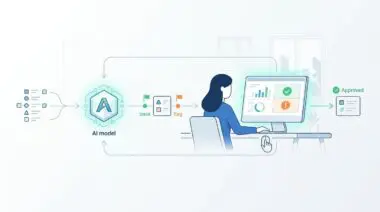
Leading enterprises are now building Agentlakes to manage this complexity. These centralized governance and orchestration layers manage thousands of autonomous agents searching across fractured document silos to ensure consistent auditability and data provenance.
These Agentlakes act as the secure, central nervous system of the modern enterprise. They provide a transparent, immutable ledger for every automated action taken by the AI.
They ensure that every piece of synthesized knowledge can be instantly traced back to its original, verified source document. This strict provenance is absolutely critical for high-stakes executive decision-making.
When a CEO asks the system for a quarterly risk assessment, the AI must provide a verifiable audit trail. Hallucinated summaries are unacceptable in environments where regulatory compliance is mandatory.
The Executive Action Plan
Strategic Trajectory
- Pivot from Reactive Search mechanisms to Proactive Knowledge Synthesis.
- Transform search infrastructure into an Autonomous Chief of Staff by 2027.
- Enable live workflow monitoring to trigger automated data retrieval.
- Deploy historical context and compliance warnings before employee queries occur.
- Eliminate manual document discovery to streamline enterprise productivity.
The next logical evolution in enterprise intelligence is the definitive shift from Reactive Search to Proactive Knowledge Synthesis. Visionary leaders must stop building passive systems that wait idly for a user prompt.
By 2027, your internal search engine must function as an Autonomous Chief of Staff. It should actively monitor live employee workflows and anticipate their informational needs in real-time.
This proactive system will seamlessly push relevant historical context directly into the employee’s digital workspace. Imagine a system that delivers vital compliance warnings before a contract is even drafted.
This aggressive, proactive stance effectively eliminates the need for manual document discovery entirely. It transforms the workforce from data gatherers into high-level strategic executors.
To execute this ambitious roadmap, founders must invest heavily in Sovereign AI architectures today. Private, on-premise, or VPC-contained computing clusters are absolutely non-negotiable for protecting sensitive corporate IP.
Conclusion: The Sovereign Future
The era of fragmented, inefficient internal search is rapidly coming to a close. The enterprises that will dominate the next decade are those that successfully map their internal knowledge graphs right now.
Secure Enterprise Generative Search is no longer just an IT upgrade. It is the ultimate competitive moat for the modern, data-driven corporation.
By solving the permission paradox and embracing Agentic orchestration, companies can transform raw, unstructured data into a decisive strategic advantage. The future belongs to the sovereign mind.
Navigating the intersection of technology, capital, and market psychology requires a sharp strategy. To future-proof your business architecture and scale with precision, connect with Andres at Andres SEO Expert.
Frequently Asked Questions
What is Secure Enterprise Generative Search (RAG 2.0)?
Secure Enterprise Generative Search, or RAG 2.0, is a fundamental reimagining of corporate intelligence indexing. Unlike legacy keyword search, RAG 2.0 acts as a connective tissue for fractured, unstructured data, allowing for secure, synthesized retrieval of proprietary information without exposing data to the public cloud.
How does the Permission Paradox impact AI adoption in the enterprise?
The Permission Paradox refers to the risk of AI models bypassing corporate firewalls to expose confidential data, such as salary info or M&A plans, to unauthorized employees. To solve this, 2026 systems use ACL-Aware Retrieval to filter the AI’s memory in real-time based on specific user credentials.
What are Neoclouds and why are they vital for sovereign AI?
Neoclouds are specialized GPU providers that offer sovereign AI environments tailored for strict corporate governance. They bypass traditional hyperscaler data-residency risks, making them essential for high-compliance sectors like defense, healthcare, and investment banking where protecting IP is an existential priority.
What is the purpose of an Agentlake in data architecture?
An Agentlake serves as a centralized governance and orchestration layer for thousands of autonomous agents. It provides a transparent, immutable ledger for every AI action, ensuring strict data provenance so that any synthesized answer can be traced back to its original, verified source document.
How does Proactive Knowledge Synthesis differ from traditional search?
While traditional search is reactive and waits for a user prompt, Proactive Knowledge Synthesis monitors live workflows to anticipate informational needs. By 2027, these systems will act as an Autonomous Chief of Staff, delivering historical context and compliance warnings before an employee even initiates a query.
Why is there a shift toward ‘Hard Hat’ practical AI tools in 2026?
Because only 15% of AI decision-makers reported an immediate EBITDA lift from experimental pilots, leaders are shifting investment toward ‘Hard Hat’ practical AI search tools. These tools focus on measurable growth ROI and operational efficiency rather than flashy, experimental chatbots.