Key Points
- Massive Model Distillation: Open-source SLMs drastically reduce inference costs by matching the reasoning power of monolithic proprietary models without the associated token taxes.
- Agentic Automation: Dynamic APIs allow multi-agent systems to pull task-specific models on demand, eliminating the high failure rates of static AI prompts.
- Serverless GPU Scaling: Advanced inference endpoints automatically manage compute clusters, removing the operational overhead of Kubernetes and GPU scarcity.
Table of Contents
Bridging The Deployment Chasm
Imagine trying to fit a massive jet engine into a standard commuter sedan. That is exactly what most companies experience when forcing high-performance AI models into unpredictable enterprise production environments.
We call this the Deployment Gap. It represents the extreme architectural friction between building a brilliant model in a vacuum and running it seamlessly across multi-cloud and edge environments.
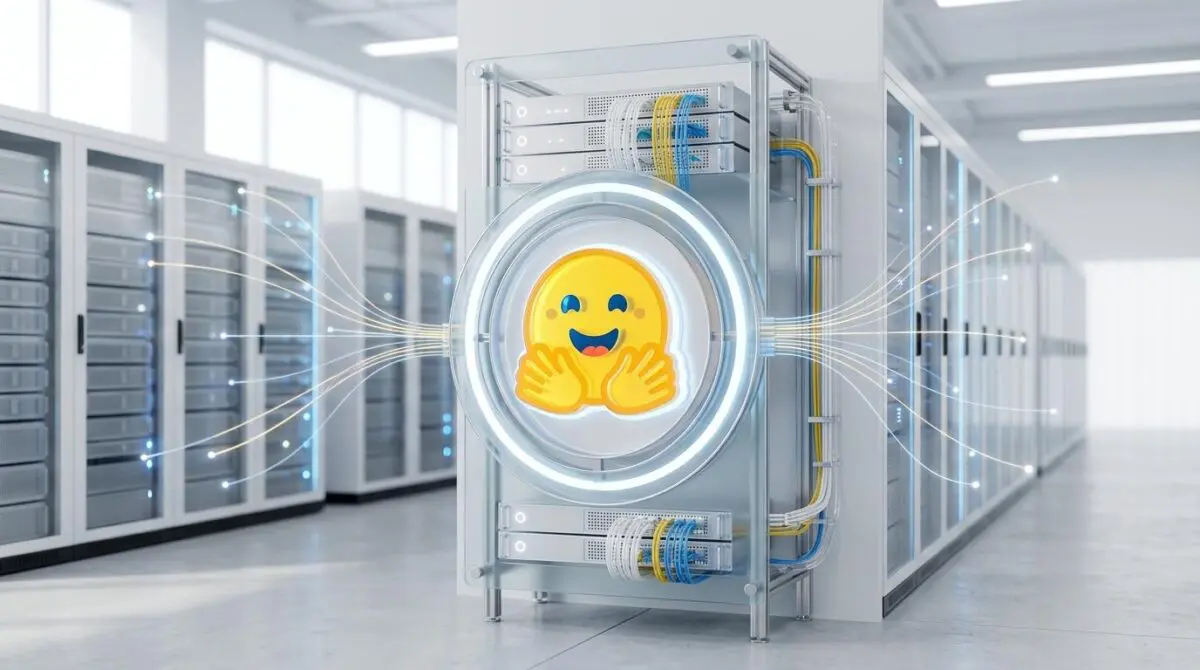
The Hugging Face Hub Community Ecosystem has emerged as the ultimate architectural solution to this bottleneck. It acts as the universal adapter for modern AI, bridging the divide between experimental training and scalable enterprise reality.
By unifying models, datasets, and execution environments, it removes the heavy lifting from corporate engineering teams. Instead of spending months configuring custom deployment pipelines, developers can leverage a unified repository that standardizes the machine learning lifecycle.
This paradigm shift democratizes access to state-of-the-art artificial intelligence. It allows even mid-sized enterprises to compete directly with massive tech conglomerates.
Quantifying The Open-Source Advantage

The sheer scale of collaborative AI assets is fundamentally shifting how enterprises deploy machine learning. As of Q2 2026, the Hugging Face Hub hosts over 2.5 million public model repositories, representing a massive increase since early 2024.
This repository growth directly fuels innovations like the release of the ‘SmolAgents’ framework, which relies on a diverse ecosystem of tools to function autonomously. Access to millions of models allows these agentic frameworks to pull exactly what they need on demand.
Standardized distillation pipelines on the Hub now allow 7B-parameter models to retain 85 percent of the reasoning benchmarks of massive 70B-parameter models. This compression efficiency drastically reduces enterprise inference costs while maintaining high precision.
It also paves the way for advanced local execution. Tools like Transformers.js v4 now utilizes WebGPU to run these highly compressed models directly in the browser with near-native speeds.
The financial impact of this compression means companies can scale their AI features to millions of users without bankrupting their cloud budgets. The collaborative nature of the platform ensures that these efficiency gains are shared globally.
When a breakthrough in model quantization occurs, it ripples through the entire ecosystem instantly. This compounding innovation curve means that enterprise deployments become cheaper and faster with each passing quarter.
The Distillation Revolution

The ecosystem is rapidly pivoting toward Massive Model Distillation. Small language models are now refined using teacher-student architectures via the huggingface_hub and distil APIs.
This shifts the balance of power away from massive closed-source APIs toward high-precision, fine-tuned open-source local deployments. For years, companies suffered from enterprise-grade vendor lock-in, bleeding capital just to keep their AI systems online.
They were handcuffed to the prohibitive, unpredictable token costs of monolithic proprietary APIs. These closed systems restrict the scaling of AI-native applications due to ballooning operational budgets.
By leveraging distillation, enterprises can deploy hyper-specialized models locally, eliminating token taxes entirely. This allows businesses to forecast their AI operational costs with total accuracy.
Running distilled models locally means organizations can fine-tune the behavior of the AI to match their exact brand voice and compliance requirements. You are no longer at the mercy of a black-box API that might change its safety filters overnight.
The power of ownership is returning to the enterprise. This ensures that core business workflows remain stable, predictable, and entirely under your control.
Autonomous Workflows And Agentic Logic

Static, single-prompt AI workflows suffer from an incredibly high failure rate in production. They simply cannot adapt to multi-step enterprise logic or utilize external software tools autonomously.
The Hub solves this by enabling native integration of model-agnostic tools for multi-agent orchestration. By leveraging the ToolCollection API, agents can dynamically pull specialized, task-specific models from the repository on demand.
This allows workflows to perform complex reasoning without manual hardcoding. Teams can finally build resilient systems that adapt, route, and solve multi-step problems without constant human intervention.
The transition from static prompts to dynamic agents unlocks a new era of enterprise automation. AI now acts as an autonomous worker rather than a simple text generator, securely accessing internal databases and verifying its own work.
By utilizing the vast library of specialized models on the Hub, an agent can seamlessly switch from a coding model to a natural language model. This modular approach drastically reduces the hallucination rate and ensures that complex business processes are executed with surgical precision.
Bringing Inference To The Edge

Sending sensitive enterprise data to external cloud-based inference servers introduces excessive latency and massive data privacy risks. Edge AI and on-device processing completely bypass these vulnerabilities.
Combined with advanced quantization formats, the Hub serves as the primary distribution layer for private, local-first AI experiences. Models run locally, meaning your proprietary data never leaves your internal corporate network.
This guarantees compliance with strict data sovereignty regulations while delivering instantaneous response times. Interestingly, this push for local execution extends into physical automation as well.
The Hugging Face LeRobot project has standardized robotics datasets so effectively that zero-shot sim-to-real transfer is now possible. Roboticists can download pre-trained physical manipulation policies that work across different hardware architectures with minimal fine-tuning.
This breakthrough bridges the gap between digital intelligence and physical automation. It allows factories and logistics centers to deploy intelligent machines faster than ever before, profoundly impacting supply chain optimization.
By processing sensor data directly on the device, these robotic systems can react to environmental changes in milliseconds. This ensures maximum safety and operational efficiency without relying on a fragile internet connection.
Serverless Compute And Infrastructure
The massive scarcity of high-end GPU compute is a major roadblock for scaling AI. Compounding this is the high operational overhead of managing Kubernetes clusters for sporadic AI inference workloads.
Hugging Face Inference Endpoints have evolved into a serverless GPU architecture to combat this friction. These endpoints automatically scale compute clusters based on your exact request volume, ensuring you never pay for idle hardware.
Additionally, the AutoTrain Advanced API allows for one-click fine-tuning on proprietary datasets. This means enterprises enjoy zero infrastructure management while still deploying world-class models tailored to their specific business logic.
Engineering teams can focus entirely on product development rather than wrestling with container orchestration and hardware provisioning. The platform dynamically routes inference requests to the most efficient hardware available, optimizing both latency and cost.
This serverless approach democratizes access to cutting-edge hardware, allowing startups to utilize the exact same compute infrastructure as Fortune 500 companies. It removes the final barrier to entry for widespread AI adoption, transforming machine learning into a highly accessible utility.
The Live Model Stream Horizon
By 2027, the Hugging Face Hub will transition into a Live Model Stream ecosystem. Models will no longer be static weights sitting dormant on a server waiting to be queried.
Instead, they will become active learning entities that update in real-time via federated learning deltas. This will allow models to evolve seamlessly as communal knowledge increases, entirely bypassing the need for full, expensive retraining.
The future of enterprise AI relies on continuous, decentralized intelligence that adapts instantly to new market variables. As this ecosystem matures, the lines between training and inference will blur entirely.
Companies that embrace this active learning architecture will outpace competitors who remain stuck in the slow, monolithic update cycles of the past.
Navigating the intersection of enterprise AI, infrastructure scaling, and workflow automation requires a sharp strategy. To future-proof your company’s AI operations and scale with precision, connect with Andres at Andres SEO Expert.
Frequently Asked Questions
What is the Deployment Gap in enterprise AI?
The Deployment Gap refers to the architectural friction encountered when transitioning high-performance AI models from experimental training environments to complex, multi-cloud enterprise production. Solutions like the Hugging Face Hub act as a universal adapter, standardizing the machine learning lifecycle to bridge this divide.
How does model distillation reduce operational AI costs?
Model distillation utilizes teacher-student architectures to create smaller, high-precision models that retain the reasoning capabilities of massive models at a fraction of the size. This reduces inference costs, eliminates unpredictable token taxes associated with proprietary APIs, and allows for accurate operational budget forecasting.
What are the advantages of using Edge AI for corporate data?
Edge AI and on-device processing using quantization formats like GGUF ensure that sensitive proprietary data never leaves the internal corporate network. This guarantees data sovereignty, delivers instantaneous response times by reducing latency, and ensures operational efficiency without a constant internet connection.
How do agentic frameworks improve AI workflow reliability?
Unlike static prompts, agentic frameworks like SmolAgents use the ToolCollection API to pull specialized models dynamically. This allows AI to act as an autonomous worker capable of multi-step reasoning and self-verification, which significantly reduces hallucination rates in production environments.
What is the benefit of Serverless GPU infrastructure for scaling?
Serverless GPU architectures, such as Hugging Face Inference Endpoints, automatically scale high-end compute clusters based on real-time request volume. This eliminates the overhead of managing Kubernetes clusters and ensures enterprises only pay for the compute they actually use rather than idle hardware.
What is a Live Model Stream in the context of future AI?
A Live Model Stream is an evolving ecosystem where models function as Active Learning Entities. Instead of remaining as static weights, these models update in real-time via federated learning deltas, allowing them to adapt to new information instantly without the need for expensive and slow full retraining cycles.