Key Takeaways
- World Action Models built on Cosmos 3 beat VLAs in physical generalization with fewer task demos.
- Independent benchmarks confirm WAM robustness but show inference latency 4.8x slower than leading VLAs.
- Cosmos 3’s open release with weights, data, and recipes makes world-model robotics economically accessible.
Table of Contents
The Physics-First Revolution in Robot Learning Has Arrived
The dominant blueprint for building robot policies — bolt an action head onto a vision-language model — has a structural flaw that researchers at NVIDIA have now quantified and exploited.
A technical post published on the NVIDIA Developer Blog details how World Action Models, or WAMs, built atop the newly open Cosmos 3 video world model, achieve physical generalization that vision-language-action models cannot match by learning how scenes evolve rather than merely describing them.
The practical upshot is a robot policy that transfers zero-shot to unfamiliar tasks, lighting conditions, and even entirely different robot bodies — all while requiring substantially fewer task-specific demonstrations than the VLA alternative.
This is not an incremental improvement in robotics.
It is a structural rethinking of what a policy backbone should be: a dynamics engine rather than a semantic interpreter.
How Cosmos 3 Transforms Video Prediction Into Actionable Robot Intelligence
Vision-language-action models inherit a fundamental limitation from their VLM backbone: they are optimized to produce text about images, not to model how a scene will evolve under physical interaction.
A VLA might recognize a mug and a gripper, but it has no intrinsic understanding of what happens when the gripper closes — whether the mug lifts, slips, or shatters.
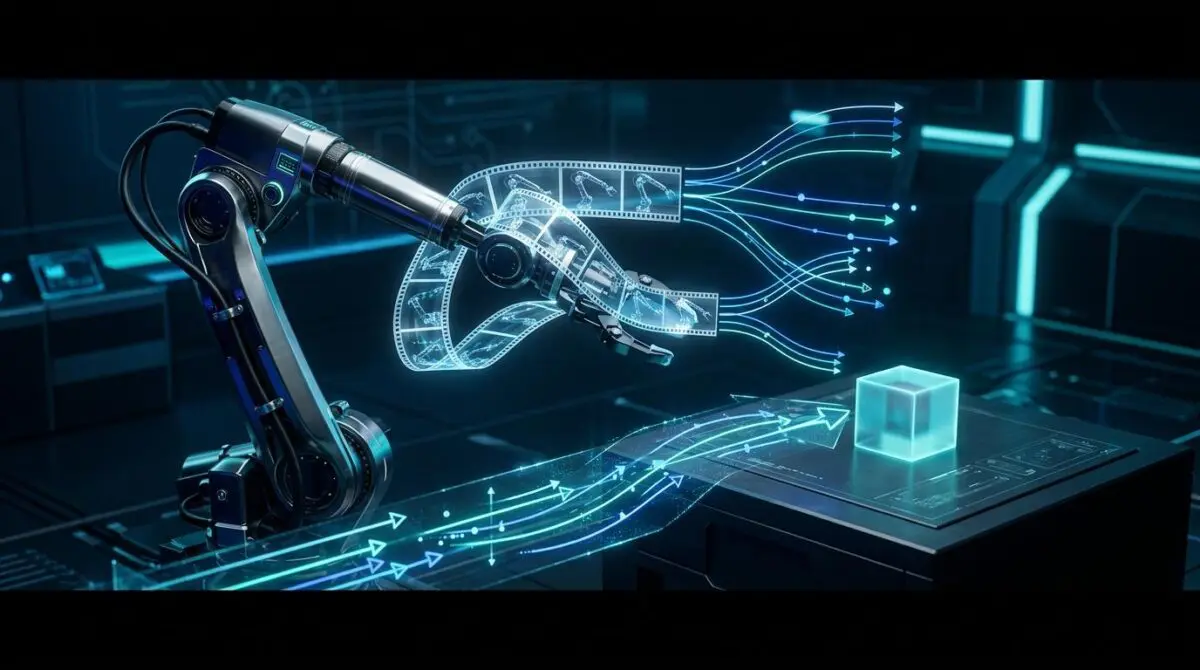
WAMs close this gap by building the policy on a video world model that has already internalized physical dynamics during pretraining.
When post-trained for manipulation, the model does not need to learn causality from scratch; it specializes a system that already anticipates how objects move when pushed, grasped, or dropped.
As detailed on the NVIDIA Developer Blog, Cosmos 3, the foundation underpinning NVIDIA’s WAM push, uses a Mixture-of-Transformers architecture that routes discrete reasoning through an autoregressive transformer while synthesizing continuous modalities — video, audio, action trajectories — through a diffusion transformer.
The pretraining dataset is vast: roughly 767 million images, 348 million real-world dynamics videos, and 8 million action samples spanning manipulation, autonomous driving, and egocentric motion.
From this foundation, NVIDIA post-trained the 16B-parameter Cosmos3-Nano-Policy-DROID for the Franka Panda arm with a Robotiq gripper, and a compact 4B Edge variant for on-device deployment on Jetson hardware.
A key architectural property is that the policy checkpoint retains the full omni-model capability — it can simultaneously output action trajectories and generate video predictions of what the robot’s cameras will see if those actions execute.
This co-generation of action and predicted outcome comes from a single model at inference time, not from separate modules bolted together.
The measurable prior is striking: in controlled comparisons documented in the Cosmos 3 technical report, starting from the omni checkpoint raised RoboLab success rates from 28.1% to 36.8% using identical data, compute, and post-training recipes.
Independent Benchmarks Confirm WAM Robustness — And Expose a Latency Gap
A rigorous comparison study conducted by researchers at Huawei Technologies and the University of Toronto, released as a preprint, evaluated state-of-the-art VLA and WAM policies on two robustness-focused benchmarks: LIBERO-Plus for single-arm manipulation and RoboTwin 2.0-Plus for bimanual tasks.
The findings validate the WAM thesis: Cosmos-Policy achieved an 82.2% success rate on LIBERO-Plus, while LingBot-VA reached 74.2% on RoboTwin 2.0-Plus, demonstrating strong resilience to both visual and language perturbations.
Hybrid approaches that partially incorporate video-based dynamic learning — such as VLA-JEPA and MOTUS — landed in an intermediate robustness band, confirming that the benefit scales with how deeply dynamics modeling is embedded in the architecture.
But the study also surfaces the critical trade-off that deployment-focused teams cannot ignore: inference latency.
A single WAM inference step runs at least 4.8 times slower than the π0.5 VLA, a gap that compounds across the sequential decision-making inherent in robot control loops.
Even optimized variants like Fast-WAM, which decouple video generation at test time to reduce overhead, clock in at 190 milliseconds per step on consumer hardware — compared to 73 milliseconds for the π0 model, a claim that has not yet been independently verified at production scale across diverse hardware configurations.
Some VLAs, most notably π0.5, can match WAM-level robustness when trained on substantially larger and more diverse datasets with explicit dynamic prediction objectives baked into the embodied pretraining phase.
This means the WAM advantage is real but not insurmountable — it is an architectural shortcut to robustness that currently trades speed for sample efficiency.
For research teams and early commercial deployments where generalization matters more than real-time throughput, the calculus favors WAMs.
For latency-sensitive production environments, the gap remains material and demands further engineering attention.
Why an Open Foundation Model Changes the Economics of Robot Deployment
Cosmos 3 arrives with an open release that includes base model weights, datasets, post-training recipes, evaluation tools, and a serving stack — all under a license permitting commercial use.
This openness collapses the barrier to entry for teams that would otherwise need to pretrain a world model from scratch, a compute-intensive undertaking that few robotics labs can afford.
Each new robot embodiment — Franka, UR, WidowX, dual-arm configurations — still requires its own post-training run, but every run starts from the same pretrained foundation, slashing the number of task-specific demonstrations needed to reach production-grade capability.
The deployment spectrum spans from workstation-class serving on an NVIDIA RTX PRO 6000 for the 16B Nano model to real-time on-device inference at 15 Hz on Jetson Thor for the 4B Edge variant, operating at native robot-control resolution.
This tiered strategy means the same architectural lineage can serve high-throughput research workflows and embedded deployment without forcing a single, compromised design point.
The broader signal is unmistakable: the era of treating robot policy as a language problem with an action appendix is giving way to architectures that model the physical world natively.
For teams building manipulation systems today, the question is no longer whether to adopt world-model-based policies, but how quickly the latency gap closes and whether their use case can tolerate the current trade-off in exchange for dramatically better generalization with less data.
Building AI systems that operate in the physical world demands infrastructure that can handle the same rigorous throughput and reliability requirements discussed here. At the intersection of AI automation and performance engineering, the same principles of architectural efficiency translate directly into faster, more resilient digital experiences. To explore how these capabilities apply to your own technical stack, reach out to Andres directly or learn more about Andres SEO Expert and the full range of services available.
Frequently Asked Questions
What is a World Action Model (WAM) and how does it differ from a vision-language-action (VLA) model?
A WAM is a robot policy built on a video world model that learns how scenes evolve under physical interaction, while a VLA is built on a vision-language model optimized to generate text about images. WAMs internalize physical dynamics during pretraining, enabling zero-shot transfer to unfamiliar tasks and robot embodiments, whereas VLAs lack intrinsic understanding of causality.
How does Cosmos 3 enable robot policies to generalize to new tasks and environments?
Cosmos 3 uses a Mixture-of-Transformers architecture pretrained on roughly 767 million images, 348 million real-world dynamics videos, and 8 million action samples. This vast pretraining allows the model to internalize physical dynamics, so when post-trained for manipulation, it already anticipates how objects move when pushed, grasped, or dropped, allowing zero-shot generalization with fewer task-specific demonstrations.
What are the latency trade-offs of WAMs compared to VLAs in robot control loops?
Independent benchmarks show that a single WAM inference step runs at least 4.8 times slower than the π0.5 VLA. Even optimized variants like Fast-WAM clock in at 190 milliseconds per step on consumer hardware, compared to 73 milliseconds for π0. This latency gap compounds across sequential decision-making, making WAMs better suited for research and early deployments where generalization matters more than real-time throughput.
Is the Cosmos 3 foundation model open-source and commercially usable?
Yes, Cosmos 3 includes an open release with base model weights, datasets, post-training recipes, evaluation tools, and a serving stack, all under a license permitting commercial use. This openness reduces the barrier to entry for teams that would otherwise need to pretrain a world model from scratch.
What hardware can run the Cosmos 3 WAM policies?
Deployment spans from workstation-class serving on an NVIDIA RTX PRO 6000 for the 16B Nano model to real-time on-device inference at 15 Hz on Jetson Thor for the 4B Edge variant, operating at native robot-control resolution.
How much data is required to train WAM-based policies compared to VLAs?
WAMs require substantially fewer task-specific demonstrations because they start from a pretrained foundation that has already internalized physical dynamics. Each new robot embodiment still requires its own post-training run, but every run starts from the same pretrained foundation, slashing data requirements compared to VLAs.
What benchmarks demonstrate the robustness of WAMs over VLAs?
In a study by Huawei and University of Toronto, Cosmos-Policy achieved an 82.2% success rate on LIBERO-Plus, and LingBot-VA reached 74.2% on RoboTwin 2.0-Plus, showing strong resilience to visual and language perturbations. Hybrid approaches landed in an intermediate robustness band, confirming that the benefit scales with how deeply dynamics modeling is embedded.