Key Takeaways
- NVIDIA TensorRT Model Connect moves Hugging Face checkpoints to native C++ inference in two commands.
- Semantic and module-level C++ APIs share the same implementation, with no Python runtime in production.
- Custom GPU kernels integrate via TVM FFI, and nightly releases deliver rapid model updates.
Table of Contents
A Two-Command Bridge from Hugging Face to Native C++ Inference
NVIDIA’s developer team has detailed a new open collection of reference implementations called TensorRT Model Connect, designed to move supported open models from a Hugging Face checkpoint to native C++ inference in two commands. The release targets a persistent deployment bottleneck for teams that want TensorRT acceleration without maintaining model-specific conversion, preprocessing, and runtime code.
Model Connect is not positioned as a new inference framework or a replacement for TensorRT. Instead, it acts as a bridge between the end-to-end inference experience for open models and TensorRT’s ability to translate a computation graph into an accelerated engine on GPU.
The practical promise is a complete working implementation to start from. Teams no longer need to rebuild the integration layer for every model family before they can benchmark or ship.
Inside the Deployment Bundle and Its Two API Layers
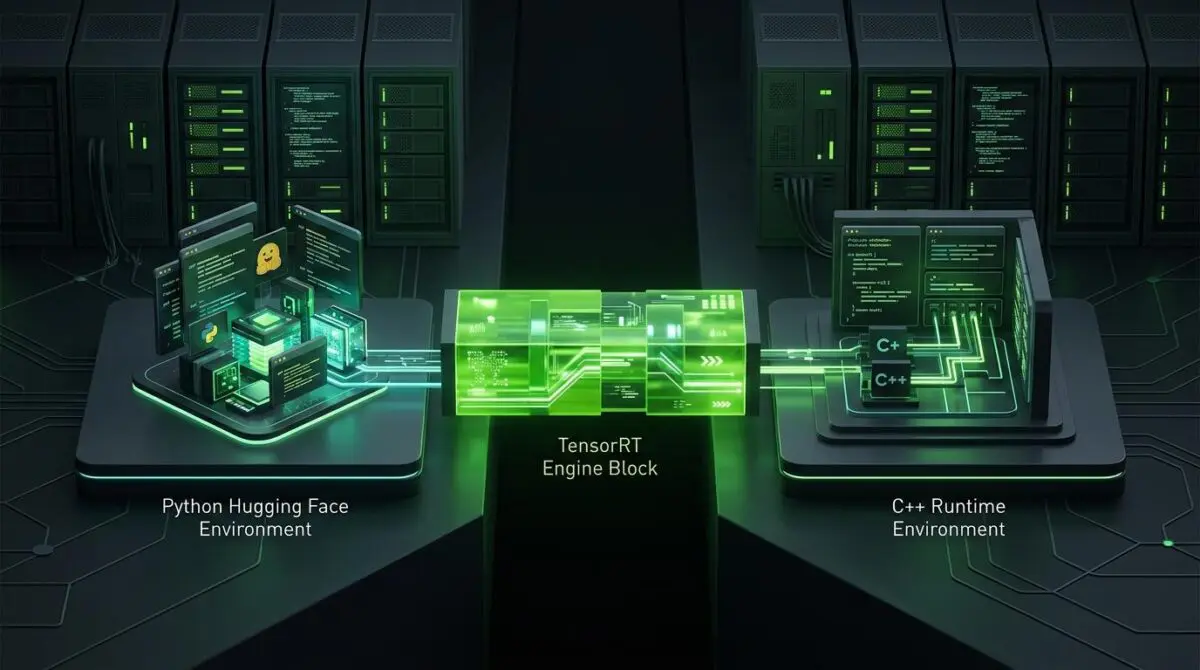
As detailed in NVIDIA’s developer blog, the workflow splits into two phases with a single deployment bundle as the artifact between them. In the first phase, a Python CLI builds that bundle from a supported Hugging Face model ID or local checkpoint.
The bundle contains the TensorRT engines and the model-specific assets required at runtime. In the second phase, a native C++ application loads the bundle and works with task-level inputs and outputs.
Model Connect handles checkpoint mapping, TensorRT engine construction, preprocessing, runtime orchestration, and post-processing. Production runtime does not require PyTorch or a Python interpreter, even though Python can be used to prepare the model.
For C++ developers, Model Connect exposes two API levels that share the same underlying implementations.
- Semantic API: accepts familiar inputs such as prompts, images, and audio while handling model-specific preprocessing, execution, and post-processing.
- Module-level API: provides direct access to named tensors and individual TensorRT components for custom pipeline control.
Developers can therefore start with a simple task-level interface and drop to module-level control only when a pipeline requires deeper customization.
Each model implementation also serves three practical purposes: running a supported open model in a native TensorRT-enabled application, learning from a complete and inspectable implementation, and extending the implementation for a related architecture or custom checkpoint.
Custom GPU Kernels and the AI-Native Release Model
TensorRT Model Connect also makes room for specialized acceleration without forcing teams to abandon the TensorRT execution path. TVM FFI provides a language-agnostic interface for invoking GPU kernels without tightly coupling the calling system to a specific implementation framework or runtime.
Through that interface, a targeted portion of a model can be replaced with a custom GPU kernel while TensorRT continues executing the rest of the inference pipeline. This lowers the cost of integrating specialized or newly developed kernels.
The project itself is built as an AI-native software effort. Coding agents generate implementation code, tests, integrations, and documentation under human direction and review.
Nightly releases shorten the path from a new model, user report, or contribution to an available implementation. Automated validation remains the release gate, and each implementation is continuously tested and optimized as the project evolves.
For supported and validated workloads, the reference implementations can deliver faster inference than torch.compile. That performance position is tied to the project’s validation cycle rather than a blanket claim across all models.
The Inference Engineering Shift Model Connect Signals
The open model ecosystem changes quickly enough that hand-built deployment pipelines often lag behind new architectures and checkpoints. Model Connect gives application developers a common starting point rather than forcing each model family through bespoke conversion and runtime code.
Community contributors can reuse existing patterns to add support for related architectures or custom checkpoints. That reuse lowers the cost of keeping native inference stacks current across data center, edge, and physical AI applications.
The removal of Python from the production runtime is particularly significant for native C++ environments. It reduces packaging complexity and opens a clearer path to TensorRT deployment wherever GPU acceleration is available.
The direction is straightforward: a consistent Model Connect path for supported open models, with the ability to inspect, customize, and optimize the underlying inference pipeline. For technical teams translating complex AI deployment shifts into content that ranks with developer audiences, Andres SEO Expert’s programmatic SEO and AI automation practice is built for exactly that challenge — contact Andres SEO Expert.
Frequently Asked Questions
What is NVIDIA TensorRT Model Connect?
TensorRT Model Connect is an open collection of reference implementations that bridges Hugging Face checkpoints to native C++ inference using TensorRT. It provides model-specific conversion, preprocessing, runtime orchestration, and post-processing in a deployable bundle, enabling teams to move from checkpoint to accelerated inference in two commands.
How do you deploy a model with TensorRT Model Connect?
The workflow has two phases. First, a Python CLI builds a deployment bundle from a supported Hugging Face model ID or local checkpoint. The bundle contains TensorRT engines and required runtime assets. Second, a native C++ application loads the bundle and uses task-level inputs and outputs. No Python or PyTorch is needed at runtime.
Does TensorRT Model Connect require Python at runtime?
No. Although Python is used to prepare the model, the production runtime for TensorRT Model Connect is a native C++ application that loads the deployment bundle. It does not require PyTorch or a Python interpreter, which reduces packaging complexity in native C++ environments.
What are the two API levels in TensorRT Model Connect?
TensorRT Model Connect exposes a Semantic API and a Module-level API. The Semantic API accepts familiar inputs like prompts, images, and audio while handling preprocessing, execution, and post-processing. The Module-level API provides direct access to named tensors and individual TensorRT components for custom pipeline control.
How does TensorRT Model Connect support custom GPU kernels?
It uses TVM FFI, a language-agnostic interface, to invoke GPU kernels without coupling the system to a specific framework. This allows a targeted portion of a model to be replaced with a custom GPU kernel while TensorRT executes the rest of the inference pipeline.
How does TensorRT Model Connect compare to torch.compile?
For supported and validated workloads, the reference implementations can deliver faster inference than torch.compile. This performance advantage is tied to the project’s continuous validation cycle rather than being a blanket claim across all models.
Why is TensorRT Model Connect important for inference engineering?
It provides a common, reusable starting point for deploying open models to TensorRT without building bespoke conversion and runtime code for each model family. The project is AI-native, with nightly releases and automated validation, and it removes Python from production to simplify native C++ deployment across data center, edge, and physical AI applications.