Key Takeaways
- DeepSeek’s V4 models (1.6T parameters, MoE) launch open-source under MIT license, with strong coding benchmarks but trailing in knowledge and reasoning.
- Founder Liang Wenfeng reveals a company culture of no KPIs, open-source as core strategy, and a phased AGI roadmap from CoT to embodied intelligence.
- Restraint defines pricing (10-month cost recoup) and API structure (time-of-day rates), while DSpark delivers 60-85% faster inference.
DeepSeek’s Unfiltered Founder: Vision Over KPIs
On the cusp of its V4 model release, DeepSeek’s founder Liang Wenfeng laid out his unorthodox philosophy in an investor call: no written vision, no KPIs, no organization — only an obsession with AGI and open source as a fundamental strategy. The call, now made public, offers a rare glimpse into the mind of a founder who believes ‘restraint is a strategy’ and that the strongest model should be open-sourced because closed source offers no advantage. As DeepSeek V4 rolls out with open weights under MIT license, the gap between Wenfeng’s vision and market reality becomes measurable.
Table of Contents
The Philosophy That Drives DeepSeek’s Technical Choices
Wenfeng described a company built on consensus, not hierarchy. ‘We are just a bunch of very ordinary people,’ he said, emphasizing that authority is earned, not assigned. Half of employee time is unallocated, and overtime is discouraged because research needs a relaxed environment. This culture directly shapes product decisions: open source is not an afterthought but ‘the point.’ Even DeepSeek’s strongest models will be released openly because, in Wenfeng’s view, monopolizing AI is impossible when it will eventually represent 10% of global GDP.
The more restrained you are, the more likely you’ll pull it off.
The AGI roadmap is equally distinctive. Wenfeng outlined five phases: Chain-of-Thought reasoning, Agents, continual learning, ‘singularity’ (self-improving models), and finally embodied intelligence. Each step builds on the last, and he argued that AI’s current bottleneck is not taste or intuition but continual learning. DeepSeek’s internal focus is on making the next model improve the company’s own efficiency first.
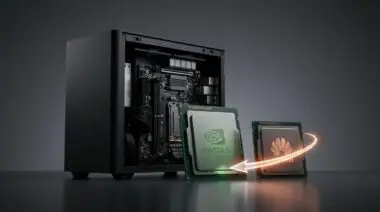
On compute, as Wenfeng disclosed in the investor call published by Geopolitechs, DeepSeek operates with roughly 20,000 H-equivalent GPUs, putting it 12-18 months behind the US but achieving results with one-twentieth the compute of frontier labs. He sees a historic opportunity for domestic chips like Huawei 950, noting that the ecosystem is fine but capacity is the bottleneck. The goal: use AI itself to erode Nvidia’s CUDA moat by generating code and building higher-level languages like TileLang.
V4 in the Real World: Benchmarks, Pricing, and Market
Real-time research from Hugging Face community benchmarks confirms that DeepSeek V4-Pro, with 1.6 trillion total parameters (49B active) and a 1M token context, leads in coding contests: LiveCodeBench Pass@1 of 93.5% edges Gemini 3.1 Pro’s 91.7%, and Codeforces Rating of 3206 surpasses GPT-5.4 xHigh’s 3168. However, on SWE-bench Verified, it ties with Opus 4.6 Max at 80.6%, and on a contamination-free benchmark DeepSWE, V4-Pro scores only 8% pass@1 against GPT-5.5’s 70%. Knowledge limitations persist: GPQA Diamond sits at 90.1% versus 94.3% for the frontier, and SimpleQA Verified at 57.9% versus 75.6%. DeepSeek’s own technical report assesses V4 is 3-6 months behind state-of-the-art in knowledge capability.
Pricing follows Wenfeng’s restraint doctrine. API costs are set to recoup hardware investment in ten months, with time-of-day rates: V4-Pro off-peak at $0.435/M input (cache miss) and $0.87/M output, doubling during peak Beijing hours. To see how this aggressive pricing strategy is already disrupting enterprise SaaS budgets and shifting global market share, read our full business analysis right here. Cache hits drop input costs dramatically ($0.0036/M for Pro). The DSpark decoding framework, open-sourced in June 2026 and detailed by FullStack Labs, boosts generation speed by 60-85% on V4-Flash and 57-78% on V4-Pro, making inference significantly cheaper and faster without altering weights.
A notable competitive tension: despite DeepSeek’s strong coding benchmarks, the knowledge gap suggests specialized use cases rather than general intelligence. The false rumor that DeepSeek reportedly routed API traffic to Anthropic’s Claude Fable 5 has been definitively debunked by community analysis, which attributes the performance to convergent training and a new instruction-tuning checkpoint. This underscores the difficulty of assessing model provenance in open-weight ecosystems.
The Open-Source Path to AGI: What It Means for the Industry
Wenfeng’s vision — open-source everything, push AGI through incremental roadmaps, and remain ‘restrained’ in ambition — presents a contrarian model in an industry dominated by closed labs and massive compute arms races. The V4 launch is a proof point that an open-weight approach can produce world-class results in specific domains like code generation while acknowledging gaps in knowledge and reasoning. Whether the strategy scales beyond 20,000 GPUs or becomes a self-accelerating loop for continuous learning remains to be seen. But for now, DeepSeek has contributed a substantial, verifiable artifact to the AI commons.
For practitioners looking to build on this foundation or optimize their own AI infrastructure, the practical lessons are clear: open models lower barriers, but performance bottlenecks shift to serving and cost management. Andres SEO Expert offers programmatic SEO AI automation to integrate such models into scalable content pipelines, and WordPress speed engineering to ensure deployments run efficiently. Connect with Andres to explore how these capabilities can be tailored to your stack. Or learn more about the methodology at Andres SEO Expert.
Frequently Asked Questions
What is DeepSeek founder Liang Wenfeng’s core philosophy?
Wenfeng believes in no written vision, no KPIs, and no formal hierarchy. Instead, he emphasizes consensus, open source as a fundamental strategy, and restraint (including discouraging overtime) to foster a relaxed research environment. He argues that monopolizing AI is impossible and that open-sourcing even the strongest models is the point.
How does DeepSeek V4-Pro perform on key benchmarks compared to competitors?
DeepSeek V4-Pro excels in coding: LiveCodeBench Pass@1 of 93.5% edges Gemini 3.1 Pro’s 91.7%, and Codeforces Rating of 3206 surpasses GPT-5.4 xHigh’s 3168. On SWE-bench Verified it ties with Opus 4.6 Max at 80.6%. However, on GPQA Diamond it scores 90.1% vs. 94.3% for frontier models, and SimpleQA Verified at 57.9% vs. 75.6%. DeepSeek’s own assessment places V4 3-6 months behind state-of-the-art in knowledge capability.
What is DeepSeek’s pricing model for V4 API?
API pricing follows a time-of-day rate: V4-Pro off-peak is $0.435/M input (cache miss) and $0.87/M output, doubling during peak Beijing hours. Cache hits drop input costs dramatically ($0.0036/M for Pro). The DSpark decoding framework (open-sourced June 2026) boosts generation speed by 60-85% on V4-Flash and 57-78% on V4-Pro without altering weights.
Why does DeepSeek open-source its strongest models?
Wenfeng believes closed source offers no advantage because AI will eventually represent 10% of global GDP and cannot be monopolized. Open source is the point of the company, not an afterthought. Even DeepSeek’s strongest models will be released openly under permissive licenses like MIT.
What are the five phases of DeepSeek’s AGI roadmap?
Wenfeng outlined five phases: Chain-of-Thought reasoning, Agents, continual learning, ‘singularity’ (self-improving models), and finally embodied intelligence. He sees AI’s current bottleneck as continual learning, and DeepSeek’s internal focus is on making the next model improve the company’s own efficiency first.
Did DeepSeek route API traffic to Anthropic’s Claude as rumored?
No. The false rumor that DeepSeek reportedly routed API traffic to Anthropic’s Claude Fable 5 has been definitively debunked by community analysis. The performance is attributed to convergent training and a new instruction-tuning checkpoint.
What is DeepSeek’s compute capacity and how does it compare to US frontier labs?
DeepSeek operates roughly 20,000 H-equivalent GPUs, putting it 12-18 months behind the US but achieving results with one-twentieth the compute of frontier labs. Wenfeng sees a historic opportunity for domestic chips like Huawei 950 and aims to use AI itself to erode Nvidia’s CUDA moat.