Key Takeaways
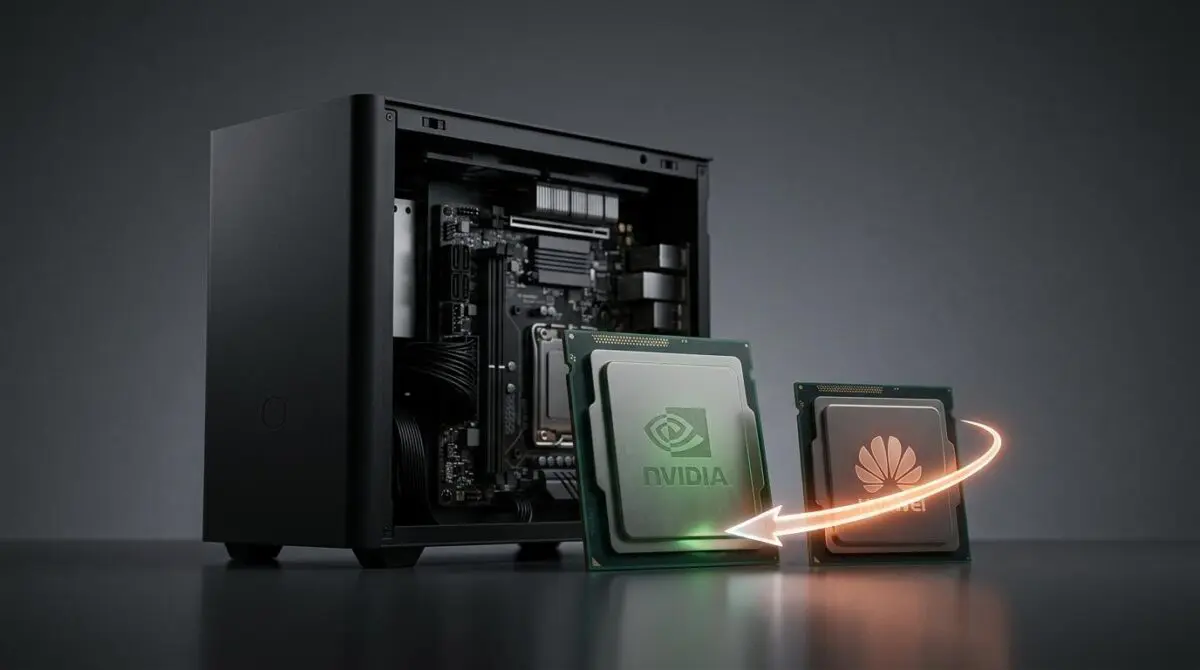
- DeepSeek CEO Liang Wenfeng asserts that Huawei’s Atlas 950 SuperPoD can fully replace NVIDIA’s GB200 and GB300 racks in performance and price, though at a 4:1 GPU ratio and a two-year lag.
- DeepSeek currently operates a compute footprint equivalent to just 20,000 NVIDIA H100 GPUs, while training the largest models would require up to 50,000 GB300 units—highlighting the resource gap with US labs.
- Real-world data shows a single NVIDIA GB300 rack consumes over 132 kW and costs $3.7–4 million, while cutting-edge models like Grok 4.5 continue to rely heavily on NVIDIA hardware for production deployments.
Inside the Call That Rattled NVIDIA’s AI Dominance Narrative
DeepSeek CEO Liang Wenfeng dropped a series of bombshells during a recent investor conference call, claiming that NVIDIA is effectively ‘digging its own grave’ as Huawei’s Atlas 950 SuperPoD emerges as a viable substitute for NVIDIA’s premium GB200 and GB300 racks. Wenfeng revealed that while one NVIDIA GB300 GPU equals roughly four Huawei Ascend 950 GPUs in performance, the Chinese supernode can match NVIDIA’s latency and task compatibility at a higher but acceptable price premium. The call also exposed the stark resource gap between Chinese AI labs and their US counterparts: DeepSeek’s total compute footprint stands at just 20,000 NVIDIA H100-equivalent GPUs, most acquired only in the last two months.
Table of Contents
DeepSeek’s Compute Reality and the Huawei Alternative
Wenfeng detailed that DeepSeek’s current compute capacity restricts active parameter counts to about 10 billion per model, far short of the 800-billion-parameter activation seen in the largest frontier models. To bridge that gap, he estimated needing 50,000 NVIDIA GB300 GPUs for training alone—or 200,000 Huawei Ascend 950 GPUs. The CEO emphasized that the primary bottleneck is resources, not talent.
Despite this deficit, Wenfeng expressed optimism about domestic alternatives. He stated that Huawei’s Atlas 950 SuperPoD can fully substitute for NVIDIA’s GB200 and GB300 racks in both performance and price. According to his remarks, the price premium—anywhere from 50% to 200%—is negligible given the strategic imperative of reducing reliance on US hardware.
‘All tasks GB300 can do, the Huawei supernode can do, latency and all the same. The only cost: 4 Huawei GPUs equal 1 NVIDIA GPU, and it’s two years behind.’
Wenfeng also disclosed that DeepSeek is now aggressively expanding its compute footprint and doubling down on high-quality data annotation, a bottleneck he described as time-constrained rather than capital-constrained.
How Huawei’s Challenge Reshapes the AI Hardware Landscape
Independent analysis corroborates the high costs and power demands of NVIDIA’s latest hardware. A Hacker News comment citing a Spheron Network blog post estimates that a single NVIDIA GB300 rack consumes over 132 kilowatts and costs between $3.7 million and $4 million. Such figures underscore the total cost of ownership that enterprises must factor in when building AI clusters.
Meanwhile, Huawei is reportedly ‘pumping SuperPoDs,’ aiming to supply Chinese AI labs with a domestic alternative. The implication, as noted by analysts, is that Chinese models will increasingly be optimized for local hardware, gradually decoupling from the NVIDIA ecosystem. However, the gap remains significant: cutting-edge models like xAI’s Grok 4.5, launched on July 9, 2026, are built on a 1.5-trillion-parameter architecture trained on ‘tens of thousands of NVIDIA GB300 GPUs,’ according to a Happyrock.cloud blog post. Grok 4.5 demonstrates inference speeds of 80 tokens per second and uses only a quarter of the tokens consumed by rival models, showcasing the performance headroom NVIDIA still commands.
This duality—NVIDIA’s unmatched production capabilities versus Huawei’s credible substitute potential—creates a bifurcated market. For enterprises with strong compute requirements, the choice may come down to performance, cost, and geopolitical risk. The NVIDIA ecosystem retains its lead in raw performance and software maturity, but Huawei’s SuperPoD offers a path for Chinese firms subject to export restrictions.
Navigating the New Hardware Paradigm
The tension between NVIDIA’s dominance and Huawei’s rise marks a pivotal moment for the AI industry. DeepSeek’s open-source strategy and willingness to adopt domestic alternatives reflect a broader movement toward hardware diversification. As models grow larger and compute demands intensify, the competition between US and Chinese hardware ecosystems will shape global AI development.
For businesses operating in this environment, ensuring that their own digital infrastructure is optimized for performance and scalability is paramount. Managed cloud hosting, site speed engineering, and AI-driven programmatic solutions from Andres SEO Expert can help your platform keep pace with modern AI workloads. Connect with Andres for a technical assessment to ensure your infrastructure is built for the next wave of AI innovation. Learn more about Andres SEO Expert and our approach to digital performance.
Frequently Asked Questions
What did DeepSeek CEO Liang Wenfeng claim about NVIDIA and Huawei?
Wenfeng stated that NVIDIA is ‘digging its own grave’ and that Huawei’s Atlas 950 SuperPoD can fully substitute NVIDIA’s GB200 and GB300 racks in performance and latency. However, four Huawei Ascend 950 GPUs equal one NVIDIA GB300 GPU, with a price premium of 50%–200%.
How does Huawei’s Atlas 950 SuperPoD compare to NVIDIA’s GB300?
According to Wenfeng, the Huawei supernode matches NVIDIA’s latency and task compatibility. The trade-off is a 4:1 GPU ratio and a 50%–200% price premium, but it offers a path to reduce reliance on US hardware.
Why is DeepSeek considering Huawei’s alternative despite the higher cost?
Chinese AI labs face export restrictions and geopolitical risk. Wenfeng called the price premium negligible given the strategic imperative of decoupling from NVIDIA. DeepSeek is also expanding compute using domestic options.
What is DeepSeek’s current compute capacity and what does it need?
DeepSeek has 20,000 NVIDIA H100-equivalent GPUs, mostly acquired recently. To reach frontier-model scale, it estimates needing 50,000 NVIDIA GB300 GPUs (or 200,000 Huawei Ascend GPUs) for training alone.
How does Huawei’s challenge reshape the AI hardware landscape?
It creates a bifurcated market: NVIDIA’s ecosystem leads in raw performance and software maturity, while Huawei offers a viable domestic alternative for Chinese firms. Chinese models will increasingly optimize for local hardware, decoupling from NVIDIA.
What are the power and cost implications of NVIDIA’s GB300 rack?
A single GB300 rack consumes over 132 kilowatts and costs between $3.7 million and $4 million, underscoring the total cost of ownership for large AI clusters.
How does Grok 4.5’s training hardware compare to DeepSeek’s constraints?
Grok 4.5 (released July 9, 2026) is trained on a 1.5-trillion-parameter model using tens of thousands of NVIDIA GB300 GPUs, achieving 80 tokens per second inference. This highlights NVIDIA’s production-scale advantage over DeepSeek’s limited capacity.