Key Takeaways
- DeepStream 9.1 introduces AutoMagicCalib (AMC) and Multi-View 3D Tracking (MV3DT) for automated multi-camera calibration and consistent object tracking across views.
- MV3DT uses shared 3D coordinates, MQTT for tracklet association, and outputs via OSD, BEV, and Kafka.
- AMC automates camera calibration using tracked objects, reducing manual setup time and errors.
- The skill system allows deployment via natural language prompts using coding agents like Claude Code and Codex.
- All code is open source on the NVIDIA DeepStream GitHub repository.
NVIDIA DeepStream 9.1 Automates Multi-Camera 3D Tracking with Agentic Skills
NVIDIA has released DeepStream 9.1, a major update to its intelligent video analytics platform, introducing AutoMagicCalib (AMC) and Multi-View 3D Tracking (MV3DT) to automate camera calibration and enable consistent object tracking across multiple camera views without manual intervention. This release, now available on GitHub, marks a leap forward in simplifying vision AI pipeline development for applications like warehouse safety, retail analytics, and smart building monitoring.
Table of Contents
How MV3DT and AMC Revolutionize Camera Calibration and Tracking
Multi-View 3D Tracking (MV3DT)
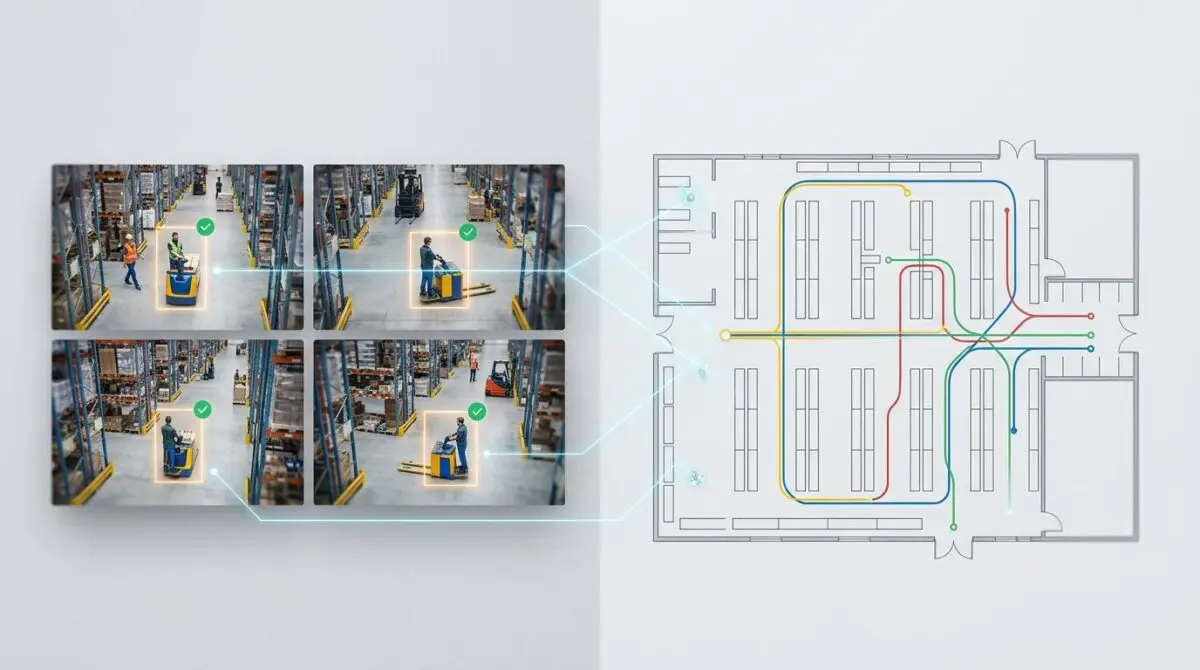
MV3DT extends DeepStream’s tracker with distributed multi-view 3D tracking across a network of calibrated cameras. Each camera independently detects objects using models like PeopleNetTransformer, PeopleNet v2.6.3, or RT-DETR 2D.
Monocular 3D perception back-projects 2D bounding boxes into 3D world-space coordinates using a ground-plane assumption and a 3×4 projection matrix stored in a YAML calibration file.
The tracker uses MQTT, a lightweight pub/sub protocol, to share tracklets across cameras. When two cameras observe the same person, the multi-view association algorithm matches tracklets using proximity in 3D world space and assigns a single globally consistent object ID.
Output streams include On-Screen Display (OSD) with a live grid of camera feeds, a Bird’s-Eye View (BEV) top-down map showing object trajectories, and Kafka messaging delivering structured protobuf metadata per frame for downstream applications.
AutoMagicCalib (AMC)
AMC automates camera network calibration by analyzing tracked objects moving across existing video files or streams. It estimates each camera’s intrinsic and extrinsic parameters to produce calibration files required for MV3DT.
The calibration pipeline extracts trajectories per camera, performs single-view rectification, matches tracklets across views, and runs bundle adjustment to minimize reprojection error globally. Optionally, users can employ VGGT for model-based calibration when object movement is limited.
Users need only provide a layout image and define a few alignment points. AMC is available as a microservice with REST APIs and a web interface, reducing manual setup from hours to minutes.
Agentic Skills for Deployment
DeepStream 9.1 introduces 13 modular agentic skills designed for coding agents like Claude Code or Codex. Instead of manually editing configuration files, developers describe the desired pipeline in plain natural language prompts, and the agent handles setup, configuration, and execution.
Skills include mv3dt-deploy for end-to-end MV3DT lifecycle management and amc-setup-calibration-stack for bringing up the calibration microservice. The skills automatically validate prerequisites, pull containers, download models, and generate pipeline configurations.
All source code, reference applications, and sample datasets are open source on the NVIDIA DeepStream GitHub repository, enabling easy adoption and customization.
Strategic Implications for AI Video Analytics
The release of DeepStream 9.1 arrives at a time when the demand for scalable, real-time video analytics is surging across industries. By automating calibration and enabling consistent object tracking across cameras, NVIDIA directly addresses a critical bottleneck in deploying multi-camera systems at scale.
However, as organizations accelerate adoption of such platforms, security must remain a priority. A June 2026 CISA vulnerability bulletin highlighted a high-severity flaw (CVSS 9.1) in a similarly named ‘deepstream’ server, underscoring the importance of rigorous vulnerability management in AI pipelines. Enterprises deploying DeepStream 9.1 must ensure their deployment stacks are hardened and updated.
Real-world applications are already emerging. The Aegis Nomad X4 autonomous vehicle, for instance, leverages the NVIDIA DeepStream SDK for real-time situational awareness through intelligent video analytics, demonstrating the platform’s critical role in edge AI deployments.
The shift toward agentic, modular AI tools is a broader industry trend, with hobbyist communities now setting up homelabs for scalable agentic workflows. DeepStream 9.1’s skill system could lower the barrier for entry into multi-camera 3D tracking, expanding its use beyond specialized computer vision teams.
The Future of Vision AI: Modular, Automated, Agentic
As detailed in NVIDIA’s official release blog post, DeepStream 9.1 sets a new standard for multi-camera tracking by combining automated calibration, consistent 3D tracking, and agentic deployment. As video analytics becomes integral to safety, efficiency, and automation across sectors, tools like AMC and MV3DT will be foundational.
For developers and enterprises, the ability to deploy complex multi-camera pipelines from a simple prompt marks a paradigm shift. The future of vision AI is not just about better models, but about smarter, more autonomous systems that reduce human overhead and accelerate time to value.
Staying ahead in the rapidly shifting landscape of AI requires precision. To future-proof your digital strategy and scale effortlessly, you need a foundation built on precision. Optimize your site with advanced speed engineering, secure your infrastructure in high-performance hosting environments, and streamline your entire workflow through autonomous AI pipelines. If you are ready to elevate your systems, Connect with Andres at Andres SEO Expert to build your ultimate architecture.
Frequently Asked Questions
What is NVIDIA DeepStream 9.1?
NVIDIA DeepStream 9.1 is a major update to NVIDIA’s intelligent video analytics platform, introducing automated camera calibration (AutoMagicCalib) and consistent multi-view 3D tracking (MV3DT) without manual intervention. It simplifies vision AI pipeline development for applications like warehouse safety, retail analytics, and smart building monitoring.
How does AutoMagicCalib (AMC) work?
AMC automates camera network calibration by analyzing tracked objects from existing video streams. It extracts trajectories per camera, performs single-view rectification, matches tracklets across views, and runs bundle adjustment to minimize reprojection error. Users only need to provide a layout image and define alignment points. It is available as a microservice with REST APIs and a web interface.
What is Multi-View 3D Tracking (MV3DT)?
MV3DT extends DeepStream’s tracker to enable distributed multi-view 3D tracking across a network of calibrated cameras. Each camera independently detects objects using models like PeopleNetTransformer or RT-DETR. Monocular 3D perception back-projects 2D bounding boxes to 3D world coordinates using a ground-plane assumption and calibration matrix. Tracklets are shared via MQTT, and a multi-view association algorithm assigns a globally consistent object ID based on 3D proximity.
How do agentic skills simplify deployment of DeepStream 9.1?
DeepStream 9.1 introduces 13 modular agentic skills designed for coding agents like Claude Code or Codex. Developers describe the desired pipeline in natural language, and the agent automatically handles setup, configuration, validation, container pulling, model downloading, and pipeline execution. Skills like mv3dt-deploy manage the end-to-end MV3DT lifecycle, reducing manual configuration effort.
What are the key applications of DeepStream 9.1?
Key applications include warehouse safety monitoring, retail analytics, smart building surveillance, and autonomous vehicle situational awareness (e.g., Aegis Nomad X4). The platform enables real-time, scalable video analytics across multiple cameras with consistent 3D tracking and automated calibration.
How does MV3DT ensure consistent object IDs across cameras?
MV3DT uses a multi-view association algorithm that matches tracklets from different cameras based on proximity in 3D world space. Tracklets are shared via MQTT pub/sub protocol. When two cameras observe the same person, the algorithm assigns a single globally consistent object ID, enabling seamless tracking across camera views.
Why is security important when deploying DeepStream 9.1?
As organizations accelerate adoption of video analytics platforms, security must remain a priority. A June 2026 CISA bulletin highlighted a high-severity flaw (CVSS 9.1) in a similarly named ‘deepstream’ server. Enterprises deploying DeepStream 9.1 should ensure their stacks are hardened, updated, and undergo rigorous vulnerability management to mitigate risks.