Key Points
- Value-per-Action Metrics: Transitioning from raw compute cost analysis to measuring the tangible business value of autonomous AI tasks.
- RAG-Driven Grounding: Eliminating model hallucinations by deeply integrating proprietary corporate data through advanced vector databases.
- Agentic Orchestration: Upgrading from passive conversational interfaces to active AI agents capable of multi-step reasoning and tool execution.
Table of Contents
The AI Landscape
According to the Gartner 2026 AI Infrastructure Report, 85% of Fortune 500 companies have transitioned from experimental pilots to full-scale ‘Agentic Enterprise’ architectures, seeing a 40% year-over-year increase in AI-related capital expenditure. This massive influx of capital signals a permanent shift in corporate technology strategies. Organizations are no longer asking if they should adopt generative AI, but rather how to measure its structural impact.
Building a business case for enterprise LLM deployment involves transitioning from experimental AI pilots to structured, value-driven integration within corporate ecosystems. The modern focus is on aligning Large Language Models with specific business outcomes. This moves the technology beyond mere novelty to measurable ROI through automated workflows and enhanced data synthesis.
By 2026, organizations that fail to establish a formal Enterprise LLM Deployment Framework face significant competitive disadvantages. Generative AI is rapidly becoming the standard interface for internal knowledge management and external customer engagement. A robust deployment framework shifts the narrative from AI as a cost center to AI as a strategic asset.
This transformation is driven by rapid advancements in neural network architectures and context window expansions. Modern models can process vast amounts of unstructured data, making them indispensable for complex analytical tasks. Consequently, prompt engineering has evolved from a niche skill into a fundamental component of enterprise system engineering.
Core Concepts & Capabilities
Core Architecture & Pillars
Economic Outcome Alignment
Shifting the valuation metric from ‘cost-per-token’ to ‘Value-per-Action’ (VpA). This requires technical mapping of LLM inference costs against the reduction in man-hours for complex cognitive tasks and the acceleration of revenue-generating cycles.
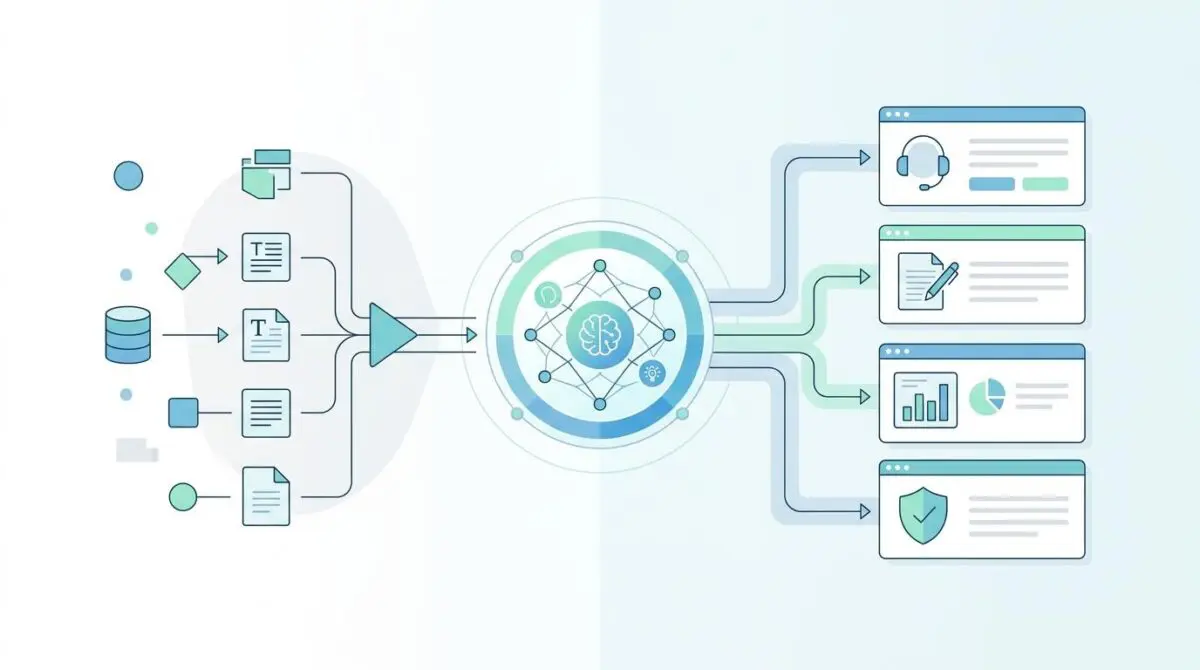
Data Architecture and RAG Integration
Implementing Retrieval-Augmented Generation (RAG) to ensure LLM outputs are grounded in proprietary corporate data. This eliminates the ‘hallucination hurdle’ by providing a verifiable vector database context for every generated response.
Governance and Risk Mitigation
The technical enforcement of data privacy, prompt injection prevention, and bias auditing. This involves deploying ‘Guardrail Layers’ between the user interface and the model endpoint to ensure compliance with global AI regulations.
Agentic Workflow Orchestration
Moving from passive chat interfaces to active AI Agents capable of tool-use and multi-step reasoning. This requires an orchestration layer (like LangGraph or AutoGPT frameworks) to manage state and memory across long-running tasks.
The foundation of a successful business case rests on Economic Outcome Alignment. Enterprises must shift their valuation metrics from a simple cost-per-token model to a more holistic Value-per-Action framework. This requires technical mapping of LLM inference costs against the reduction in man-hours for complex cognitive tasks.
Organizations must evaluate the trade-off between proprietary frontier models and specialized, self-hosted open-source variants. This decision directly impacts infrastructure spending and data sovereignty. Achieving true enterprise value requires Implementing Retrieval-Augmented Generation (RAG) to ensure model outputs are grounded in proprietary corporate data.
Forrester Research (May 2026) reveals that enterprises utilizing RAG-integrated LLMs for internal knowledge management report a 60% reduction in employee ‘search-to-action’ latency compared to traditional document management systems. This eliminates the hallucination hurdle by providing a verifiable vector database context for every generated response. It beautifully resolves the technical conflict between static model knowledge and dynamic, real-time departmental needs.
Furthermore, robust governance and risk mitigation are non-negotiable components of the modern AI stack. This involves deploying ‘Guardrail Layers’ between the user interface and the model endpoint to ensure compliance with global AI regulations. Such security measures protect against prompt injection and enforce strict data privacy standards across all automated workflows.
Strategic Implementation
Implementation Roadmap
Opportunity Audit and ROI Mapping
Identify high-latency, high-volume cognitive tasks. Calculate the current cost-to-complete and project 30-50% efficiency gains using LLM-assisted workflows.
Data Readiness and Vectorization
Audit internal data silos. Sanitize and index proprietary documents into a high-performance vector database (like Pinecone or Milvus) to support RAG-based model grounding.
Infrastructure and Model Selection
Choose between API-based frontier models for speed or on-premise deployments for sensitive data. Establish a ‘Model Router’ to send simple tasks to small models and complex tasks to frontier models to save costs.
Pilot Deployment and Feedback Loop
Launch a ‘Champion Program’ in a single department. Monitor token usage, accuracy rates, and user adoption metrics to refine the prompt engineering and RAG retrieval parameters before full-scale rollout.
Executing an Enterprise LLM Deployment Framework requires a phased, highly technical approach. The journey begins with a comprehensive opportunity audit to identify high-latency, high-volume cognitive tasks. By calculating the current cost-to-complete, organizations can accurately project efficiency gains using LLM-assisted workflows.
Data readiness is the next critical frontier in the deployment lifecycle. Enterprises must audit internal data silos and sanitize proprietary documents before indexing them into high-performance vector databases. This foundational step is what makes RAG-based model grounding possible and highly effective.
Infrastructure and model selection dictate the operational tempo of the entire AI ecosystem. Companies must establish a model router to intelligently direct simple tasks to smaller, efficient models while reserving complex reasoning for frontier models. This dynamic routing optimizes compute costs while maintaining high performance for critical operations.
Transitioning to active AI agents requires an orchestration layer (like LangGraph or AutoGPT frameworks) to manage state and memory across long-running tasks. This shifts the LLM from a passive chat interface into an active operator capable of tool-use and multi-step reasoning. A pilot deployment in a single department allows teams to monitor token usage and accuracy rates before a full-scale rollout.
Real-World Impact & Use Cases
The real-world impact of a meticulously crafted business case is profound across all legacy departments. Legal teams utilize agentic workflows to parse thousands of contract clauses in seconds, drastically reducing review cycles. Finance departments leverage LLMs to synthesize quarterly earnings reports and identify spending anomalies autonomously.
Research and development divisions use generative AI to accelerate literature reviews and hypothesis generation. By integrating AI directly into ERP and CRM systems, the LLM becomes an active participant in daily operations. This deep integration transforms how corporate data is accessed, analyzed, and leveraged for strategic decision-making.
The strategic value lies in the ability of AI agents to execute complex workflows without constant human supervision. However, business cases must still account for the cost of Human-in-the-Loop systems and automated red-teaming. These oversight mechanisms are crucial for satisfying internal audit requirements and mandates like the EU AI Act.
Customer service departments are also seeing massive disruption through hyper-personalized, autonomous resolution bots. These systems do not just answer questions; they actively process refunds, update account details, and manage logistics. This level of autonomous task execution is what justifies the initial infrastructure investment.
Best Practices & Future Outlook
Strategic Best Practices
- Prioritize ‘Modular AI’ architecture to swap models as newer versions emerge.
- Implement strict data anonymization protocols before tokenization.
- Maintain a ‘Value Dashboard’ that tracks real-time ROI versus compute spend.
- Ensure all AI-generated outputs are clearly labeled to maintain organizational transparency.
Future-proofing an AI strategy requires prioritizing a modular architecture from day one. This allows organizations to seamlessly swap out underlying models as newer, more capable versions emerge. Implementing strict data anonymization protocols before tokenization is also essential for maintaining enterprise-grade security.
Successful deployments rely on maintaining a centralized value dashboard. This tool tracks real-time return on investment versus compute spend, ensuring the AI initiative remains financially viable. Additionally, ensuring all AI-generated outputs are clearly labeled helps maintain organizational transparency and trust.
As we look toward the future, the integration of autonomous agentic task execution will only deepen within corporate ecosystems. Enterprises that master this deployment framework will command a significant advantage in operational efficiency and talent retention. The era of experimental AI is over; the era of the agentic enterprise has begun.
Navigating the rapid evolution of Large Language Models and AI infrastructure requires a precise strategy. To stay ahead of the AI revolution and optimize your digital presence, connect with Andres at Andres SEO Expert.
Frequently Asked Questions
What is an Enterprise LLM Deployment Framework?
An Enterprise LLM Deployment Framework is a structured, value-driven strategy used to transition AI from experimental pilots to full-scale corporate integration. It aligns Large Language Models with specific business outcomes, shifting the role of AI from a cost center to a strategic asset that enhances internal knowledge management and external engagement.
How do organizations calculate the ROI of AI infrastructure?
Enterprises calculate ROI by shifting valuation metrics from ‘cost-per-token’ to ‘Value-per-Action’ (VpA). This involves mapping technical inference costs against the reduction in man-hours for complex cognitive tasks and the acceleration of revenue-generating cycles, typically projecting efficiency gains of 30-50%.
What is the benefit of Retrieval-Augmented Generation (RAG) for businesses?
RAG grounds LLM outputs in proprietary corporate data, which eliminates the ‘hallucination hurdle’ by providing a verifiable vector database context. Research indicates that RAG-integrated systems can reduce employee ‘search-to-action’ latency by up to 60% compared to traditional document management systems.
How do agentic workflows differ from standard AI chat interfaces?
Agentic workflows move beyond passive chat to active AI agents capable of tool-use and multi-step reasoning. Using orchestration layers like LangGraph, these agents manage state and memory across long-running tasks, allowing them to autonomously execute complex processes in departments like legal, finance, and R&D.
What security measures are necessary for enterprise AI deployment?
Robust deployment requires ‘Guardrail Layers’ between the user interface and model endpoint to enforce data privacy, prevent prompt injection, and perform bias auditing. These measures ensure compliance with global regulations, such as the EU AI Act, while protecting sensitive proprietary information.
How does a model router help optimize AI operational costs?
A model router intelligently directs simple tasks to smaller, cost-efficient models while reserving complex analytical tasks for frontier models. This dynamic routing optimizes compute spend and infrastructure resources, ensuring that high-performance reasoning is only used when technically required.