Key Points
- Advanced AI agents process high-volume XML and JSON feeds to eliminate manual script maintenance and standardize news ingestion.
- Integrating human-in-the-loop intervention nodes ensures editorial brand voice consistency while reducing final review times to seconds.
- Automated SEO schemas and direct CMS syndication transform invisible curated content into indexed and traffic-generating assets.
Table of Contents
- The High Cost of Information Lag
- Quantifying the Curation Automation Advantage
- Transforming High-Volume XML Feeds
- Deploying Semantic Clustering Agents
- Designing Rapid Intervention Nodes
- Programmatic Content Syndication
- Capturing Organic Search Traffic
- Navigating Decentralized Intelligence
- The Next Era of Automated Publishing
The High Cost of Information Lag
Picture this: your editorial team spends hours manually sifting through dozens of industry blogs just to compile a weekly news roundup. By the time they format the links, summarize the takeaways, and hit publish, the news is already 48 hours old. This high-velocity data volume exceeds human processing speed, creating a massive information lag and draining your most expensive talent on repetitive copy-pasting tasks.
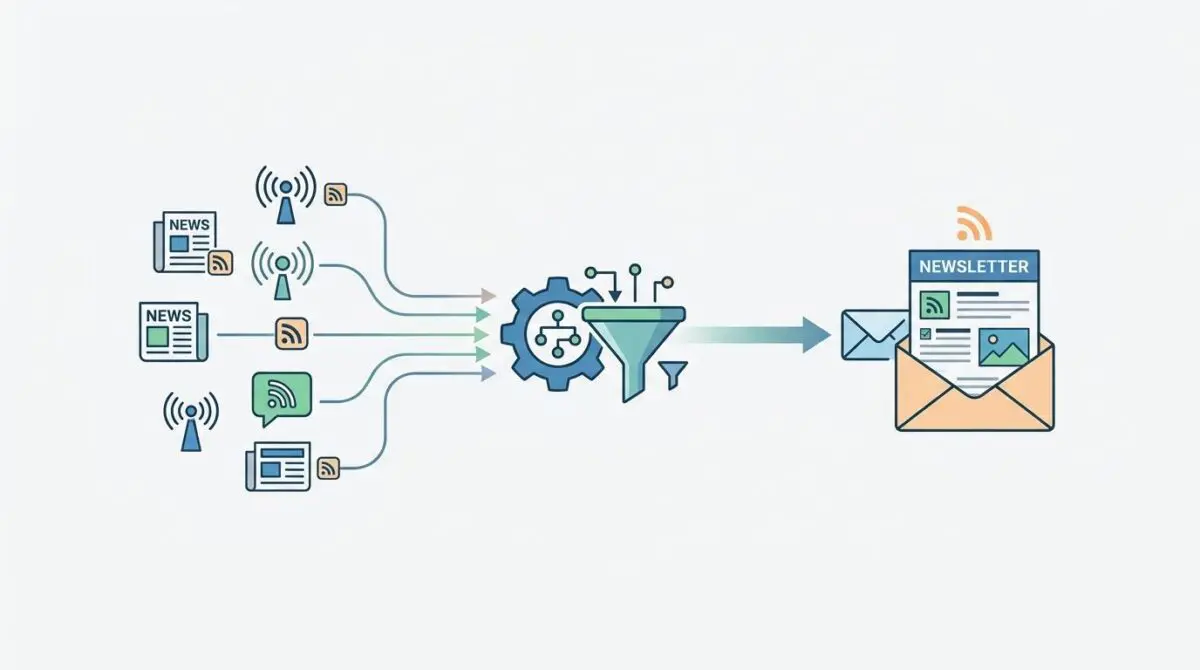
Enter Agentic RSS-to-Newsletter Curation Pipelines as the ultimate solution to reclaim time and scale your content output. These intelligent systems automatically ingest, parse, and rewrite industry feeds in real-time. They transform raw data noise into polished, publish-ready intelligence without human fatigue.
Quantifying the Curation Automation Advantage
Market Intelligence & Data
Editorial Efficiency Gain
A 2025 Content Marketing Institute study found that AI-led news curation improved editorial team output by 84% compared to manual methods used in 2023.
Weekly Labor Reclaimed
Research by Zapier in early 2026 indicates that automated RSS parsing and LLM summarization saves professional curators an average of 18.5 hours per week.
Content Op-Ex Reduction
Gartner’s 2025 Digital Marketing Report states that companies implementing agentic news pipelines reduced their content production overhead by 42%.
Niche Publication Growth
According to 2026 Substack platform data, the number of automated niche ‘micro-newsletters’ grew by 310% as the technical barrier to entry for curation vanished.
The transition to AI-led news curation isn’t just a minor workflow tweak; it represents a fundamental shift in editorial capacity. A 2025 Content Marketing Institute study revealed an 84% improvement in editorial team output when shifting from manual scraping to intelligent parsing. This massive leap means your top writers can focus on deep-dive analysis rather than hunting for broken RSS links.
Time is the most critical asset for any publishing team looking to scale. According to recent industry research on automation time savings, professionals reclaim an average of 18.5 hours per week by utilizing automated RSS parsing and LLM summarization. Reclaiming nearly half a workweek allows creators to double their publication frequency without burning out.
The financial impact of these pipelines is equally staggering for media companies and corporate marketing departments. Gartner’s recent data highlights a 42% reduction in content production overhead for organizations deploying agentic news pipelines. By automating the heavy lifting of data gathering, businesses dramatically lower the cost of maintaining a consistent industry voice.
As technical barriers to entry evaporate, specialized publishing is exploding at an unprecedented rate. Recent platform data points to a massive growth in automated niche micro-newsletters driven by accessible technology. Much of this growth is powered by native modules that process high-volume XML and JSON feeds, allowing solo operators to build enterprise-grade curation engines without writing a single line of code.
Transforming High-Volume XML Feeds

Traditional RSS parsers frequently break on non-standard XML schemas, turning what should be an automated process into a constant maintenance nightmare. Every time a source updates their site structure, manual script adjustments are required just to keep the news flowing. This fragility has historically made reliable news ingestion a major bottleneck for curators.
The landscape shifted dramatically when platforms like Make.com and n8n released native 2025 AI-Transformer modules. These intelligent nodes can process thousands of simultaneous XML and JSON feed requests without requiring custom Python scripts. They automatically normalize messy data structures, ensuring your pipeline never stalls due to a missing formatting tag.
Deploying Semantic Clustering Agents

Generic industry feeds suffer from incredibly high signal-to-noise ratios. Relying on basic keyword filters often results in irrelevant sponsored content or promotional fluff polluting professional newsletters. Curators need a dynamic way to extract only the most critical, high-value intelligence from the daily digital avalanche.
Specialized agents powered by Claude 4 and GPT-5 solve this by performing advanced Semantic Clustering. These agents automatically group 50 or more disparate news items into coherent thematic categories based on your specific user-defined taxonomies. They read between the lines, discarding the noise and organizing the raw data into a structured, logical narrative for your readers.
Designing Rapid Intervention Nodes
Fully automated AI rewriting carries inherent risks, particularly for premium B2B audiences that demand absolute factual accuracy. LLMs can occasionally hallucinate technical facts or stray from the specific editorial brand voice your subscribers expect. Letting an AI publish directly to your audience without oversight is a dangerous operational game.
To mitigate this, modern pipelines utilize Relay.app and Slack integrations to create seamless Intervention Nodes. These strategic checkpoints allow human editors to review, approve, or reject AI-generated summaries and headlines via simple mobile buttons. This human-in-the-loop approach guarantees quality control while reducing final editorial review time down to mere seconds.
Programmatic Content Syndication

Manual content formatting is a hidden tax that consumes up to 70% of a human curator’s total production time. Copying text into a CMS, inserting the correct hyperlinks, and ensuring proper source attribution is tedious and error-prone work. It drains creative energy that should be spent on high-level strategic analysis.
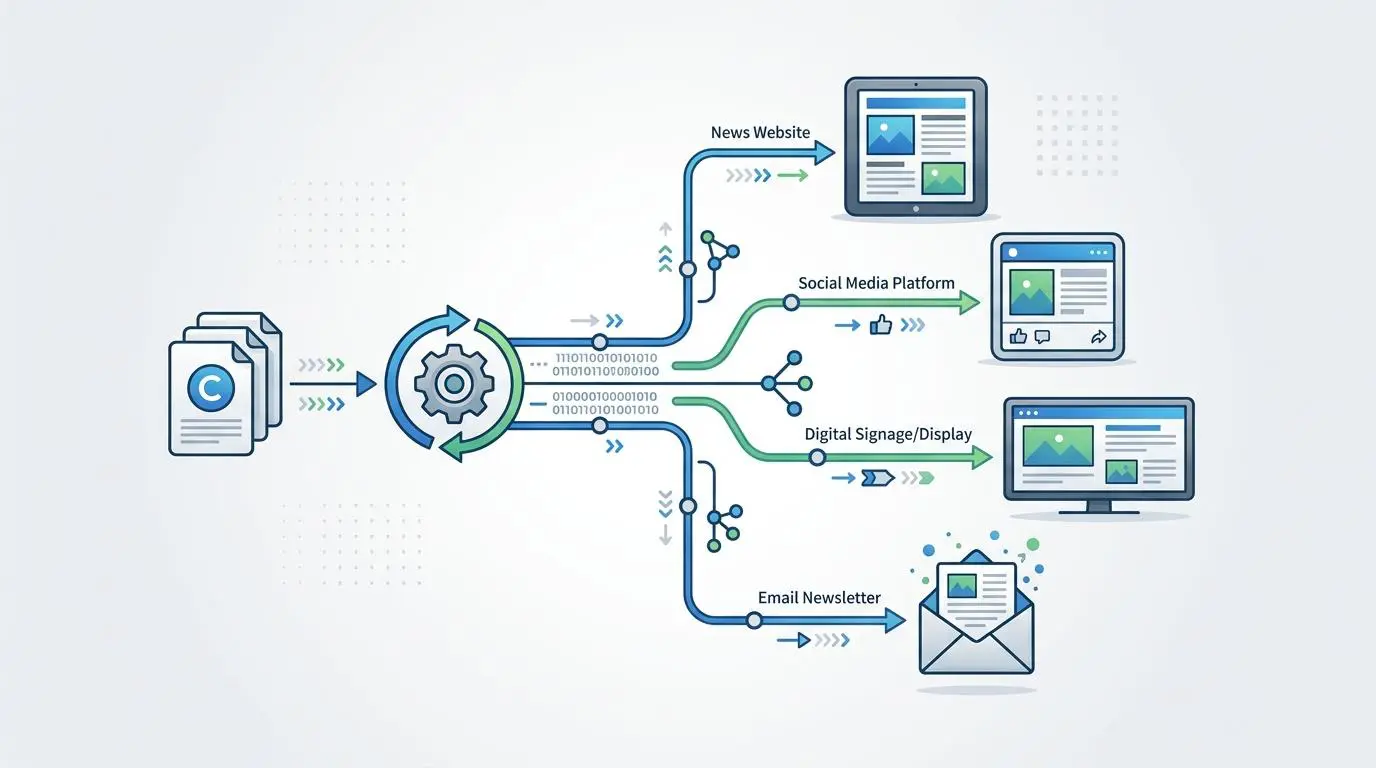
Direct API syndication to platforms like Beehiiv and Ghost eliminates this friction entirely. These pipelines facilitate programmatic newsletter generation by automating several critical steps:
- Subscriber Segmentation: Automatically routing specific industry news to targeted audience tags based on their preferences.
- Dynamic Formatting: Generating custom HTML layouts and applying consistent brand styling on the fly.
- Visual Curation: Creating custom cover art via DALL-E 4 directly within the pipeline.
This automated workflow delivers a visually stunning, fully formatted publication straight to your drafts folder, ready for final approval.
Capturing Organic Search Traffic
A major flaw in traditional curation is that newsletter content often remains unindexed and invisible to search engines. Creators spend hours compiling valuable industry insights, only to lock them away in email inboxes. This prevents publishers from capturing lucrative organic traffic from the very news they curate.
Agentic pipelines solve this by automatically generating Google-compliant NewsArticle Schema for web-hosted newsletter archives. They build intelligent internal link clusters as the content is published, perfectly positioning the site for the 2026 Search Generative Experience (SGE). Your curated newsletters transform from ephemeral emails into permanent, traffic-generating SEO assets.
Navigating Decentralized Intelligence
The current dependence on centralized API providers and cloud-based LLMs creates significant single points of failure. For enterprises handling proprietary industry intelligence, routing sensitive data through public servers introduces potential privacy leaks. Security and data sovereignty are rapidly becoming the new frontier for automated curation.
The rise of decentralized RSS (dRSS) and local-first LLM processing using Llama 4 variants is rewriting the rules of data privacy. These systems allow corporations to run complex curation pipelines entirely on-premise, securing their competitive intelligence. Furthermore, advanced 2026 workflows now use Multi-Agent Consensus Verification, where three distinct LLMs vote on a story’s factual accuracy before it ever reaches a human editor.
The Next Era of Automated Publishing
By late 2026, the traditional newsletter format will evolve into interactive Conversational Briefs. Readers will interface with their RSS-fed AI agents via voice, receiving highly personalized, real-time summaries of industry events during their daily commutes. The static email is rapidly becoming a dynamic, two-way intelligence briefing.
Those who adopt agentic curation pipelines today are building the robust infrastructure required for tomorrow’s media empires. You are no longer just a curator; you are the architect of a high-speed intelligence network.
Navigating the intersection of technology, workflows, and operational efficiency requires a sharp strategy. To future-proof your business architecture and scale with precision, connect with Andres at Andres SEO Expert.
Frequently Asked Questions
What are the primary benefits of implementing agentic RSS-to-newsletter curation pipelines?
Agentic pipelines significantly improve editorial efficiency by up to 84%, reclaim an average of 18.5 hours of weekly labor, and reduce content production overhead by 42%. They allow publishers to scale output by automating the ingestion, parsing, and summarization of industry feeds.
How does semantic clustering solve the signal-to-noise problem in news feeds?
Semantic clustering agents powered by advanced LLMs like Claude 4 and GPT-5 group disparate news items into coherent thematic categories. This process filters out irrelevant promotional content and noise, ensuring only high-value, relevant intelligence is included in the final newsletter.
How do publishers ensure factual accuracy when using AI for news curation?
To maintain quality control, modern workflows utilize human-in-the-loop intervention nodes via platforms like Relay.app and Slack. These checkpoints allow human editors to review, edit, or reject AI-generated summaries and headlines before they are published to an audience.
Can automated newsletter curation contribute to organic search traffic (SEO)?
Yes. Agentic pipelines can automatically generate Google-compliant NewsArticle Schema for web-hosted archives and build internal link clusters. This transforms curated newsletters into discoverable SEO assets optimized for the Search Generative Experience (SGE).
What is decentralized intelligence in the context of secure curation?
Decentralized intelligence refers to using decentralized RSS (dRSS) and local-first LLM processing (such as Llama 4 variants) on-premise. This ensures data sovereignty and security, preventing sensitive industry intelligence from being routed through public cloud servers.
How does programmatic syndication reduce production time for curators?
Programmatic syndication uses direct APIs to automate formatting, subscriber segmentation, and asset creation. This eliminates the manual formatting tax which typically accounts for 70% of a curator’s production time, delivering content directly to the CMS.