Key Points
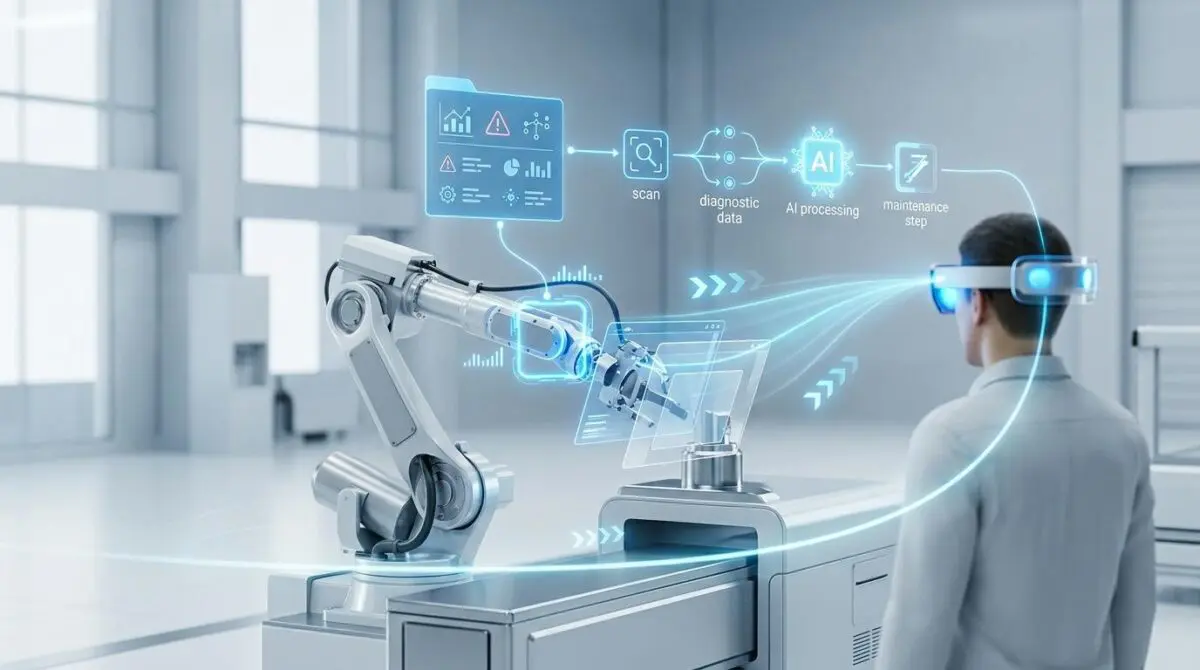
- Zero-Touch Deployment: Connect IIoT error codes directly to smart glasses using no-code platforms like n8n for instant AR overlays.
- AI-Agent Reasoning: Utilize agentic AI to translate cryptic machine faults into specific, context-aware 3D troubleshooting steps.
- Privacy-at-the-Edge: Ensure compliance with strict biometric laws by processing spatial mapping and face-blurring locally on AR wearables.
Table of Contents
- Shattering the Maintenance Knowledge Gap
- Quantifying the True Cost of Machine Downtime
- Erasing Context Latency on the Factory Floor
- Democratizing IIoT Integrations with Low-Code
- AI Agents as the Ultimate Reasoning Engine
- The Hidden Tax of Clipboards and Tribal Knowledge
- Engineering Privacy-at-the-Edge for Compliance
- The Predictive HUD Frontier
Shattering the Maintenance Knowledge Gap
Picture a critical pressure valve failing on a high-speed automotive assembly line. This triggers a cascade of cryptic error codes across the factory floor. A maintenance technician arrives, only to waste precious minutes flipping through a massive PDF manual on a ruggedized tablet.
This delay perfectly illustrates the maintenance knowledge gap in action. Identifying the correct troubleshooting procedure often consumes an astonishing 60% of the total repair window.
When equipment downtime averages $260,000 per hour, every second spent searching for information is a direct hit to the bottom line. The traditional approach of manual diagnostics simply cannot scale in modern manufacturing environments.
Technicians need immediate, context-aware guidance. This critical information must be projected directly into their line of sight the moment a fault occurs.
Enter event-driven industrial AR orchestration. This architecture acts as the ultimate digital bridge, instantly translating machine telemetry into actionable visual instructions.
By automating the deployment of augmented reality troubleshooting guides, organizations can reclaim thousands of lost hours. It effectively eliminates the friction of manual data retrieval entirely.
Quantifying the True Cost of Machine Downtime
Market Intelligence & Data
Error Rate Reduction
According to the OxMaint 2026 ‘AR Wearables and Smart Glasses’ report, manufacturing firms saw a significant drop in maintenance errors when using automated AR overlays.
Total Downtime Cost
The Siemens 2026 ‘True Cost of Downtime’ report indicates that unplanned equipment failure now costs Fortune Global 500 companies 11% of their annual revenue.
First-Time Fix Improvement
OxMaint research from early 2026 found that technicians equipped with real-time AR troubleshooting guides improved their first-time-fix metrics by a quarter.
Automotive Downtime Cost
A 2025/2026 update from Aberdeen Strategy Research confirms that Tier 1 automotive manufacturers lose this amount for every minute of unscheduled production stoppage.
The 32% reduction in maintenance error rates represents a fundamental shift in how frontline workers interact with complex machinery. By removing the cognitive load of interpreting static diagrams, technicians can focus entirely on the physical repair.
This massive drop in mistakes is heavily supported by new ecosystems connecting major industrial platforms to advanced simulation environments. These integrations enable a digital twin-to-HUD workflow that recently reduced mean time to repair by nearly 50% at leading smart factories.
Looking at the broader financial impact, the scale of lost revenue is staggering. Recent studies confirm that unplanned equipment failure now costs Fortune Global 500 companies 11% of their annual revenue, or $1.5 trillion.
This astronomical figure highlights why reactive maintenance strategies are no longer viable for enterprise manufacturing. Automated AR orchestration directly attacks this financial hemorrhage by shrinking the time it takes to diagnose and resolve critical failures.
Improving the first-time-fix rate by 25% fundamentally changes the unit economics of industrial maintenance. Resolving an issue correctly on the first attempt eliminates the need for costly follow-up visits.
It also prevents secondary breakdowns from occurring. Real-time AR guides ensure that the worker has the exact 3D schematic required for the specific serial number of the failing machine.
In high-stakes environments like Tier 1 automotive assembly lines, a cost of $22,000 per minute for unscheduled stoppages turns minor delays into major crises. Every minute a worker spends scrolling through a PDF equates to the price of a mid-sized vehicle in lost production.
Deploying instantaneous, heads-up troubleshooting guides is the only way to compress these repair windows. It remains the most effective strategy to protect vital production quotas.
Erasing Context Latency on the Factory Floor
Technicians operating in high-noise, high-stress industrial zones frequently battle a phenomenon known as context latency. This is the agonizing delay between a machine registering a fault and the human operator retrieving the relevant repair steps.
Flipping through paper checklists or navigating clunky digital directories while wearing heavy safety gloves is a recipe for operational paralysis.
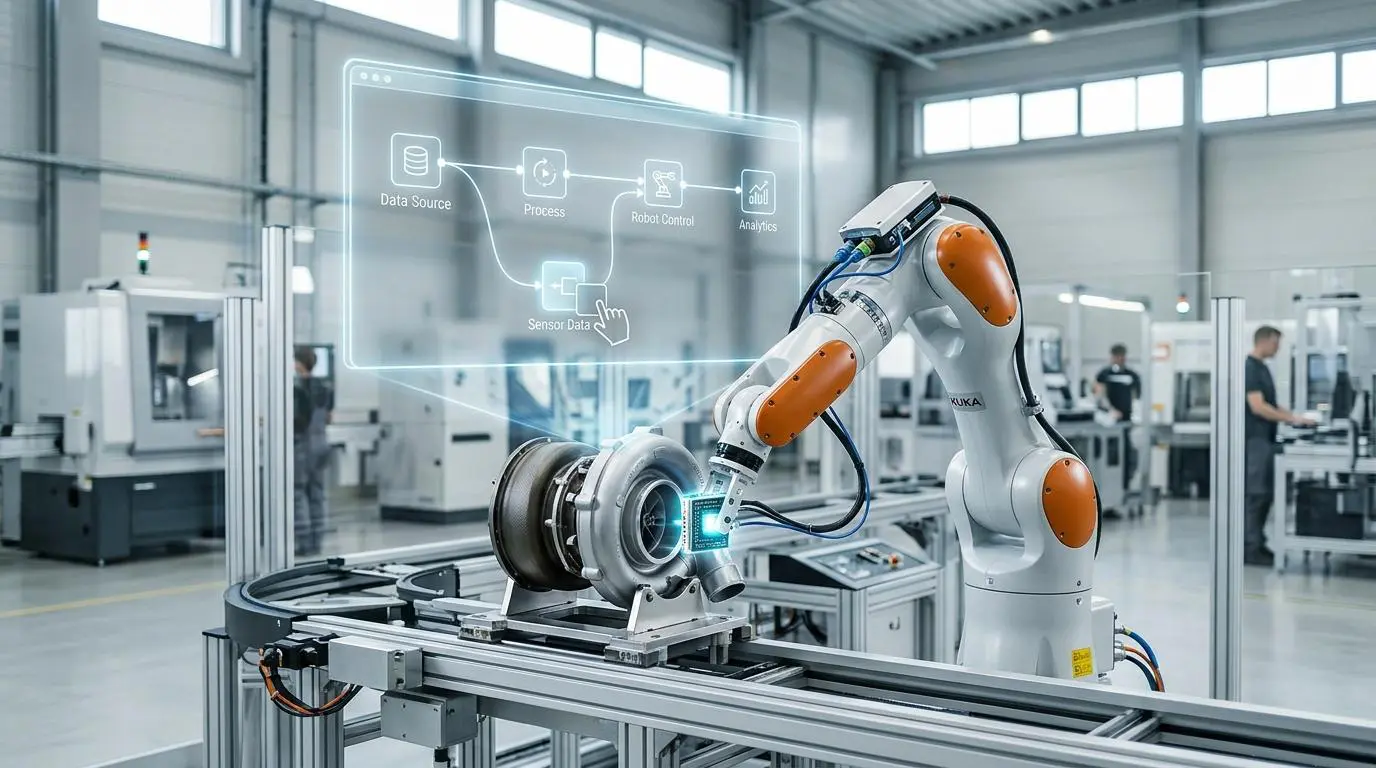
Modern event-driven industrial AR orchestration eliminates this latency entirely by utilizing real-time telemetry from MQTT brokers. The moment a programmable logic controller detects an anomaly, the data is instantly routed to the technician’s wearable device.
There is absolutely zero manual intervention required to initiate the diagnostic sequence.
Advanced smart glasses have become the standard for this instantaneous data delivery. These devices project heads-up schematics directly over the faulty physical component.
The technician sees exactly which valve to turn or wire to replace. This seamlessly bridges the digital and physical worlds on the factory floor.
Democratizing IIoT Integrations with Low-Code
Historically, building custom integrations between industrial machinery and enterprise IT systems was a monumental bottleneck. Manufacturers faced a massive IT backlog, often waiting months just to connect a single machine type to a digital workflow.
This slow pace of deployment severely limited the scalability of augmented reality initiatives across the enterprise.
The rise of no-code and low-code platforms has completely democratized IIoT orchestration. Maintenance leads and operational managers can now use visual canvases to design complex event-driven workflows.
They can easily map specific PLC error codes directly to the corresponding 3D CAD assets stored in enterprise AR systems.
This visual approach allows highly targeted AR troubleshooting guides to deploy in seconds without writing a single line of backend code. Teams can iterate on repair procedures rapidly.
They can update digital instructions across the entire factory floor with a single click. The result is a highly agile maintenance infrastructure that adapts to new equipment instantly.
AI Agents as the Ultimate Reasoning Engine
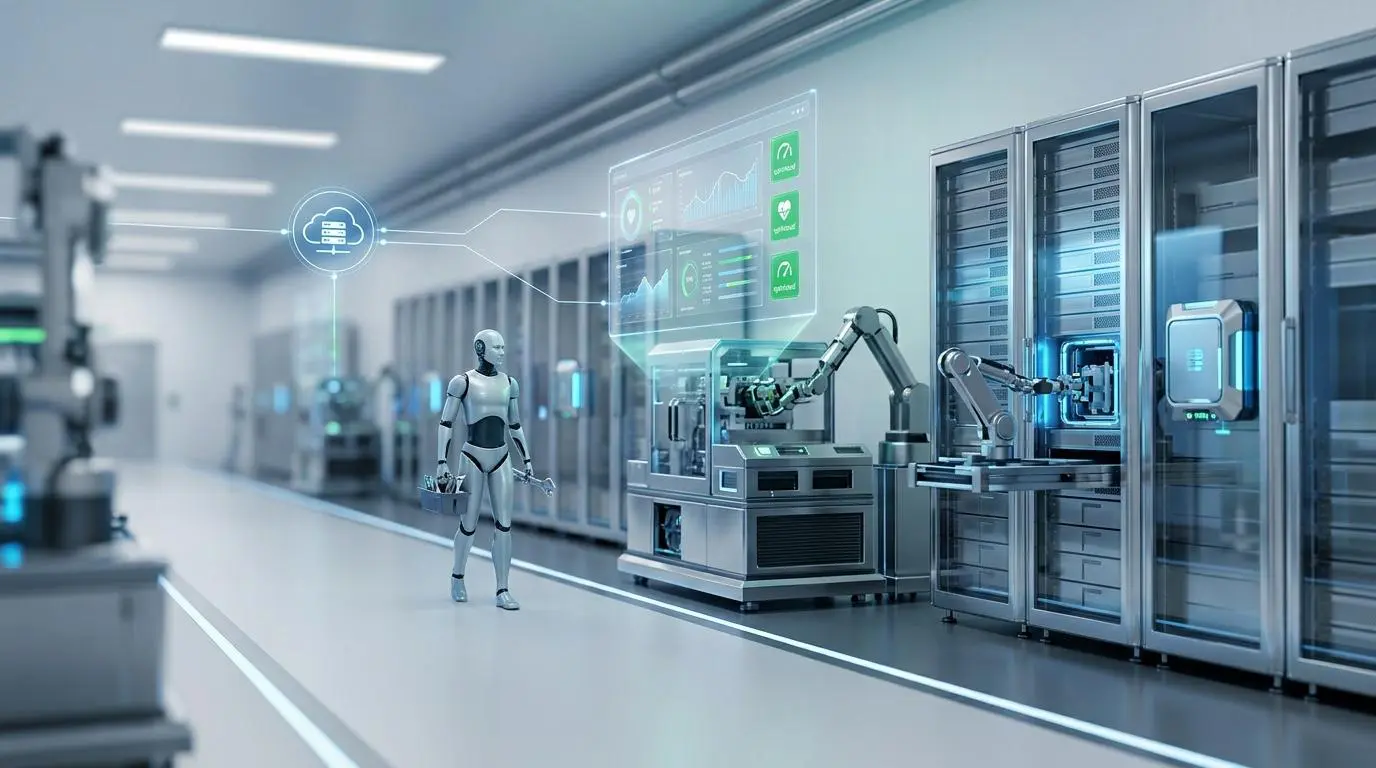
Industrial machines often output cryptic error codes that require veteran engineering expertise to decipher. Translating a vague warning into a specific, actionable physical repair has traditionally relied on the tribal knowledge of senior staff.
When these experts are unavailable, inexperienced technicians are left guessing. This inevitably drives up error rates and extends costly downtime.
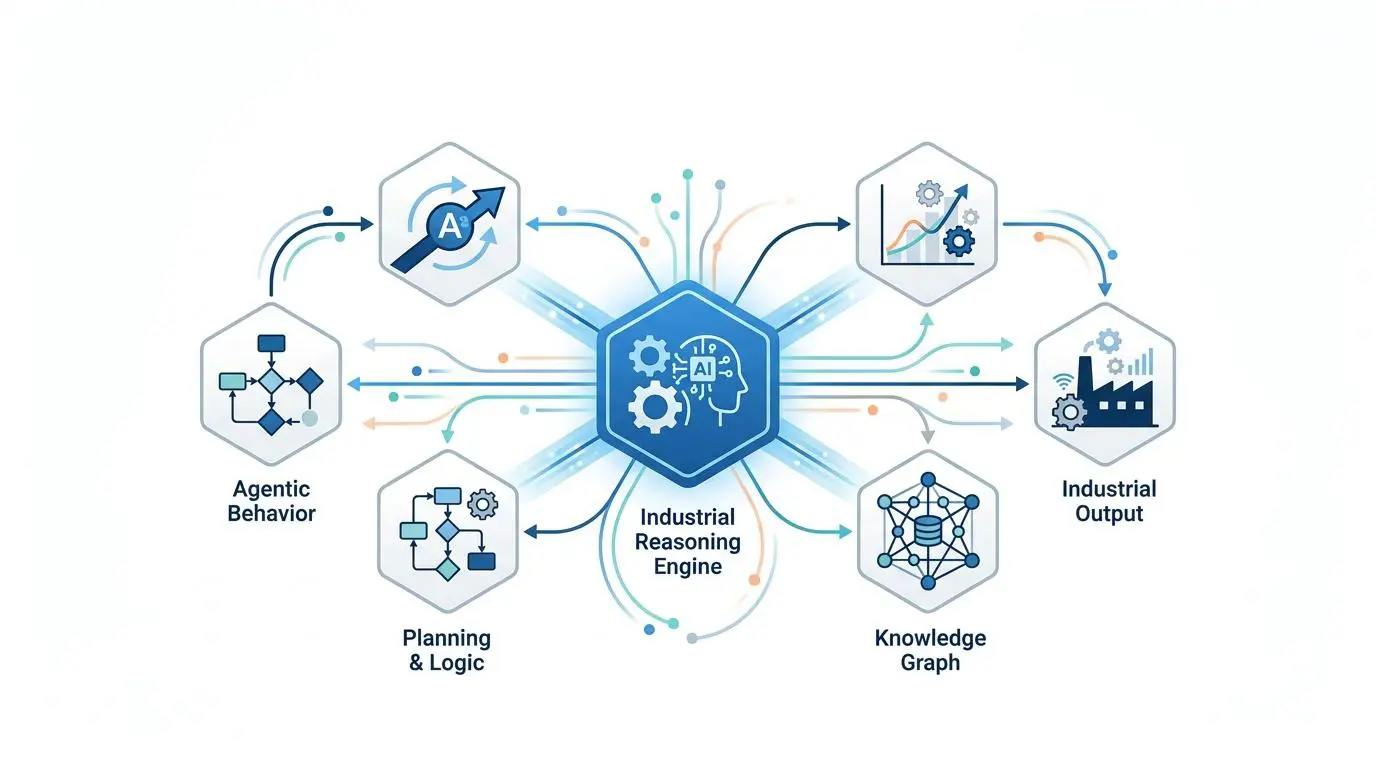
Agentic AI systems have emerged as the intelligent reasoning engine powering modern AR deployments. Utilizing advanced frameworks, these AI agents actively interpret incoming machine data.
When an obscure pressure valve code is detected, the agent immediately springs into action to analyze the context and determine the best course of action.
The AI queries the machine’s historical maintenance logs and identifies the most probable root cause. It then fetches a dynamically enriched AR guide tailored to that exact machine serial number.
This ensures the technician receives a highly specific repair sequence rather than a generic manual. It effectively scales veteran expertise to every worker on the floor.
The Hidden Tax of Clipboards and Tribal Knowledge
Manual data entry on clipboards or basic spreadsheets introduces a dangerous vulnerability into manufacturing operations. Minor anomalies and slight deviations in machine performance are frequently missed during routine manual inspections.
These silent failures compound over time. They inevitably lead to catastrophic and highly expensive breakdowns.
Furthermore, as senior engineers retire, companies face a massive loss of tribal knowledge. Inexperienced staff are increasingly tasked with handling complex repairs, resulting in high error rates and extended diagnostic times.
Without automated guidance, the workforce simply cannot keep pace with the complexity of modern industrial automation.
Measuring the ROI of Zero-Touch Deployment
Transitioning to a zero-touch guide deployment model yields immediate and measurable financial returns. Organizations implementing automated AR orchestration consistently report saving an average of 12 minutes per repair cycle.
Across thousands of maintenance events annually, this translates to massive labor savings and significantly increased machine availability.
The impact on repair quality is equally profound. Facilities have documented a 25% improvement in first-time-fix rates alongside a 32% reduction in overall maintenance errors.
By equipping technicians with precise, automated visual overlays, companies drastically reduce the need for repeat maintenance visits.
Engineering Privacy-at-the-Edge for Compliance
Deploying camera-enabled wearables in industrial zones introduces significant compliance risks. Capturing sensitive worker data or inadvertently recording proprietary machinery designs can lead to severe legal and competitive consequences.
The complex patchwork of state-level biometric laws and AI regulations has heavily regulated spatial computing in the workplace.
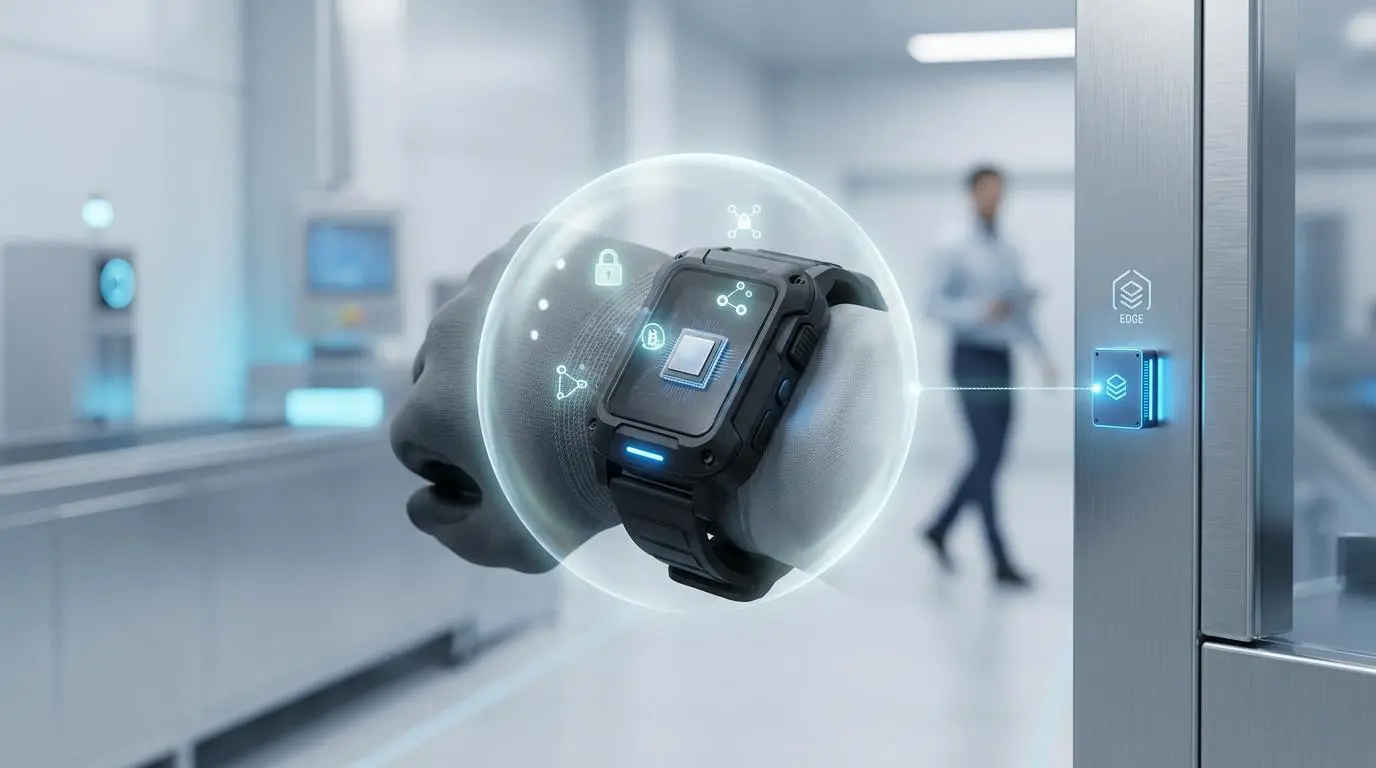
To navigate these strict regulations, industrial AR providers have engineered robust privacy-at-the-edge architectures. Modern smart glasses now process all spatial mapping and environmental scanning locally on the device’s internal chipset.
This localized processing ensures that raw video feeds and biometric identifiers are never transmitted to vulnerable cloud servers.
Techniques like real-time face-blurring and automated redaction of sensitive documents are executed instantly within the headset.
By guaranteeing that proprietary and personal data never leaves the factory floor, organizations can confidently scale their AR orchestration without violating compliance frameworks.
The Predictive HUD Frontier
The future of industrial maintenance is rapidly shifting from reactive triggers to proactive visualization. The industry is fully embracing predictive AR heads-up displays powered by advanced edge computing.
Edge-AI sensors will continuously monitor internal component wear-and-tear in real time, providing unprecedented visibility into machine health.
Instead of waiting for an error code to initiate a workflow, these systems will project just-in-time maintenance overlays before a physical failure even occurs. Technicians will see thermal degradation or vibration anomalies visualized directly on the machine casing.
This predictive orchestration will essentially eliminate unplanned downtime. It transforms maintenance into a continuous, frictionless process.
Navigating the intersection of technology, workflows, and operational efficiency requires a sharp strategy. To future-proof your business architecture and scale with precision, connect with Andres at Andres SEO Expert.
Frequently Asked Questions
What is the financial impact of unplanned equipment downtime in manufacturing?
Unplanned equipment failure costs Fortune Global 500 companies approximately $1.5 trillion annually, representing 11% of their annual revenue. In high-stakes environments like Tier 1 automotive assembly lines, the cost of unscheduled production stoppages can reach $22,000 per minute.
How does industrial AR orchestration reduce maintenance error rates?
By translating machine telemetry into immediate visual instructions, industrial AR orchestration reduces maintenance errors by 32%. This technology removes the cognitive load of interpreting static manuals, allowing technicians to focus on physical repairs with real-time 3D schematics projected into their line of sight.
What is the role of Agentic AI in augmented reality maintenance?
Agentic AI acts as an intelligent reasoning engine that interprets cryptic PLC error codes. Using frameworks like LangGraph, AI agents analyze machine history and telemetry to fetch RAG-enriched AR guides, providing technicians with specific, dynamically generated repair sequences rather than generic manuals.
Can low-code platforms be used to build IIoT-to-AR workflows?
Yes, low-code platforms like n8n and Tulip Interfaces democratize IIoT orchestration. They allow maintenance leads to use visual canvases to map PLC error codes via tools like Node-RED directly to 3D CAD assets in AR systems, bypassing traditional IT development backlogs.
How do industrial AR systems handle worker privacy and data compliance?
To comply with regulations such as BIPA and California’s AI rules, modern AR systems utilize privacy-at-the-edge architectures. This ensures that spatial mapping, face-blurring, and environmental scanning are processed locally on the headset, preventing sensitive biometric and proprietary data from leaving the factory floor.
What are the benefits of improving the first-time-fix rate in industrial maintenance?
Improving the first-time-fix rate by 25% significantly alters maintenance economics by eliminating costly follow-up visits and preventing secondary breakdowns. Real-time AR guides ensure technicians have the exact schematic for a specific machine serial number, leading to higher repair quality and reduced downtime.