Key Points
- Decentralized Processing: Utilizing local NVIDIA Jetson modules severs cloud dependency and enables sub-50ms actuator response times.
- Automated Data Pipelines: Connecting edge detection logs to FMIS platforms via MQTT and automation tools eliminates agricultural data silos.
- Human-in-the-Loop Safeguards: Integrating instant mobile push notifications for low-confidence detections prevents expensive false-positive chemical applications.
Table of Contents
- The Invisible Toll of Manual Field Scouting
- Quantifying the Shift to Autonomous Spot Spraying
- Breaking the Manual Acreage Limit
- Severing the Cloud Umbilical Cord
- Bridging the Field-to-Database Divide
- Engineering the Mobile Override Mechanism
- Flipping the Hardware Investment Math
- Taking Precision Agriculture to the Skies
- The Next Epoch of Bio-Predictive Farming
The Invisible Toll of Manual Field Scouting
Consider the last time a microscopic rust outbreak decimated a massive harvest simply because a human scout missed the early warning signs. Traditional agriculture has long relied on manual field inspections and blanket chemical spraying to protect crop yields. This outdated approach guarantees that over 70 percent of expensive chemicals are wasted on healthy plants.
Relying on human eyes to scan thousands of acres is a mathematical impossibility that scales poorly and costs heavily. When operators attempt to compensate by spraying entire fields proactively, they degrade soil health and bleed capital. The modern agricultural landscape requires a system that moves faster than human fatigue.
Implementing an Edge-AI-to-Actuator Precision Agriculture Workflow completely eliminates this operational friction. By giving heavy machinery the localized intelligence to see, decide, and spray in fractions of a second, farm operators can reclaim their time and protect their margins. This autonomous ecosystem transforms a reactive chore into a hyper-efficient defense grid.
Quantifying the Shift to Autonomous Spot Spraying
Market Intelligence & Data
Pesticide Volume Reduction
According to a 2025 study by the International Society of Precision Agriculture, edge-triggered spot spraying reduces herbicide and fungicide volume by 95% compared to traditional broadcast methods.
AI Agriculture Market Value
Projections from MarketsandMarkets for 2026 indicate that the global market for AI in agriculture, driven by edge detection systems, has reached $18.4 billion.
Latency for Real-Time Action
NVIDIA’s 2025 hardware benchmarks confirm that current-gen edge modules achieve sub-50ms latency from image capture to nozzle activation, enabling operation at speeds of 15 mph.
Average Yield Increase
The 2025 World Agricultural Outlook Board report highlights that farms utilizing real-time disease detection see a 22% increase in net yield by preventing localized outbreaks from spreading.
The transition away from traditional broadcast spraying represents a monumental shift in resource management. By utilizing edge-triggered spot spraying, modern agricultural operations can reduce their herbicide and fungicide volume by a staggering 95 percent. This precise application ensures that chemicals are only deployed exactly where pathogens are actively detected.
This massive reduction in chemical waste is a primary driver behind the skyrocketing investments in agricultural technology. Financial forecasts reflect this rapid adoption, with the projected global market for AI in agriculture reaching unprecedented valuations by 2026. Farm operators are recognizing that intelligent edge systems are essential components for scalable profitability.
Speed is the ultimate currency when treating crops from machinery moving at 15 miles per hour. Achieving sub-50ms latency from image capture to nozzle activation is now possible by deploying enhanced YOLOv11 algorithms on NVIDIA Jetson edge devices for real-time crop disease detection. This localized processing power eliminates the dreaded lag of cloud computing.
The cascading effect of this real-time precision extends far beyond immediate chemical savings. By instantly neutralizing localized outbreaks before they mutate into farm-wide epidemics, agricultural enterprises are witnessing a 22 percent increase in net yield. Protecting the crop at the exact moment of vulnerability fundamentally transforms the baseline economics of modern farming.
Breaking the Manual Acreage Limit

Manual field scouting is bottlenecked by the simple limits of human endurance and a shrinking skilled labor pool. Even the most experienced agronomists can effectively survey only a small fraction of large-scale acreage on any given day. This leaves the vast majority of the crop completely unmonitored and vulnerable to rapid pathogenic spread.
The real friction lies in identifying microscopic early-stage rust or blight before it becomes a farm-wide epidemic. Human error and visual fatigue make it nearly impossible to spot these tiny anomalies consistently across thousands of rows. By the time a disease is visible from the cabin of a tractor, the optimal window for localized treatment has already closed.
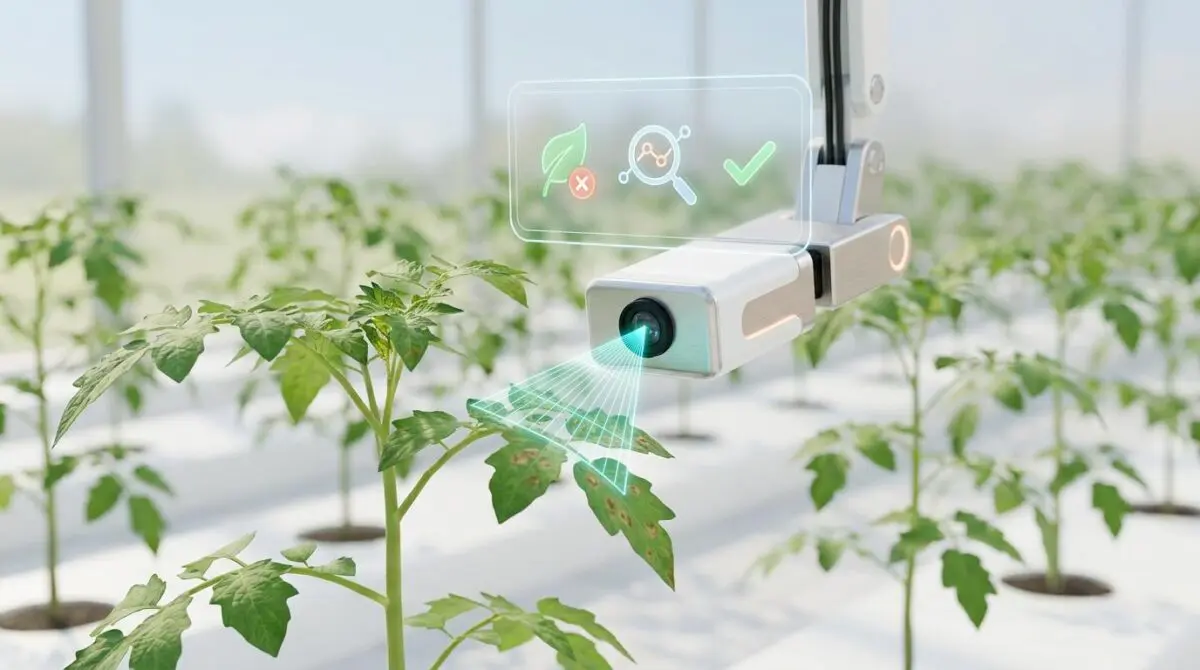
Automating this workflow shifts the burden of detection from human eyes to relentless optical sensors. High-speed cameras mounted directly on the sprayer booms scan every single inch of the canopy with flawless consistency. This ensures total coverage of the acreage, entirely removing the physical limitations of manual scouting.
Severing the Cloud Umbilical Cord

Relying on cloud-based artificial intelligence is a critical failure point in rural areas plagued by poor cellular connectivity. If a smart sprayer must send an image to a remote server for processing, the machine will have driven far past the infected plant before the command to spray is returned. This latency makes real-time spot treatment impossible under real-world agricultural conditions.
The solution is a decentralized architecture utilizing vision-language models and YOLOv11 running directly on NVIDIA Jetson Orin modules. These localized on-device vision agents classify over 30 crop-specific pathogens directly at the edge. The entire decision loop happens physically on the boom arm without ever needing an internet connection.
Severing this cloud umbilical cord guarantees sub-second detection and actuator triggering regardless of geographic isolation. The machinery becomes a self-contained, intelligent ecosystem capable of executing complex biological assessments at high speeds. This edge autonomy is the definitive key to unlocking precision agriculture at scale.
Bridging the Field-to-Database Divide

A major hidden tax of early smart sprayers was the creation of isolated data silos. While the machinery successfully sprayed the pathogens, it failed to communicate that detection history to the broader intelligence network. This lack of historical data prevented operators from mapping long-term soil health or predicting future yield impacts accurately.
To solve this, advanced workflows utilize MQTT-based message queuing to synchronize edge detection logs seamlessly. Platforms like Make or n8n can intercept these lightweight MQTT payloads the moment the machinery returns to a Wi-Fi zone or connects via satellite. This automated pipeline instantly translates raw detection events into structured database entries.
These structured logs are then pushed directly into Farm Management Information Systems like the John Deere Operations Center or Climate FieldView. By bridging this field-to-database divide, operators gain a perfect, geo-tagged historical map of disease pressure across their entire property. This automated synchronization turns reactive spraying into a powerful predictive asset.
Engineering the Mobile Override Mechanism

Total automation carries the inherent risk of false positives, which can trigger expensive and unnecessary chemical applications. If a shadow or a harmless leaf mutation confuses the AI model, the system might dump heavy fungicides on perfectly healthy soil. Operators need a fail-safe to prevent runaway costs without slowing down the machinery.
This is where the human-in-the-loop factor becomes strategically vital. The workflow is engineered to instantly send push notifications via Telegram or Slack whenever the edge model registers a low-confidence detection. The alert includes a high-resolution snapshot and GPS coordinates, delivered straight to the mobile device.
This allows the operator to manually verify a high-risk pathogen in seconds before authorizing a heavy chemical trigger. It bridges the gap between machine speed and human intuition. This quick manual override mechanism ensures that expensive interventions are only executed when absolutely necessary.
Flipping the Hardware Investment Math
The high upfront costs of AI cameras and specialized edge computing hardware often deter operators from upgrading their fleets. However, this initial sticker shock masks the aggressive financial return generated by immediate chemical and labor savings. Transitioning from scheduled blanket spraying to intelligent detect-and-treat workflows drastically alters the operational ledger.
By applying chemicals only where pathogens exist, operators reduce their input costs by 40 to 120 dollars per acre, depending heavily on the crop type. When multiplied across thousands of acres, the capital saved on fungicides alone is staggering. This massive reduction in operational overhead directly funds the technological upgrade.
Because of these compounding savings, the hardware investment typically achieves a full return on investment within 12 to 18 months. Flipping this math proves that edge automation is not an operational expense, but a high-yield financial instrument. The machinery essentially pays for itself within two harvest cycles.
Taking Precision Agriculture to the Skies
Ground-based machinery, no matter how intelligent, is frequently limited by deep soil moisture, steep topography, or dense canopy growth. When tractors cannot physically enter a muddy field, the crop remains vulnerable to rapid fungal expansion. Solving this accessibility bottleneck requires elevating the automation workflow above the soil line.
The future horizon relies on the seamless integration of autonomous drone swarms communicating directly with ground-based edge cameras. As the ground sensors detect early-stage outbreaks from the perimeter, they instantly transmit exact target coordinates to aerial units. These drones then launch autonomously to perform highly targeted aerial micro-dosing in hard-to-reach terrain.
Furthermore, a strategic shift by major manufacturers has introduced chemical-free edge automation to these platforms. Advanced systems now use high-intensity localized UV-C laser bursts to neutralize pathogens instantly upon AI detection, bypassing liquid chemicals entirely. This mid-air, laser-precision handoff represents the pinnacle of localized crop defense.
The Next Epoch of Bio-Predictive Farming
By late 2026, the agricultural automation landscape will evolve entirely from reactive detection to bio-predictive intervention. Edge sensors will utilize multi-spectral imaging to identify invisible physiological plant stress up to 48 hours before visible symptoms ever emerge. This foresight will trigger the deployment of localized biological preventatives rather than harsh reactive fungicides.
This shift will transform farming into a proactive, data-driven science where crop loss is mitigated before the pathogen can even take root. The integration of edge AI, autonomous actuators, and predictive modeling will create an impenetrable agricultural defense network. Automation will no longer just save time; it will actively engineer higher crop resilience.
Navigating the intersection of technology, workflows, and operational efficiency requires a sharp strategy. To future-proof your business architecture and scale with precision, connect with Andres at Andres SEO Expert.
Frequently Asked Questions
How much can AI-driven spot spraying reduce pesticide use?
Edge-triggered spot spraying can reduce herbicide and fungicide volume by up to 95 percent compared to traditional broadcast methods. By utilizing localized intelligence to detect pathogens in real-time, chemicals are only applied to specific infected targets rather than the entire field.
Why is edge AI preferred over cloud computing for agricultural machinery?
Edge AI is preferred because it eliminates the latency associated with cloud processing, which is critical for machinery moving at high speeds. Localized processing on hardware like NVIDIA Jetson Orin allows for sub-50ms latency, ensuring the system can see, decide, and spray even in rural areas without cellular connectivity.
What technology enables real-time crop disease detection?
Real-time detection is powered by YOLOv11 algorithms running on NVIDIA Jetson edge modules. These vision agents act as high-speed sensors that classify over 30 crop-specific pathogens directly on the sprayer boom without requiring an external internet connection.
What is the typical return on investment for AI agricultural hardware?
The hardware investment for AI-driven precision agriculture typically achieves a full return on investment within 12 to 18 months. This is driven by aggressive savings on input costs, ranging from 40 to 120 dollars per acre depending on the crop type.
How does a mobile override mechanism prevent chemical waste?
A mobile override mechanism acts as a human-in-the-loop fail-safe. When the AI model identifies a pathogen with low confidence, it sends a push notification with a high-resolution snapshot and GPS coordinates to the operator’s device. This allows them to manually verify the risk before authorizing an expensive chemical trigger.
How do smart sprayers synchronize data in remote farming locations?
Smart sprayers use MQTT-based message queuing to log detection events locally. Once the machinery returns to a Wi-Fi zone or connects via satellite, platforms like Make or n8n automatically synchronize these logs with Farm Management Information Systems to create historical maps of disease pressure.