Key Takeaways
- Reliable ETL is an operational discipline: idempotency, retries, and checkpoints prevent silent failures.
- ETL vs. ELT is a control-flexibility trade-off: transform before loading or load raw for flexibility.
- Orchestration is the new moat: scheduling, error routing, and recovery make pipelines self-healing.
Table of Contents
When ETL Reliability Becomes the Product
On August 27, 2026, the n8n Blog published a technical guide that moves the ETL conversation from basic extract-transform-load mechanics to operational resilience. The central argument is that production pipelines earn trust when they handle scheduling, retries, idempotency, and recovery without forcing constant human intervention.
Those operational details separate a workflow that survives a controlled demo from one that remains reliable when a source API spikes, a warehouse connection drops, or a partial load leaves rows in limbo.
ETL vs. ELT: Separating Architecture From Purpose
An ETL workflow extracts records from several source systems, normalizes them into a consistent format, and loads them into a destination such as a data warehouse, relational database, or analytics platform. A general data pipeline can move information between nearly any two points, but ETL is a narrower integration pattern with a transform stage before the destination.
That distinction is not merely semantic. It changes where processing occurs, how failures are handled, and how much control teams retain over data quality.
When ETL Controls Data Before It Lands
ETL transforms records before they reach their final destination. That sequence gives teams more control over validation, standardization, and the removal of sensitive details prior to warehouse storage.
It is often the stronger choice when downstream applications depend on clean, consistent inputs or when governance requirements restrict what can be stored.
When ELT Keeps Raw Data Flexible
ELT reverses the order by loading raw data first and transforming inside the destination. Raw records remain available for multiple downstream uses instead of being shaped for a single purpose.
This approach may work better for high-volume data that modern cloud data warehouses can process efficiently. It also helps when different teams need to shape the same raw dataset in different ways.
Reliability Patterns That Keep Automation Honest
The extract, transform, and load stages are only part of a production system. The way a pipeline behaves when new records arrive or when a job fails halfway determines whether it needs constant intervention or recovers gracefully.
Full Loads vs. Incremental Loads
With a full load, every run replaces all records in the target table. It is simple to implement, but it becomes slower and more expensive as data volume grows.
With an incremental load, only new or changed rows since the most recent successful execution are handled. The approach reduces compute spend and shortens recovery time because fewer records must be reprocessed after a failure.
The trade-off is maintenance precision. Inaccurate updates, missed changes, or partial reprocessing can silently corrupt the output if change tracking is not carefully managed.
Batch vs. Streaming Automation
Most ETL workflows operate on schedules, processing data in hourly, daily, or weekly batches. Batch automation is easier to manage and works well for analytics that do not need immediate updates.
Streaming systems process events immediately as they arrive. They deliver fresher data but introduce additional complexity around ordering, state management, and error recovery.
Idempotency, Retries, and Checkpoints
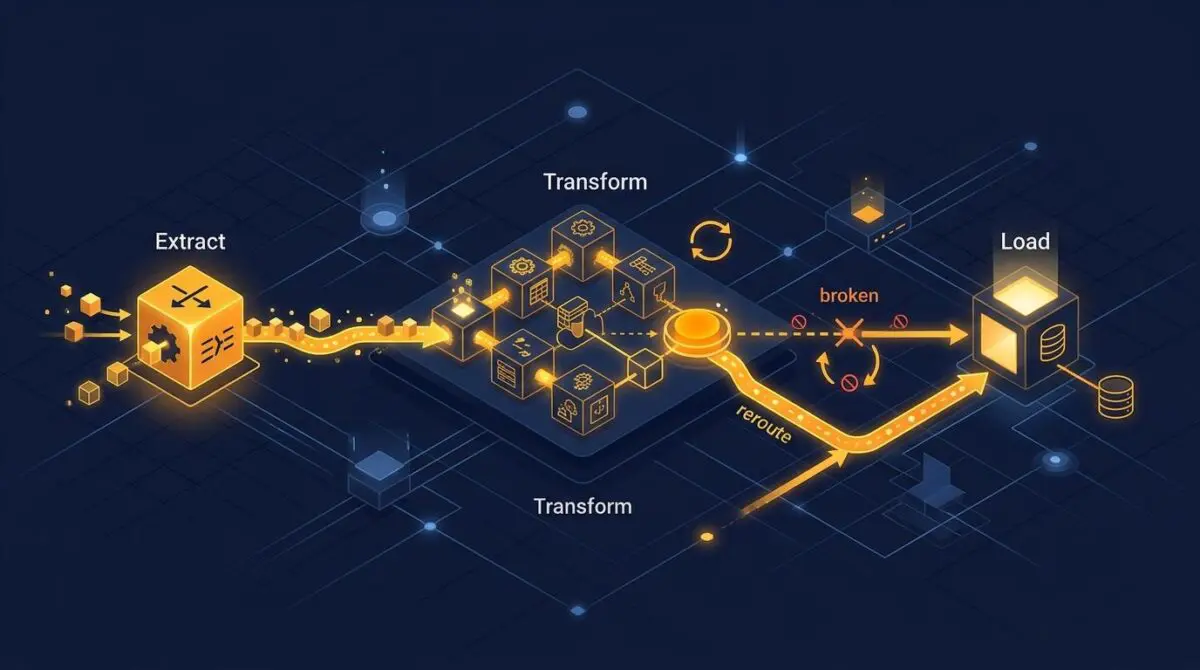
Transient failures are inevitable in distributed automation. A network timeout, unavailable API, or temporary database issue should not force a full rerun from the beginning.
Three defensive mechanisms change how pipelines fail:
- Idempotency: yielding the same final state no matter how many times a workflow executes, preventing duplicate inserts after retries.
- Retries: automatically repeating a failed task or stage after a transient error.
- Checkpoints: recording completed stages so a retry begins after the last good state, not from zero.
Orchestration Turns Patterns Into Automation
In the n8n Blog’s guide, n8n presents itself as an orchestration layer around ETL workflows rather than a direct replacement for high-volume data platforms. It connects to source systems through native integrations and HTTP requests, transforms records with nodes such as Set, Aggregate, Filter, and Merge, and loads outputs into destinations like PostgreSQL or BigQuery.
Pipelines can be triggered on fixed schedules or by events. Built-in retry settings and error workflows recover failed executions without manual intervention, and error workflows can notify teams, log failures, or retry only the affected step.
Orchestration Economics and the Automation Stack in 2026
In 2026, the automation market is splitting between tools that move data at scale and tools that manage the operational lifecycle around that movement. The n8n approach treats scheduling, retries, error routing, and recovery as first-class workflow components, which shifts the build-versus-buy calculation for small and mid-sized data operations.
Most reliability failures in ETL do not come from a single bad transformation. They come from partial loads, silent duplicate inserts, or jobs that cannot resume cleanly after a transient outage.
This is why orchestration is becoming more valuable than raw extraction breadth. A platform that connects APIs and SaaS applications alongside databases can absorb the hybrid integration work that larger data platforms often leave to custom code.
Specialist ETL platforms remain strong where raw transformation throughput dominates. The unfilled lane is hybrid orchestration, where API-driven SaaS sources and database batch jobs need a single operational control plane.
The vendor positions n8n for lightweight to mid-volume ETL workflows. Teams should still validate production-scale performance against their own data volumes, since vendor-reported capability does not replace load testing in a live environment.
Recovery Design Is the New Operational Moat
The automation platforms that earn long-term trust will not be judged by how quickly they move a test file; they will be judged by whether a 2 a.m. API failure reruns cleanly without duplicate rows. For teams building ETL pipelines that need resilient orchestration without custom infrastructure, Andres SEO Expert’s programmatic SEO and AI automation service brings the same operational discipline to automated content workflows — contact us.
Frequently Asked Questions
What is the difference between ETL and ELT?
ETL transforms data before loading it into the destination, giving teams more control over validation and governance. ELT loads raw data first and transforms it inside the warehouse, keeping raw records flexible for multiple uses.
Why is idempotency important in ETL pipelines?
Idempotency ensures that running the same workflow multiple times produces the same final state, preventing duplicate inserts after retries or accidental reruns.
How do retries and checkpoints help recover from ETL failures?
Retries automatically repeat failed tasks after transient errors, while checkpoints record completed stages so a retry resumes from the last good state instead of starting from zero.
When should you choose full loads over incremental loads?
Full loads are simpler and suitable for small data volumes, but incremental loads are better for growing datasets because they process only new or changed rows, reducing compute costs and recovery time.
What is the role of orchestration in ETL workflows?
Orchestration manages scheduling, retries, error routing, and recovery as first-class components, turning raw workflow patterns into resilient automation that doesn’t require constant human intervention.
How does n8n handle ETL pipeline failures?
n8n provides built-in retry settings and error workflows that recover failed executions automatically, either by notifying teams, logging failures, or retrying only the affected step.
What are common causes of ETL reliability failures?
Most reliability failures come from partial loads, silent duplicate inserts, or jobs that cannot resume cleanly after a transient outage, rather than from a single bad transformation.