Key Takeaways
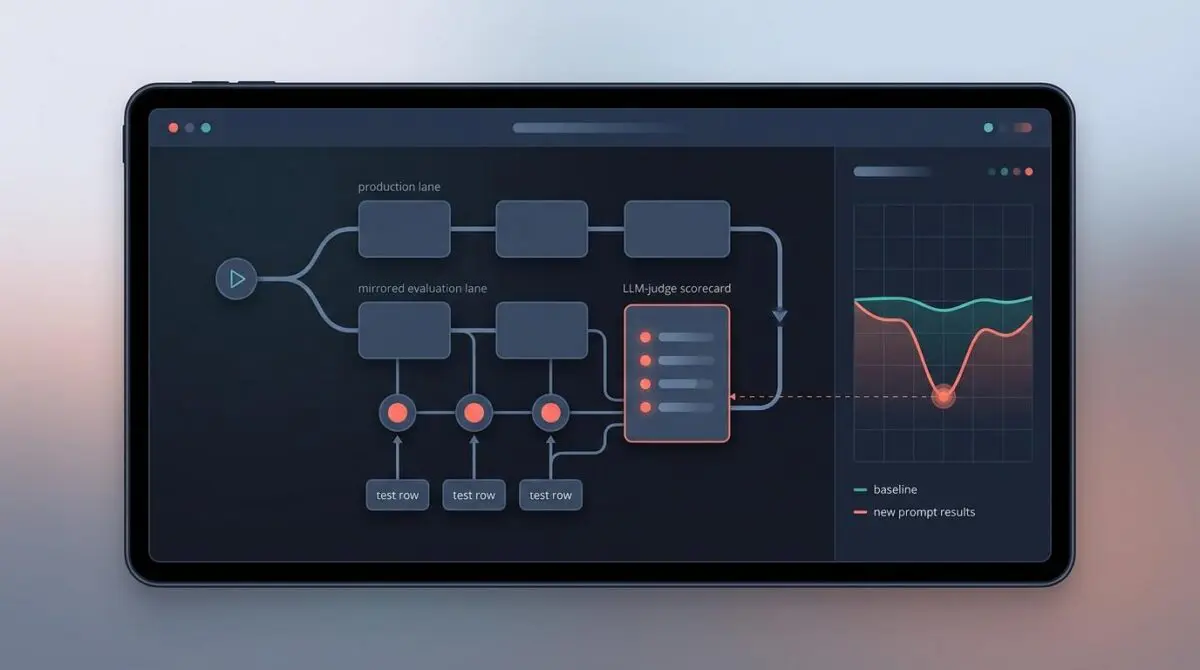
- n8n’s Evaluations feature runs prompt tests directly on the automation canvas, combining deterministic metrics, custom checks, and LLM-as-a-Judge scoring.
- Snowflake data shows how far benchmarks drift from production: a model above 90 percent on Spider reached only 51 percent on real business-intelligence questions.
- After every prompt change, rerun the same dataset against a saved baseline, because a strong average can still hide a regression on one high-value input.
Table of Contents
Prompt Testing Is No Longer Optional for Production Automation
Production AI workflows are shipping prompt changes on hope, not evidence. A new technical guide from the n8n blog argues that manual spot-checking misses regressions that only systematic evaluation can catch.
The framework now covers deterministic scoring, LLM-as-a-Judge, and regression testing for automations built on n8n.
The core problem is structural: language models produce variable outputs, and exact-match assertions cannot reliably judge whether a newer prompt version is better or worse.
As the n8n blog guide explains, a response can be technically valid but still fail the job. It might include the right information while ignoring the requested format, or it might sound convincing while getting an important detail wrong.
How n8n Moves Prompt Evaluation Inside the Workflow
Traditional software testing assumes a clear definition of correct output. Prompt testing has to accept uncertainty and measure the parts of an output that matter for a specific automation.
The evaluation tooling market now includes code-first frameworks, observability platforms, and in-workflow systems.
- Code-first frameworks such as Promptfoo and DeepEval keep evaluations inside the development and CI/CD pipeline.
- Observability platforms such as LangSmith, Braintrust, Langfuse, and Arize Phoenix focus on tracing, experimentation, and production monitoring.
- In-workflow evaluation sits directly in the automation canvas, which is the model n8n’s Evaluations feature enables.
Within n8n, deterministic metrics include String Similarity, Categorization, and Tools Used. Teams can add custom checks such as regular expressions that verify a reply contains a valid product SKU or phone number.
LLM-as-a-Judge handles use cases where two different answers can both be correct. A stronger model scores outputs against defined criteria, which is useful for customer support replies and open-ended content.
n8n’s built-in AI metrics for Correctness and Helpfulness score on a 1-5 scale. That lets production use a cheaper model while a more potent evaluator tests a small subset of question-answer pairs.
The workflow itself becomes the test harness. Test data can live in a Data Table or Google Sheet, with each row representing an input and, where appropriate, an expected output for scoring.
An Evaluation Trigger node runs the workflow once per row. The Evaluation node records outputs with Set Outputs and scores them with Set Metrics, while Check If Evaluating keeps evaluation logic separate from normal executions.
That separation avoids extra model calls, latency, and cost on the production path. Results appear in an Evaluations tab for side-by-side comparison against a saved baseline.
For deeper debugging, LangSmith tracing is available for LangChain-based workflows on self-hosted n8n instances, though not on n8n Cloud.
After any prompt update, teams should rerun the same dataset and inspect both aggregate metrics and individual cases. A strong average can still hide a regression on one high-value input.
Benchmark Gaps and the Real Cost of Silent Regression
Evaluation frameworks are only useful if the test data reflects real production pressure. Snowflake’s LLM evaluation analysis shows how wide the benchmark-to-production gap can be.
A 2025 study found that DAIL-SQL with GPT-4o scored 86.6 percent execution accuracy on Spider 1.0 but only 5.68 percent on Spider 2.0-lite.
Snowflake’s internal text-to-SQL testing found a model above 90 percent on Spider reached only 51 percent on a business-intelligence set built from real user questions and schemas.
That pattern is not limited to text-to-SQL. It reinforces n8n’s argument that prompt tests must run against examples that represent the inputs a workflow actually handles.
Snowflake reports Cortex Analyst reached more than 90 percent accuracy on real-world use cases, roughly twice a single-prompt frontier-model approach and about 14 percent higher than other evaluated market solutions.
Because that figure comes from Snowflake’s own evaluation set, it should be read as an internal vendor result rather than a neutral third-party benchmark.
Arize pushes a layered evaluation strategy that combines code checks, LLM-as-a-Judge, human review, and production sampling. The firm also stresses that agentic systems need path-level inspection, not just final-answer scores.
That aligns with n8n’s regression checks but also raises the stakes for LLM judges. Snowflake found one groundedness judge with an 81 percent F1 score but a Cohen’s kappa of only 0.54.
Snowflake also warns about position bias and self-enhancement bias in judge models. Its research points toward explicit rubrics and coarser scales, such as a four-point anchored score, to keep graders honest.
The cost side matters too. Snowflake frames evaluation cost as cases multiplied by evaluators per case multiplied by run frequency, with a typical judge call costing about a cent or less.
That sounds small until large suites run on every pull request. In-workflow testing can reduce some of that overhead by keeping evaluation steps out of normal production executions.
The market itself is consolidating. OpenAI agreed to acquire Promptfoo in 2026, a sign that evaluation tooling is becoming core infrastructure rather than a side utility.
Evaluation Becomes the Control Plane for Automations
Prompt testing is now an engineering control, not a release ritual. Automation teams that keep test cases, baselines, and graders inside the workflow can catch regressions before users do.
For teams building AI automation pipelines that need repeatable evaluation and continuous prompt quality, programmatic SEO and AI automation from Andres SEO Expert applies the same baseline-and-regression discipline — connect with the team.
Frequently Asked Questions
Why is prompt testing necessary for production automation?
Language models produce variable outputs, so exact-match assertions cannot reliably judge whether a prompt version is better or worse. Systematic evaluation catches regressions that manual spot-checking misses, including format failures and convincing but incorrect details.
How does n8n move prompt evaluation inside the workflow?
n8n’s Evaluations feature places evaluation on the automation canvas. An Evaluation Trigger runs the workflow once per test row, an Evaluation node records outputs and scores them, and Check If Evaluating keeps evaluation logic separate from normal production executions.
What is the difference between deterministic scoring and LLM-as-a-Judge in n8n?
Deterministic scoring uses metrics such as String Similarity, Categorization, Tools Used, and custom regex checks for things like product SKUs or phone numbers. LLM-as-a-Judge uses a stronger model to score outputs against defined criteria when multiple answers can be correct.
What built-in AI metrics does n8n provide for prompt evaluation?
n8n provides built-in AI metrics for Correctness and Helpfulness, scored on a 1-5 scale. This allows production to use a cheaper model while a more capable evaluator tests a small subset of question-answer pairs.
Why can benchmark scores mislead production prompt testing?
Benchmarks often fail to reflect real production pressure. A 2025 study found DAIL-SQL with GPT-4o scored 86.6 percent on Spider 1.0 but only 5.68 percent on Spider 2.0-lite, and Snowflake’s internal text-to-SQL testing saw a model above 90 percent on Spider reach only 51 percent on a business-intelligence set.
How should teams run regression tests after updating a prompt in n8n?
After any prompt update, teams should rerun the same dataset and inspect both aggregate metrics and individual cases. A strong average can hide a regression on one high-value input, so the workflow should compare results against a saved baseline in the Evaluations tab.
What are the costs and biases of LLM-as-a-Judge evaluation?
Evaluation cost is roughly cases multiplied by evaluators per case multiplied by run frequency, with a typical judge call costing about a cent or less. Biases such as position bias and self-enhancement bias can affect judge models, so explicit rubrics and coarser anchored scales help keep graders honest. In-workflow testing can reduce overhead by keeping evaluation steps out of production executions.