Key Points
- Alphabet has officially pivoted to an Agent-First operational model, utilizing Gemini 3.0 to transform search into a proactive execution engine for global logistics and finance.
- The deployment of Sovereign AI clouds on custom TPU v6 architecture allows enterprises to run proprietary models securely, solving the billion-dollar dark data dilemma.
- Executives must prepare for the Post-Screen era by shifting their focus from managing human talent to orchestrating highly scalable Synthetic Workforces.
Table of Contents
The Cognitive Friction: From AI-First to Agent-First
According to a May 2026 report from Gartner, generative AI agents integrated into Google Workspace have reclaimed an average of 14 hours per week for executive-level employees, driving a projected $2.1 trillion increase in global labor productivity this year alone.
This is not merely a software update or an incremental feature release. It is a fundamental rewiring of enterprise physics.
Alphabet Inc. (Google) has officially transitioned from an AI-First to an Agent-First operational model. The core innovation driving this massive shift is the World Model architecture embedded within Gemini 3.0.
Unlike legacy systems that passively predict text, this new architecture executes complex, multi-step business processes across Google Workspace and external APIs. It is a shift from passive retrieval to autonomous execution.
Market Intelligence & Smart Capital
Market Intelligence & Data
Annual AI Capex
Morgan Stanley’s 2026 analysis confirms Alphabet has increased its capital expenditure to $52 billion to maintain its lead in custom TPU silicon and subsea data cables.
Search Dominance
Despite the rise of specialized LLMs, Statcounter data for April 2026 shows Google maintains a nearly 90% share of the global search market through its ‘Generative Search Experience’ (SGE).
Cloud Revenue Growth
CNBC’s Q1 2026 earnings breakdown highlights a 42% year-over-year surge in Google Cloud revenue, driven primarily by enterprise demand for Vertex AI’s agentic workflows.
Fortune 500 Integration
Forrester Research reports that 68% of the Fortune 500 have now designated Google as their primary ‘AI Infrastructure Provider’ as of Q2 2026.
When you analyze the capital flow, the $52 billion Capex reveals a ruthless commitment to vertical integration. Alphabet is not just building software; they are laying the physical foundation for Sovereign AI clouds.
This infrastructure allows multinational corporations to run proprietary, highly sensitive models on Google’s custom TPU v6 architecture. It effectively transforms search from a static retrieval mechanism into a proactive execution engine capable of driving global logistics and real-time financial decision-making.
Smart money understands that whoever controls the compute layer controls the future of corporate strategy.
The Intelligence Infrastructure: Solving the Dark Data Dilemma
Modern executives are increasingly paralyzed by Cognitive Overload. As the sheer volume of enterprise data vastly exceeds human processing capacity, decision-making bottlenecks become a critical market friction.
Alphabet directly addresses this billion-dollar problem of dark data through its AI Hypercomputer. This system acts as a Unified Intelligence Layer, seamlessly synthesizing fragmented data across historically siloed ERP and CRM systems.
CEOs can now query their entire organization’s history and current trajectory via natural language. They experience zero-latency retrieval, allowing for instantaneous strategic pivots.
Project Isomorphic: The Energy Arbitrage
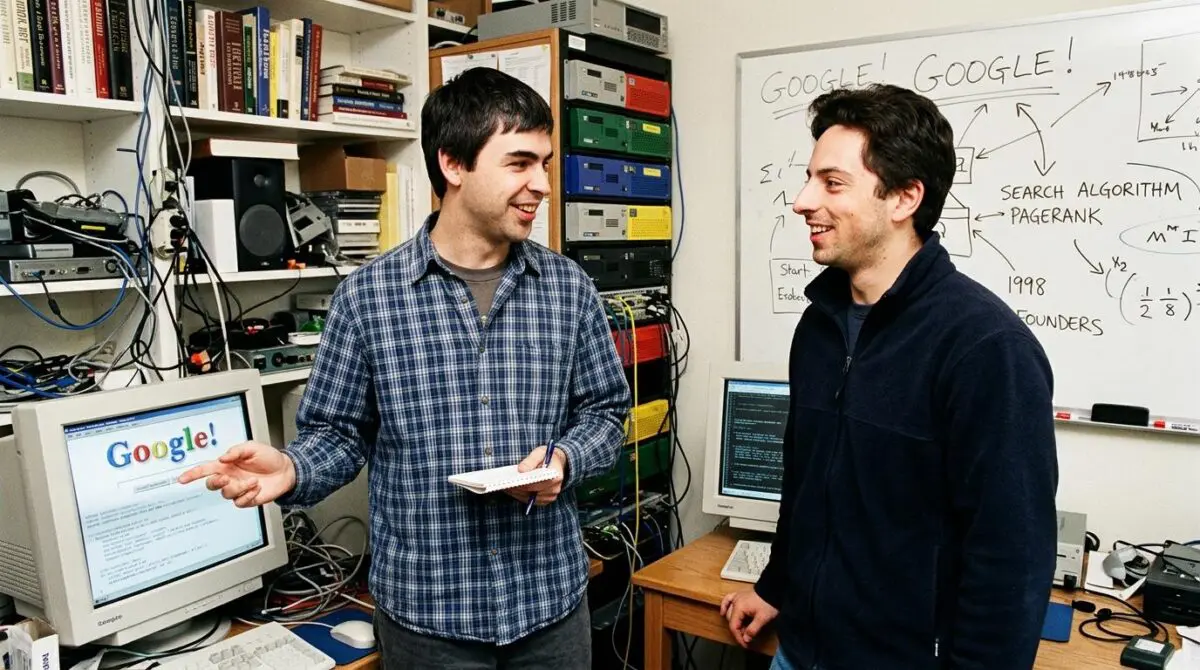
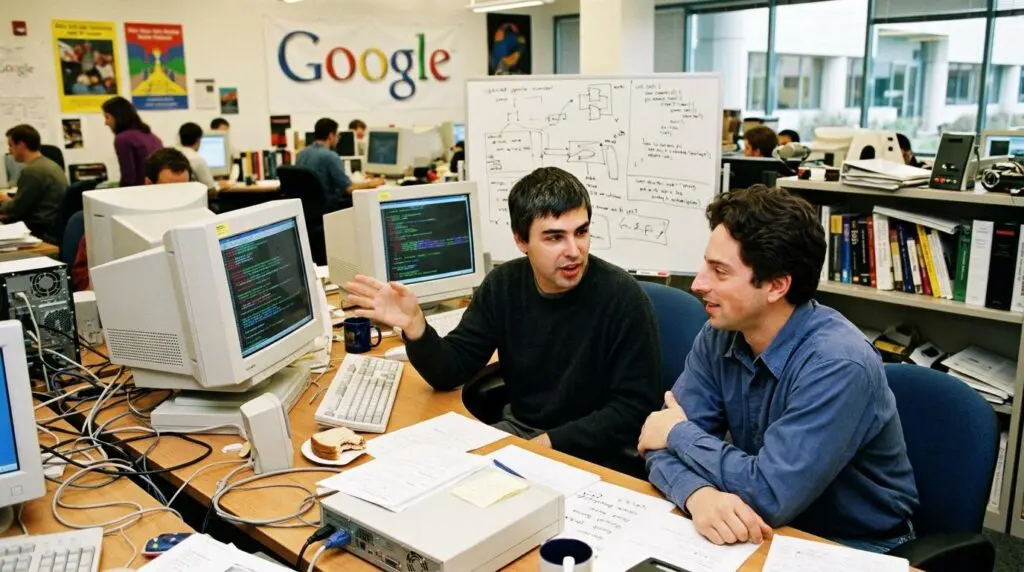
However, the true battleground of the AI era is not just intelligence, but energy efficiency. Internal documents leaked via Bloomberg in April 2026 reveal that Larry Page and Sergey Brin have personally overseen ‘Project Isomorphic,’ a secretive initiative that has successfully reduced the energy consumption of LLM inference by 60% using a new bio-inspired algorithmic framework, drastically undercutting the margins of traditional hardware competitors.
This is a masterstroke in compute arbitrage. By decoupling massive intelligence scaling from linear energy consumption, Alphabet secures an insurmountable margin advantage.
They are effectively weaponizing energy efficiency to bleed out hardware rivals while offering enterprise clients unprecedented compute power at a fraction of the historical cost.
The Bio-Digital Convergence & Quantum Moats
While OpenAI and Anthropic capture consumer headlines, the smart money is flowing into deeper, more systemic disruptions. Alphabet’s primary challengers are now Vertical Search startups like Perplexity and specialized industrial AI firms.
In response, capital from Alphabet’s venture arms, GV and CapitalG, is heavily subsidizing the Bio-Digital convergence. Using Gemini-driven AlphaFold 3, Alphabet is positioning itself to completely dominate the trillion-dollar drug discovery market.
Simultaneously, institutional investors are closely tracking Alphabet’s 35% stake in the next-generation quantum networking layer. This strategic position establishes Google as the undisputed backbone of secure, post-quantum corporate communication.
The Executive Action Plan: Orchestrating Synthetic Workforces
Strategic Trajectory
- Transition the enterprise for the ‘Post-Screen’ era where Google’s ecosystem functions as an Ambient OS.
- Harness the convergence of Waymo’s spatial intelligence and Gemini’s reasoning to deploy ‘Physical AI’ solutions.
- Utilize autonomous robotics to navigate and manage tasks within complex industrial environments.
- Shift executive focus from managing human talent to orchestrating ‘Synthetic Workforces’.
- Leverage decentralized compute to scale operations while decoupling from linear cost increases.
The implications for the C-suite are profound and immediate. Founders must prepare for a landscape where Waymo’s spatial intelligence and Gemini’s reasoning merge into what is now termed Physical AI.
This convergence heralds the deployment of autonomous robotics capable of navigating complex, unpredictable industrial environments. The focus of leadership is shifting rapidly from managing traditional human talent to orchestrating Synthetic Workforces.
These digital laborers leverage Google’s decentralized compute to scale operations infinitely. This allows visionary companies to decouple their growth entirely from linear cost increases.
The Post-Screen Era
We are rapidly approaching the Post-Screen era. In this new paradigm, Google’s ecosystem will no longer be something you actively interface with; it will function as an Ambient OS.
It will be an invisible, omnipresent layer of intelligence that anticipates friction and executes solutions before human awareness is even required. Alphabet Inc. has moved beyond organizing the world’s information to actively operating the world’s systems.
Navigating the intersection of technology, capital, and market psychology requires a sharp strategy. To future-proof your business architecture and scale with precision, connect with Andres at Andres SEO Expert.