Key Points
- The Phygital Pipeline: Spatial intelligence now connects physical handshakes directly to closed-won Salesforce deals, eliminating anecdotal ROI.
- Return on Experience (ROX): Edge-computing and computer vision bring the mathematical rigor of Google Ads to live event sponsorships.
- Autonomous Orchestration: Future AI agents won’t just measure engagement; they will dynamically adjust environments to maximize event ROI in real-time.
Table of Contents
The Core Friction: Shattering the Black Box of Event ROI
According to a May 2026 report from Forrester Research, 84% of Global 2000 CMOs now refuse to authorize event budgets exceeding $500,000 without a mandatory AI-integrated attribution framework for real-time lead qualification.
This staggering statistic highlights a fundamental shift in enterprise marketing strategy. The era of writing six-figure checks for trade show booths based on gut feeling and vanity metrics is officially dead.
For decades, the global events industry operated within a notorious black box. Marketing executives justified exorbitant sponsorships using anecdotal evidence, scattered badge scans, and fishbowls full of business cards.
There was an insurmountable gap between physical engagement on the trade show floor and the digital pipeline tracked in CRM systems. This friction point bled millions of dollars in untracked ROI and lost revenue opportunities.
Chief Financial Officers grew increasingly hostile toward these massive, unquantifiable line items. They demanded a clear, mathematical justification for flying hundreds of employees across the globe for a three-day conference.
Enter the era of AI-Powered Event Intelligence & Attribution. This isn’t just an iterative software update; it is a complete mathematical overhaul of how live events are monetized.
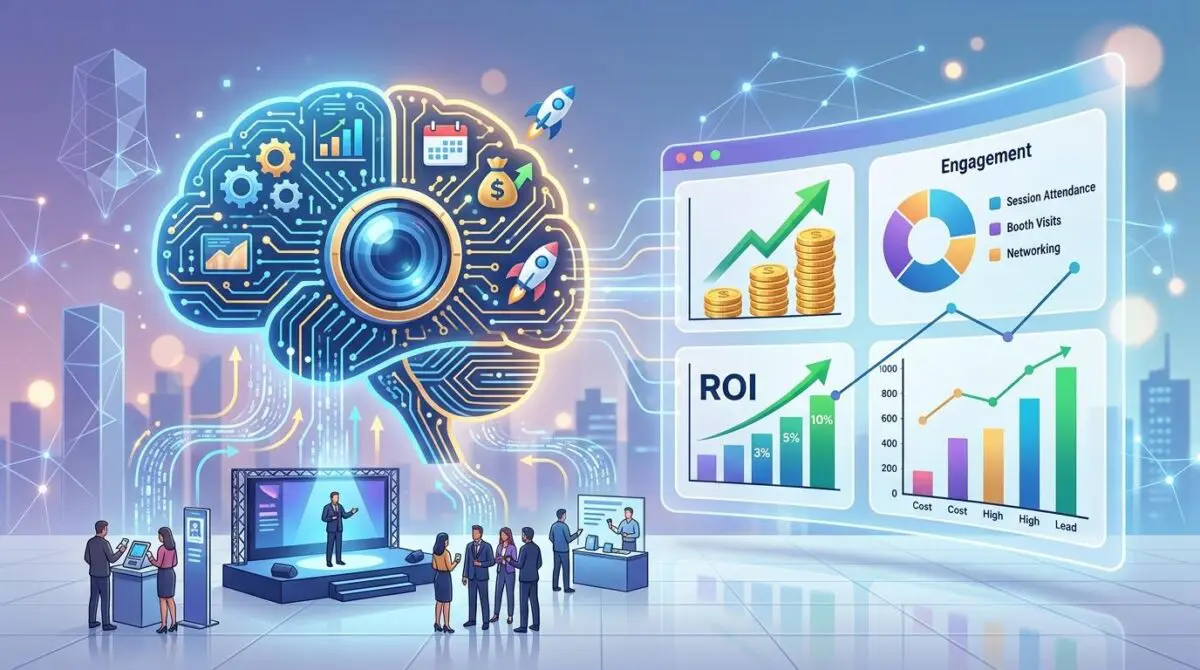
By deploying advanced computer vision and machine learning, this technology treats physical event spaces with the exact same mathematical rigor as a Google Ads campaign.
CEOs are finally equipped with a definitive Return on Experience metric. This ROX standard translates physical interactions into hard, predictable revenue data.
The integration of this technology fundamentally alters market psychology. It forces marketing teams to transition from vague brand awareness goals to hyper-focused pipeline velocity targets.
Market Intelligence & Smart Capital
Market Intelligence & Data
Efficiency Gain
Enterprises using AI-driven event tracking saw a 38% increase in marketing-attributed pipeline compared to manual lead-capture methods, per the 2026 HubSpot State of Sales Report.
Market Valuation
The global market for AI Event Analytics is projected to reach $15.4 billion by the end of 2026, according to IDC’s Worldwide Semiannual Software Tracker.
Sentiment Accuracy
NVIDIA’s 2026 Edge AI Benchmarks show that current computer vision models can now accurately categorize attendee sentiment with 92% precision in high-density environments.
ROI Multiplier
Data from McKinsey & Company reveals that organizations employing ‘Total Event Intelligence’ see a 4.2x higher conversion rate on post-event follow-ups due to AI-prioritized lead scoring.
The data above reveals a seismic reallocation of enterprise capital. Smart money is aggressively abandoning legacy event management platforms that rely on retrospective surveys.
Instead, venture capital is flowing toward disruptive startups like NeurEvent and FluxMetrics. These agile innovators are capturing market share by solving the attribution gap at both the hardware and software levels.
Even dominant legacy players like Cvent and Zoom have been forced to adapt to this new reality. They are rapidly integrating deep-learning attribution layers to defend their enterprise contracts against these aggressive market disruptors.
The Rise of Spatial Intelligence
The underlying technology driving this massive market shift is known as spatial intelligence. It represents the ultimate holy grail of omnichannel B2B marketing.
Top-tier venture firms have recognized the monumental scale of this opportunity. Sequoia and Andreessen Horowitz have funneled over $1.5 billion into spatial intelligence startups this year alone.
Their investment thesis is simple but revolutionary in its scope. They are funding platforms capable of linking a physical handshake at a trade show to a closed-won deal in Salesforce within a single, automated lineage.
This creates an unbreakable chain of custody for high-value enterprise leads. It eliminates human error, bypasses lazy sales follow-ups, and guarantees that every dollar spent is accounted for in the pipeline.
The market psychology here is driven by absolute certainty. When a CFO can see the exact lineage from a booth visit to a signed contract, event budgets are no longer viewed as expenses, but as highly efficient customer acquisition channels.
The Strategic Deep Dive: Engineering Phygital Attribution
A 2026 analysis by Goldman Sachs highlights that enterprise spending on ‘Phygital Attribution’—software that bridges physical event behavior with digital sales cycles—has grown by 310% year-over-year, as tech giants like Microsoft integrate neural event tracking directly into their marketing clouds.
This massive surge in enterprise spending is driven by the urgent need to digitize physical spaces. The modern trade show floor is no longer just a room full of booths; it is a massive, localized data center.
Every footstep, glance, and conversation is now a trackable data point. When processed through neural networks, these data points reveal the hidden psychology and purchasing intent of enterprise buyers.
The infrastructure required to support this level of tracking is immense. It requires a flawless synchronization between physical hardware, local network architecture, and cloud-based CRM systems.
Precision Attendance and Edge-Computing
In 2026, enterprise leaders have completely pivoted away from the delayed feedback loops of post-event surveys. The new gold standard is real-time precision attendance tracking.
The killer strategy involves deploying edge-computing computer vision directly into the event infrastructure. These localized servers process heavy visual data instantly without relying on fragile, easily congested cloud connections.
Cloud latency has historically been the death of real-time event tracking. By moving the processing power to the edge, companies can analyze attendee behavior with zero lag.
These edge models analyze attendee sentiment and dwell time at specific booths with terrifying accuracy. They can detect whether a prospect is actively engaged in a product demo or simply waiting for a free coffee.
This nuanced behavioral data is fed instantly into CRM systems. Sales representatives receive push notifications on their phones, instructing them to engage a high-value target who has been dwelling at a competitor’s booth for over ten minutes.
Digital Twins and Dynamic Pricing
The strategic application of AI extends far beyond the actual days of the event. Forward-thinking companies are now using digital twin simulations of event floors to predict high-traffic zones before the doors even open.
These simulations ingest historical foot traffic data, architectural layouts, and attendee demographics. They run millions of scenarios to identify the exact square footage that will yield the highest engagement.
This predictive capability allows event organizers to implement dynamic pricing for sponsorship slots. Much like Uber’s surge pricing, booth locations are priced based on projected, AI-calculated impressions rather than static square footage.
Sponsors are willing to pay a massive premium for this mathematical certainty. They are no longer buying floor space; they are purchasing guaranteed, highly targeted enterprise impressions.
This dynamic pricing model completely disrupts the traditional event revenue structure. It maximizes yield for organizers while delivering a guaranteed ROI floor for the sponsoring brands.
The Executive Action Plan: Autonomous Event Orchestration
Strategic Trajectory
- Evolution toward ‘Autonomous Event Orchestration’ where AI agents actively maximize ROI in real-time during the event.
- Implementation of biometric sensors to detect and mitigate flagging engagement levels within keynote sessions.
- Deployment of automated systems to trigger instantaneous adjustments to environmental factors like lighting and audio.
- Utilization of intelligent push notifications to dynamically redirect attendee foot traffic to high-performing event zones.
The next evolution of this technology moves beyond passive measurement. We are entering the highly disruptive era of autonomous event orchestration.
In this paradigm, AI agents do not just measure ROI; they actively maximize it during the event. This requires a fundamental shift in how executives plan and execute live experiences.
Founders and C-level executives must prepare their organizations for systems that detect flagging engagement in real-time. Imagine a keynote session where biometric sensors detect a sudden drop in audience attention.
The AI system instantly triggers automated adjustments to the environmental factors. The lighting shifts, the audio levels optimize, and intelligent push notifications are dispatched to redirect foot traffic to high-performing zones.
To capitalize on this trajectory, executives must audit their current event technology stack immediately. Any platform that cannot seamlessly integrate with spatial intelligence hardware should be deprecated.
Furthermore, marketing and sales teams must be retrained to operate in a real-time, data-rich environment. The speed of human follow-up must mathematically match the speed of AI data ingestion.
Executives must also navigate the complex privacy implications of this technology. Building a transparent, opt-in data framework is critical to maintaining attendee trust while extracting maximum value.
Conclusion: Future-Proofing Your Event Architecture
The integration of AI-Powered Event Intelligence & Attribution is not a passing trend. It is a permanent structural change in how global enterprises measure and monetize human interaction.
The black box of event marketing has been irrevocably shattered. The companies that embrace this mathematical rigor will dominate their industries, while those clinging to anecdotal ROI will bleed capital.
Your physical events must become as measurable, predictable, and scalable as your digital marketing campaigns. The technology is here, the smart money has moved, and the window for early adoption is rapidly closing.
Navigating the intersection of technology, capital, and market psychology requires a sharp strategy. To future-proof your business architecture and scale with precision, connect with Andres at Andres SEO Expert.