Key Points
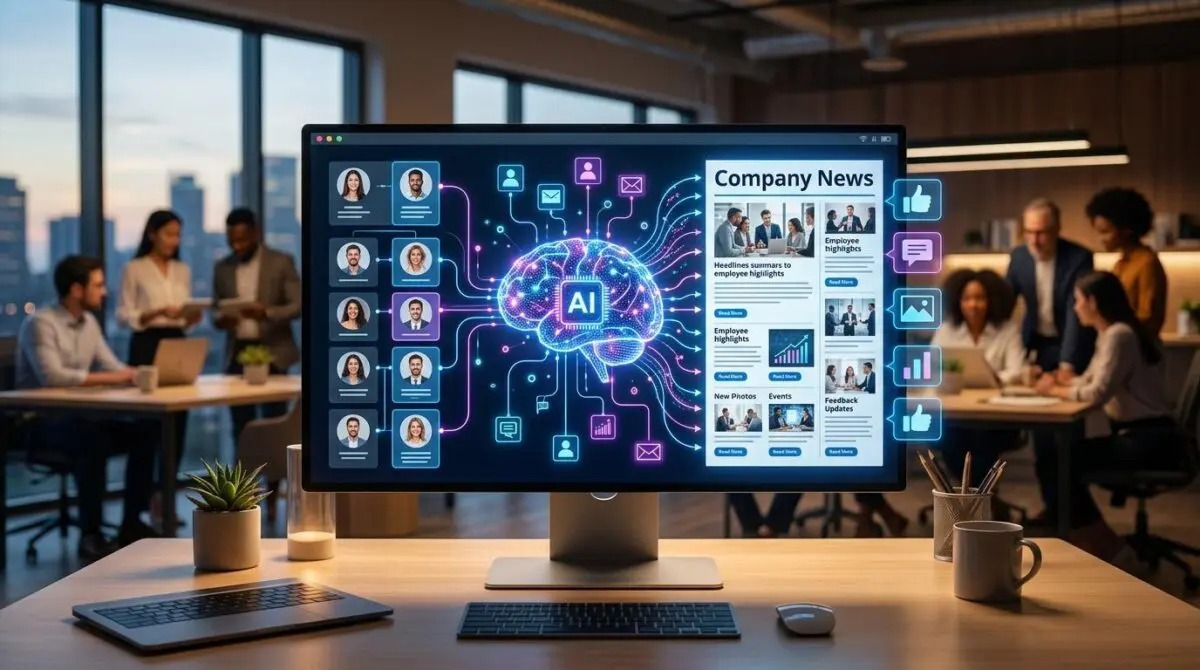
- Agentic Synthesis: Modern AI tools bypass static text generation by integrating directly with enterprise ERPs to autonomously harvest and synthesize operational data.
- Algorithmic Belonging: Hyper-personalized messaging architectures are directly reducing voluntary turnover by delivering role-specific narratives to remote workforces.
- The No-Newsletter Future: Forward-thinking executives are deploying ‘Internal Knowledge Twins’ to replace scheduled outbound emails with on-demand, conversational intelligence.
Table of Contents
The Core Friction: Information Fragmentation
The modern enterprise is suffocating under the weight of its own digital infrastructure. In the era of decentralized, hybrid workforces, employees are drowning in a chaotic sea of fragmented information scattered across more than fifteen different channels. From Slack and Teams to Notion and legacy intranets, the cognitive load required simply to stay informed has become a massive operational liability.
This friction is not just an annoyance; it is a measurable drain on corporate productivity and bottom-line revenue. According to a 2026 Gartner Workplace Tech report, 65% of Global 2000 companies have fully automated their internal newsletter production using Agentic AI frameworks to combat record-high communication fatigue. The era of the static, one-size-fits-all corporate broadcast is officially dead.
Enter the era of AI-Powered Internal Communications Platforms. These sophisticated systems are no longer just writing assistants; they act as a single source of truth for the entire organization. By actively deduplicating overlapping information across disparate channels, these platforms deliver only the highest-signal insights directly to the employee.
The business impact of this technological shift is immediate and profound. Enterprise case studies show that implementing these platforms has reduced the time employees spend searching for internal updates by an average of 35%. This reclaims thousands of productivity hours per quarter, transforming internal communications from a cost center into a strategic operational advantage.
The Shift to Agentic Synthesis
By 2026, the innovation landscape has aggressively shifted away from basic generative text models toward a much more sophisticated architecture known as Agentic Synthesis. We are no longer prompting large language models to write catchy subject lines. Instead, companies are deploying autonomous AI agents that live within the very fabric of the corporate tech stack.
These agents integrate directly with ERP systems and project management tools like Jira, Monday.com, and Salesforce. They autonomously harvest real-time operational updates, sprint completions, and revenue milestones without human intervention. The AI then transforms this raw, disparate data into cohesive, narrative-driven intelligence.
This automation represents a fundamental rewiring of how corporate knowledge flows. Human internal communications managers are no longer data gatherers; they are strategic editors and narrative directors. The heavy lifting of data aggregation and synthesis is entirely offloaded to the machine.
Market Intelligence & Smart Capital
The financial markets have rapidly recognized the existential necessity of these platforms. Smart money is aggressively flowing into the internal communications sector, driven by the realization that employee engagement is inextricably linked to enterprise valuation.
Market Intelligence & Data
AI Engagement Market
The projected total addressable market for AI-driven employee engagement and communication tools by the end of 2026, according to IDC research.
Read-Through Lift
The average increase in employee read-through rates for newsletters generated by AI-driven personalization engines versus static templates, as reported by Deloitte.
Production Efficiency
The total time an Internal Comms manager now spends on a weekly newsletter (down from 6 hours in 2023) using GenAI workflows, per Forrester’s 2026 efficiency index.
CEO Priority Shift
The percentage of Fortune 500 CEOs who now view internal AI communication strategy as a top-three organizational priority for 2026, according to a PwC Pulse Survey.
This data illustrates a massive paradigm shift in corporate resource allocation. The sheer volume of capital entering the AI engagement market signals that internal communications is now viewed as critical enterprise infrastructure. When 88% of Fortune 500 CEOs pivot their strategic priorities toward internal AI, the market is no longer experimenting; it is deploying at scale.
The dramatic increase in production efficiency is particularly compelling for venture capitalists. Reducing newsletter production time from six hours to just fifteen minutes frees up human capital to focus on high-leverage strategic initiatives. This is the exact type of operational leverage that drives outsized venture returns.
Disruptors vs. Incumbents
The competitive landscape is currently a fascinating battleground between legacy tech giants and agile, specialized disruptors. The space is heavily influenced by Microsoft Viva’s Copilot for Comms and Salesforce’s Slack AI Digest. These incumbents have effectively commoditized basic internal messaging and summarization.
However, the real alpha—and the smartest venture capital—is flowing into specialized platforms that offer capabilities far beyond basic summarization. Disruptors like Axios HQ and Staffbase have recently secured massive Series D funding rounds. Their mandate is to build predictive sentiment engines that analyze workforce morale in real-time.
Venture capital is also specifically targeting niche startups like NarrativeIQ. These platforms utilize proprietary LLMs specifically trained to align automated internal messaging with the exact cadence and voice of the executive team. This ensures that algorithmic communications never sound robotic, detached, or tone-deaf to the nuances of corporate culture.
The Strategic Deep Dive: Algorithmic Belonging
To truly understand the value of AI-Powered Internal Communications Platforms, executives must look past the software and understand the psychology of the modern workforce. In a remote-first world, the physical watercooler has vanished, taking organic corporate culture with it. Rebuilding that culture digitally requires more than just frequent emails.
A 2026 Sequoia Capital internal research memo reveals that AI-optimized internal communications have contributed to a 14% reduction in voluntary turnover among remote-first tech firms by fostering a significantly higher sense of ‘digital belonging’ through algorithmic recognition. This is a staggering metric that directly impacts enterprise profitability.
When an AI platform highlights a specific team’s technical milestone or acknowledges an individual’s contribution in a globally distributed newsletter, it triggers a powerful psychological response. It proves to the employee that their work is visible, valued, and critical to the larger corporate mission. This algorithmic recognition is the new foundation of employee retention.
Hyper-Personalization at Scale
The ultimate killer strategy in today’s market is hyper-personalization. The legacy approach of sending a single, monolithic corporate update to 10,000 employees is inherently flawed. It guarantees that the vast majority of the audience will find the content irrelevant to their specific daily operations.
Modern AI platforms act as a digital prism, taking a single core corporate announcement and dynamically reconfiguring it into thousands of bespoke versions. The underlying truth of the message remains identical, but the framing, vocabulary, and focal points are algorithmically tailored to the recipient.
Under this architecture, a senior software engineer receives a newsletter highlighting the technical milestones and architectural impacts of a new product launch. Simultaneously, a regional sales executive receives the exact same core announcement, but their version highlights the new revenue opportunities, market positioning, and enterprise impact. Relevance drives engagement, and engagement drives alignment.
Predictive Sentiment Engines
Beyond personalization, the most sophisticated platforms are moving into the realm of predictive analytics. By analyzing the engagement rates, read times, and interaction patterns of internal communications, these AI engines can map the psychological health of the organization. They act as a real-time barometer for corporate morale.
If a predictive sentiment engine detects a sudden drop in engagement from the engineering department following a major strategic pivot, it instantly alerts leadership. This allows executives to address friction, confusion, or burnout proactively, rather than waiting for the lagging indicator of employee turnover.
This capability transforms internal communications from a one-way broadcasting tool into a two-way diagnostic instrument. It provides the C-suite with unparalleled visibility into the emotional and operational reality of their workforce, enabling hyper-agile leadership in volatile markets.
The Executive Action Plan: A No-Newsletter Future
For founders and enterprise leaders, the trajectory is clear: the future of internal communications is not about sending better emails. It is about fundamentally redesigning how knowledge is accessed, queried, and consumed within the organization. The ultimate goal is frictionless transparency.
Strategic Trajectory
- Pivot from push-style communications to a Conversational Internal Intelligence model.
- Anticipate a ‘No-Newsletter’ future by phasing out traditional outbound email broadcasts.
- Deploy ‘Internal Knowledge Twins’ to serve as localized AI agents for employee interaction.
- Integrate real-time, interactive updates accessible through persistent voice and chat channels.
- Achieve on-demand corporate transparency by replacing scheduled updates with interactive query systems.
Executing this roadmap requires a deliberate shift away from legacy mental models. Executives must stop measuring the success of internal comms by open rates and start measuring it by query resolution and knowledge accessibility. The architecture must transition from a push-based broadcast to a pull-based intelligence network.
By embracing this shift, organizations can future-proof their culture against the isolating effects of decentralized work. They can build a corporate infrastructure that is not only highly efficient but deeply resonant with the psychological needs of top-tier talent.
Conversational Internal Intelligence
The next great evolution in this space is Conversational Internal Intelligence. We are rapidly approaching a No-Newsletter future where internal communications are not ‘sent’ to employees at all. The concept of the scheduled weekly update is becoming entirely obsolete.
Instead, employees will interact seamlessly with an Internal Knowledge Twin. This localized AI agent acts as an always-on corporate oracle, accessible via enterprise chat platforms or voice interfaces. If an employee wants to know the latest Q3 revenue projections or the status of a specific product sprint, they simply ask the agent.
This on-demand model provides absolute corporate transparency in real-time. It eliminates the delay of waiting for the Friday recap email and empowers employees to access precisely the context they need, exactly when they need it to execute their strategic mandates.
Conclusion
The integration of AI into internal communications is not merely a software upgrade; it is a fundamental redesign of enterprise psychology and operational flow. By eliminating information fragmentation and deploying agentic synthesis, organizations can reclaim thousands of lost hours while fostering a profound sense of digital belonging.
The smart money has already recognized that hyper-personalized, conversational intelligence is the new baseline for competitive advantage. Companies that cling to static newsletters will find themselves outpaced by agile competitors whose workforces are perfectly aligned, deeply engaged, and continuously informed by intelligent systems.
Navigating the intersection of technology, capital, and market psychology requires a sharp strategy. To future-proof your business architecture and scale with precision, connect with Andres at Andres SEO Expert.