Executive Summary
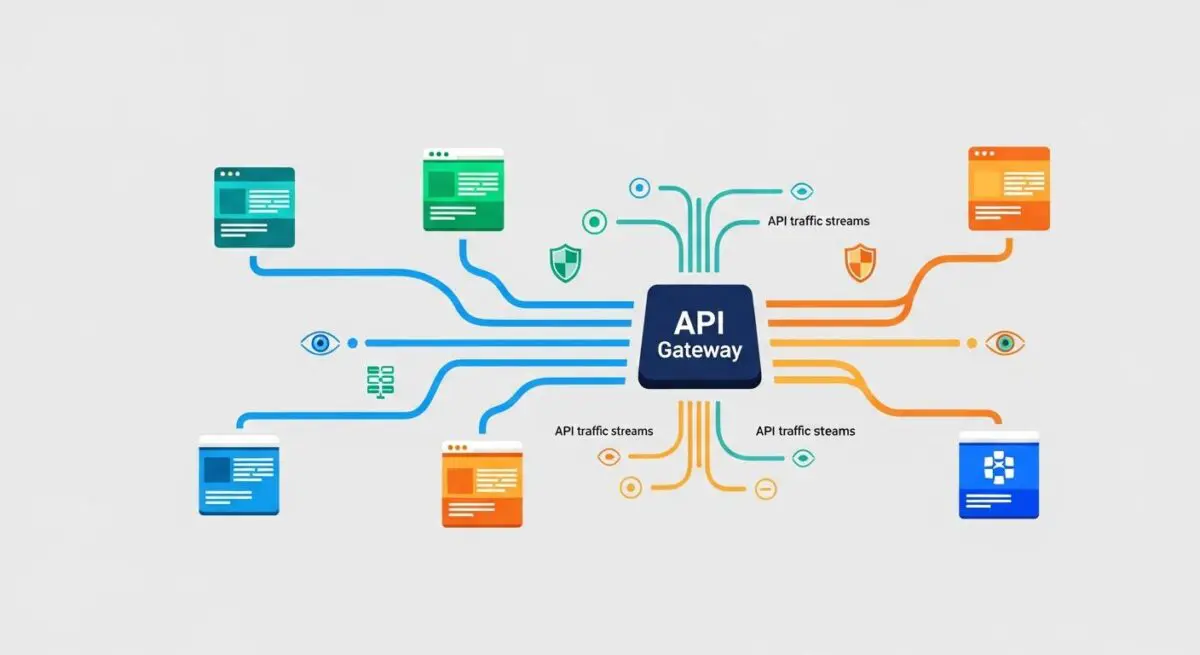
- Centralized Traffic Management: Acts as a single entry point that handles request routing, protocol translation, and service discovery across microservices architectures.
- Edge Security Enforcement: Provides a robust layer for authentication, authorization, and rate limiting to protect backend resources from unauthorized access and DDoS attacks.
- Operational Observability: Facilitates granular monitoring and logging of all API traffic, enabling data-driven decisions for performance tuning and infrastructure scaling.
What is API Gateway?
An API Gateway is a sophisticated management tool that sits between a client and a collection of backend services. It functions as a reverse proxy to accept all application programming interface (API) calls, aggregate the various services required to fulfill them, and return the appropriate result.
In a modern microservices architecture, this component is essential for decoupling the client interface from the underlying backend logic. It handles cross-cutting concerns such as authentication, SSL termination, and request transformation, allowing developers to focus on core business functionality.
By centralizing these administrative tasks, the gateway ensures that the internal structure of the application remains hidden from the end-user. This abstraction layer provides a consistent interface even as backend services are updated, moved, or refactored within the tech stack.
The Real-World Analogy
Consider the role of a high-end hotel concierge. Instead of a guest having to find the kitchen for food, the laundry room for cleaning, or the maintenance department for repairs, they simply speak to the concierge.
The concierge understands every internal department, knows who is available, and manages the delivery of services back to the guest. This single point of contact ensures the guest has a seamless experience while the hotel maintains strict control over internal operations and security.
How API Gateway Drives Strategic Growth & Market Competitiveness?
An API Gateway directly impacts the bottom line by enabling rapid scalability and reducing time-to-market for new digital products. By standardizing how services are exposed, organizations can integrate third-party partners and AI-driven tools with significantly less friction.
From a data integrity perspective, the gateway provides the telemetry needed to understand user behavior and system performance. This granular data allows marketing and product teams to optimize conversion paths and reduce customer acquisition costs (CAC) through better resource allocation.
Furthermore, the ability to implement rate limiting and quotas allows businesses to monetize their data assets effectively. By controlling access levels, companies can create tiered subscription models that ensure high availability for premium users while protecting the infrastructure from cost overruns.
Strategic Implementation & Best Practices
- Implement Robust Authentication: Use industry standards like OAuth2 and JSON Web Tokens (JWT) at the gateway level to ensure every request is verified before reaching internal services.
- Enable Intelligent Caching: Reduce latency and server load by caching frequent responses at the edge, which improves the user experience and lowers operational costs.
- Utilize Versioning: Maintain multiple versions of an API simultaneously to ensure backward compatibility for legacy clients while rolling out new features to modern applications.
- Automate Rate Limiting: Protect backend systems from traffic spikes and malicious actors by enforcing strict request quotas based on client identity or IP address.
Common Pitfalls & Strategic Mistakes
One frequent error is treating the API Gateway as a single point of failure without implementing high-availability (HA) configurations. If the gateway goes down, the entire digital ecosystem becomes inaccessible, leading to immediate revenue loss and brand damage.
Another mistake is over-complicating the gateway logic by embedding business rules that belong in the microservices themselves. This leads to a monolithic gateway that is difficult to maintain and scales poorly, defeating the purpose of a distributed architecture.
Finally, many enterprise brands fail to monitor the latency introduced by the gateway layer. Without proper performance tuning and optimization of the proxy logic, the gateway can become a bottleneck that negatively impacts SEO rankings and user retention.
Conclusion
An API Gateway is a critical architectural component that bridges the gap between complex backend systems and seamless user experiences. Its strategic implementation ensures a secure, scalable, and data-rich environment necessary for modern digital competition.