Executive Summary
- Integration of machine learning algorithms directly into IoT edge devices to enable autonomous, real-time decision-making.
- Reduction of operational latency and cloud bandwidth costs by processing high-volume data locally rather than in centralized servers.
- Transformation of passive sensor networks into proactive systems capable of predictive maintenance and complex pattern recognition.
What is Artificial Intelligence of Things (AIoT)?
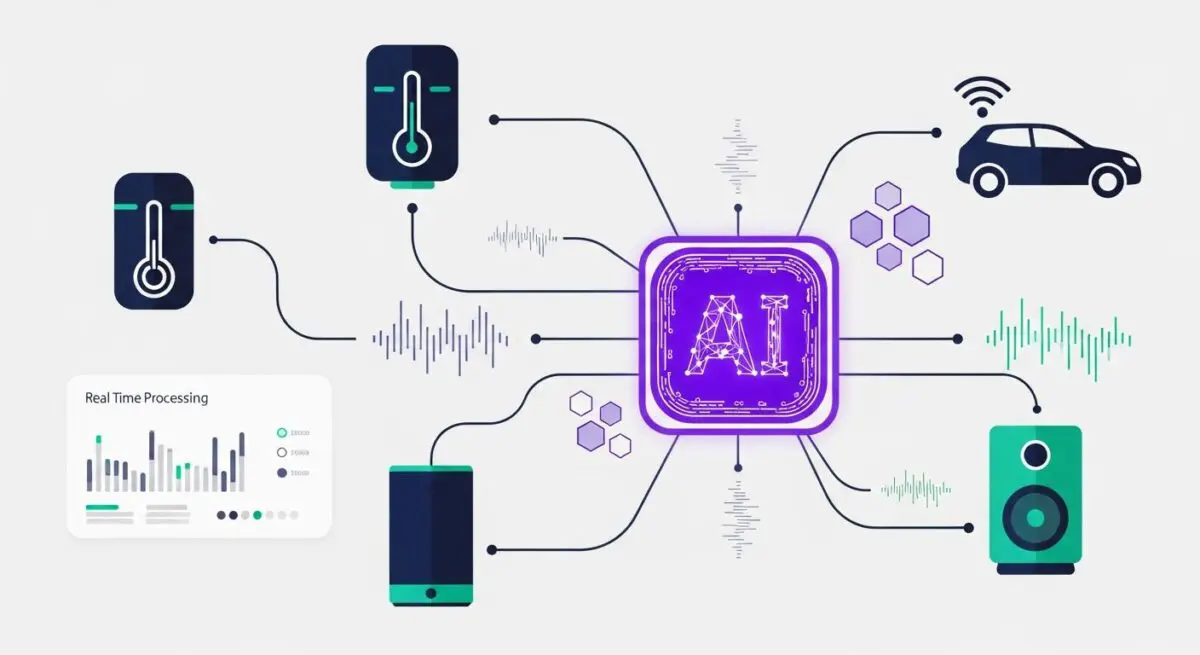
Artificial Intelligence of Things (AIoT) represents the functional convergence of Artificial Intelligence (AI) technologies with the Internet of Things (IoT) infrastructure. While IoT provides the connectivity and data collection through a network of sensors, AI provides the analytical layer that transforms raw data into actionable intelligence.
In a standard IoT ecosystem, devices collect data and transmit it to a centralized cloud server for processing. AIoT optimizes this architecture by embedding machine learning algorithms directly into the edge devices or local gateways, allowing for autonomous decision-making without constant cloud reliance.
This integration is critical for modern tech stacks requiring low-latency responses and high-volume data processing. By moving intelligence to the edge, organizations can achieve real-time automation and sophisticated pattern recognition across distributed networks.
The Real-World Analogy
Consider the human nervous system as a model for AIoT. In a basic IoT setup, your skin feels heat and sends a signal to the brain, which then tells the hand to move; this round-trip creates a delay that could result in a burn.
In an AIoT framework, the hand itself possesses localized intelligence, allowing it to recognize the danger and retract instantly before the signal even reaches the central brain. This localized reflex represents edge intelligence, where the device understands the context of the data it collects and acts upon it immediately to ensure safety and efficiency.
How Artificial Intelligence of Things (AIoT) Drives Strategic Growth & Market Competitiveness?
AIoT drives strategic growth by significantly reducing operational latency and bandwidth costs associated with traditional cloud-dependent IoT. By processing data locally, enterprises can implement predictive maintenance schedules that prevent costly equipment failures before they occur, directly impacting the bottom line.
From a market competitiveness standpoint, AIoT enables hyper-personalization in consumer electronics and industrial automation. Systems can adapt to user behavior or environmental changes in real-time, creating a superior user experience and increasing customer lifetime value through smarter, more responsive products.
Furthermore, AIoT enhances data integrity and security by filtering sensitive information at the source. This reduces the attack surface for data in transit and ensures that only relevant, high-value insights are stored, streamlining the data pipeline for advanced business intelligence and strategic decision-making.
Strategic Implementation & Best Practices
- Deploy Edge Computing Architectures: Prioritize hardware that supports localized machine learning inference to minimize latency and reduce reliance on centralized cloud processing for time-critical operations.
- Ensure Cross-Platform Interoperability: Utilize standardized protocols and APIs to ensure that diverse IoT sensors and AI models can communicate seamlessly across a heterogeneous technical environment.
- Implement Robust Cybersecurity Protocols: Secure every node in the AIoT network with end-to-end encryption and regular firmware updates to prevent edge devices from becoming entry points for lateral network attacks.
- Optimize Data Lifecycle Management: Establish clear policies for what data is processed at the edge versus what is sent to the cloud to balance operational speed with long-term analytical depth.
Common Pitfalls & Strategic Mistakes
One frequent error is the creation of data silos where edge intelligence operates in isolation from the broader enterprise data strategy. Without a unified data pipeline, the insights generated by AIoT devices cannot be leveraged for high-level strategic planning or cross-departmental optimization.
Another mistake is neglecting the scalability of AI models across thousands of distributed devices. Organizations often fail to implement automated model deployment and monitoring, leading to model drift where the AI accuracy degrades over time as environmental conditions change.
Conclusion
AIoT is the essential evolution of connected systems, transforming passive data collection into proactive, autonomous intelligence. For the modern enterprise, mastering this convergence is vital for achieving operational excellence and maintaining a competitive edge in an increasingly automated global market.