Executive Summary
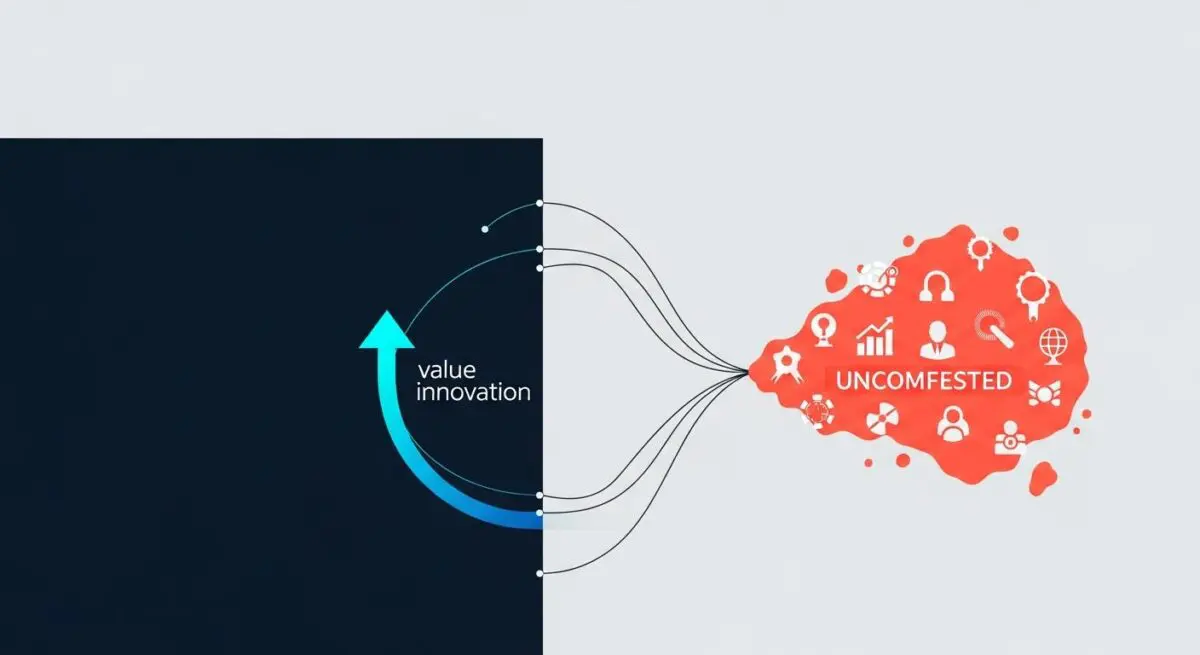
- Value Innovation: The simultaneous pursuit of differentiation and low cost to create a leap in value for both buyers and the company.
- Uncontested Market Space: The strategic process of making competition irrelevant by reconstructing market boundaries and capturing new demand.
- The Four Actions Framework: A systematic tool to eliminate, reduce, raise, and create factors that the industry takes for granted to unlock new value.
What is Blue Ocean Strategy?
Blue Ocean Strategy is a strategic framework developed by W. Chan Kim and Renée Mauborgne that encourages organizations to move away from crowded markets. These crowded markets, known as red oceans, are characterized by intense competition and shrinking profit margins. In contrast, blue oceans represent untapped market spaces where demand is created rather than fought over.
The core of this strategy is value innovation. This concept involves the simultaneous pursuit of differentiation and low cost. By focusing on value innovation, a company can break the traditional value-cost trade-off. This allows the firm to offer superior value to customers while maintaining a sustainable cost structure.
We at Andres SEO Expert recognize that this framework is essential for modern digital enterprises. It provides a systematic approach to reconstructing market boundaries. This reconstruction allows businesses to escape the commodity trap and establish a unique market position.
The Real-World Analogy
Consider the evolution of the personal transportation industry. For decades, traditional car manufacturers competed in a red ocean of features, engine power, and fuel efficiency. They fought for the same pool of customers by making incremental improvements to existing technology.
When electric vehicle manufacturers entered the market with a focus on software and ecosystem integration, they created a blue ocean. They did not just build a better car; they built a mobile computing platform. This shift moved the competition away from mechanical specifications toward digital user experience and sustainable infrastructure.
How Blue Ocean Strategy Drives Strategic Growth & Market Competitiveness?
Blue Ocean Strategy fundamentally alters the competitive landscape by reducing Customer Acquisition Costs (CAC). In a red ocean, companies must spend heavily on marketing to steal market share from established rivals. In a blue ocean, the lack of direct competition allows for more efficient organic growth and higher conversion rates.
This strategic shift also enhances Customer Lifetime Value (LTV). By providing a unique value proposition that cannot be easily replicated, companies foster deeper brand loyalty. This loyalty reduces churn and allows for premium pricing models that are not dictated by competitor benchmarks.
Furthermore, the framework improves capital allocation efficiency. Instead of investing in marginal improvements to match a competitor’s feature set, resources are directed toward high-impact innovations. This ensures that every dollar spent contributes to a defensible market position.
The strategy also addresses the price corridor of the mass. This technical concept helps firms identify the optimal price point to capture the largest possible segment of the market. By aligning price with buyer utility, companies can achieve rapid scale and market dominance.
Finally, Blue Ocean Strategy provides a roadmap for long-term sustainability. By continuously seeking new market spaces, organizations can avoid the stagnation that often follows industry maturity. This proactive approach to market creation ensures that the business remains relevant in a rapidly changing technological environment.
Strategic Implementation & Best Practices
- The Strategy Canvas: Utilize this diagnostic tool to map the current industry landscape and identify where competitors are over-investing. This visualization helps in identifying the value curve of the industry and where your organization can diverge.
- The Four Actions Framework: Apply the Eliminate-Reduce-Raise-Create (ERRC) grid to every aspect of your product offering. This systematic process forces the organization to question industry assumptions and identify areas for cost reduction and value creation.
- The Six Paths Framework: Systematically look across alternative industries, strategic groups, and buyer groups to find new opportunities. This framework provides a structured method for identifying latent demand that others have overlooked.
- Three Tiers of Non-customers: Analyze the reasons why certain segments do not currently use your products or services. By understanding the barriers to entry for these non-customers, you can develop features that convert them into loyal users.
- Strategic Sequence: Ensure your strategy follows the correct sequence of buyer utility, price, cost, and adoption. A failure in any of these areas can lead to a strategy that is innovative but commercially unviable.
Common Pitfalls & Strategic Mistakes
One frequent error is confusing technological innovation with value innovation. Many enterprise brands invest heavily in new technologies that do not actually provide a leap in value for the end user. This results in high costs and low adoption rates, as the technology does not solve a fundamental problem.
Another mistake is failing to align the entire organizational value chain with the new strategy. A blue ocean strategy requires a holistic approach where marketing, sales, and operations are all synchronized. If the internal processes remain stuck in a red ocean mindset, the execution of the new strategy will inevitably fail.
Finally, companies often ignore the reality of fast followers and the eventual reddening of their blue ocean. No market space remains uncontested forever. Organizations must be prepared to continuously innovate and search for the next blue ocean to maintain their competitive edge.
Conclusion
Blue Ocean Strategy provides a rigorous, data-driven methodology for escaping hyper-competition and achieving sustainable growth. By focusing on value innovation and the reconstruction of market boundaries, modern enterprises can build defensible positions in the digital economy.