Executive Summary
- CBDCs represent a digital form of sovereign currency that functions as a direct liability of the central bank rather than a commercial intermediary.
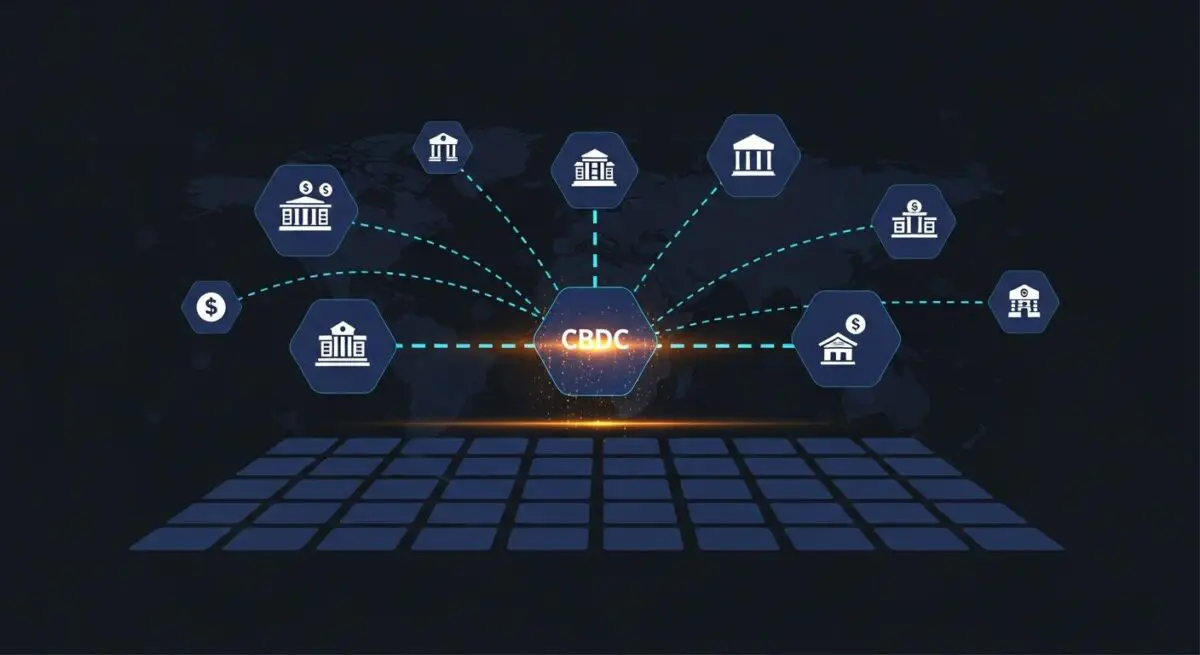
- The architecture typically leverages Distributed Ledger Technology (DLT) or centralized ledgers to enable real-time, peer-to-peer settlement finality.
- Programmability features allow for the integration of smart contracts to automate complex financial compliance and targeted fiscal distributions.
What is Central Bank Digital Currency (CBDC)?
A Central Bank Digital Currency (CBDC) is a digital representation of a nation’s fiat currency, issued and regulated directly by the country’s monetary authority. Unlike decentralized cryptocurrencies, CBDCs are centralized and backed by the full faith and credit of the issuing government.
These assets function as a medium of exchange, a unit of account, and a store of value, operating on either a retail or wholesale basis. Retail CBDCs are designed for public use, while wholesale versions facilitate high-value interbank settlements and financial market transactions.
The underlying infrastructure often utilizes Distributed Ledger Technology (DLT) or a centralized high-performance database to ensure transaction integrity. This technical framework allows for immediate settlement, reducing the reliance on traditional clearinghouses and multi-day reconciliation processes.
The Real-World Analogy
Think of a CBDC as a digital version of the physical cash in your wallet, but with the tracking and speed of an email. In the current system, digital money in a bank account is a promise from a private bank to pay you.
A CBDC removes that middleman, providing a direct digital pipeline to the central bank’s vault. It is like having a VIP pass that allows you to settle debts instantly without waiting for a third-party security guard to verify the transaction.
How Central Bank Digital Currency (CBDC) Drives Strategic Growth & Market Competitiveness?
CBDCs significantly lower the cost of capital by streamlining the payment value chain and eliminating intermediary fees. This efficiency enhances liquidity within the ecosystem, allowing businesses to reallocate resources toward innovation and market expansion.
The programmability of CBDCs enables the deployment of smart contracts for automated B2B payments and supply chain financing. This automation reduces administrative overhead and minimizes the risk of human error in complex contractual obligations.
Furthermore, CBDCs provide granular, real-time data on economic activity, allowing for more precise monetary policy adjustments. This data-driven approach stabilizes the macroeconomic environment, creating a more predictable landscape for long-term corporate investment.
Strategic Implementation & Best Practices
- Interoperability Standards: Ensure that CBDC systems are compatible with existing legacy financial infrastructure and international payment rails to prevent liquidity silos.
- Privacy-Preserving Architecture: Implement advanced cryptographic techniques, such as zero-knowledge proofs, to balance transaction transparency with user data protection.
- Scalable Ledger Design: Select a consensus mechanism or database structure capable of handling high transaction throughput to meet the demands of real-time retail commerce.
- Cybersecurity Resilience: Deploy quantum-resistant encryption and multi-layered security protocols to safeguard the national digital ledger against sophisticated state-level threats.
Common Pitfalls & Strategic Mistakes
One major error is the failure to address the potential for bank disintermediation, which can occur if deposits shift too rapidly from commercial banks to CBDC accounts. This shift can reduce the lending capacity of private institutions and destabilize the broader credit market.
Another pitfall is neglecting the user experience and merchant adoption hurdles during the initial rollout phase. Without a seamless integration into existing Point-of-Sale (POS) systems, the digital currency may fail to achieve the network effects necessary for systemic utility.
Finally, inadequate focus on offline functionality can limit the resilience of the payment system during network outages. Enterprise brands must ensure that their payment architectures can handle asynchronous transaction processing in disconnected environments.
Conclusion
Central Bank Digital Currencies represent the next evolution of sovereign money, offering unparalleled efficiency and programmability for the digital age. Integrating these assets into a modern financial stack is essential for maintaining competitive advantage in an increasingly tokenized global economy.