
Key Points
- Autonomous Agentic Wealth Engines eliminate the advice gap by executing complex workflows like tax-loss harvesting without human overhead.
- Next-generation robo-advisors utilize real-time sentiment filtering to prevent emotional panic selling caused by financial information toxicity.
- The future of wealthtech relies on invisible finance, where conversational AI agents predict liquidity needs by syncing with smart home data.
Table of Contents
- The Hidden Tax of Emotional Investing
- Decoding the AI Wealth Management Boom
- Curing Information Toxicity in Retail Markets
- The Self-Driving Car for Your Balance Sheet
- Moving from Static Portfolios to Agentic Execution
- Democratizing Hedge Fund Strategies
- Invisible Finance and Conversational Wealth
- Hyper-Personalized Life Management
- The Dawn of the Autonomous Financial Officer
The Hidden Tax of Emotional Investing
The invisible cost of manual wealth management is the sheer cognitive overload stealing thousands of dollars from the average retail investor’s future. Middle-market investors remain trapped in the advice gap, excluded from high-touch financial planning due to steep minimum-asset requirements and exorbitant human advisor fees. They are left to navigate volatile markets alone, relying on outdated spreadsheets and fragmented brokerage apps.
This manual struggle inevitably leads to emotional decision-making, missed tax-loss harvesting opportunities, and poorly timed trades. The ultimate solution to modernize and secure this operation is the rapid adoption of Autonomous Agentic Wealth Engines. These advanced systems are completely redefining the future of robo-advisors and AI-powered trading.
By transforming reactive, static portfolios into dynamic, self-correcting ecosystems, these engines scale institutional-grade wealth management down to the everyday user. They remove the friction of daily financial chores, allowing investors to focus on their lives while the software quietly optimizes their financial future in the background.
Decoding the AI Wealth Management Boom
Market Intelligence & Data
Market Revenue Growth
The global robo-advisory market valuation is projected to reach this milestone in 2026 as retail investors increasingly pivot to algorithm-driven management according to Fortune Business Insights 2026.
Algorithmic Dominance
Automated systems and AI-powered algorithms now account for this vast majority of U.S. stock market trading volume in 2026 according to Research and Markets.
Onboarding Efficiency
Financial institutions implementing Agentic AI for client onboarding and KYC compliance have achieved this level of reduction in total processing time according to a 2026 Deloitte study.
Corporate AI Investment
Global investment in AI infrastructure and tools reached this peak in 2025, setting the stage for the autonomous financial services of 2026 according to the Stanford HAI 2026 AI Index Report.
The financial sector is witnessing a massive migration of capital as the global robo-advisory market valuation is projected to reach this milestone in 2026. This multi-billion dollar surge represents a fundamental shift in consumer trust and technological reliance. Retail investors are abandoning traditional, high-fee advisory models in favor of algorithm-driven management that offers precision without the bloated overhead.
This revenue growth proves that automated wealth generation is no longer a niche alternative. It has become the primary vehicle for modern portfolio building.
Human intuition is rapidly being replaced by mathematical certainty, with automated systems now accounting for the vast majority of daily trading volume. This algorithmic dominance means that everyday investors trading manually are essentially bringing a knife to a gunfight against institutional supercomputers.
By adopting AI-powered trading tools, retail users can finally participate in markets that are continuously optimized at millisecond speeds. The sheer volume of automated trades guarantees tighter spreads and highly efficient price discovery for everyone involved.
Operational bottlenecks are vanishing overnight, evidenced by the staggering reduction in processing time for compliance and client onboarding. Financial institutions deploying Agentic AI can now verify identities, assess risk profiles, and fund accounts in minutes rather than days.
This massive efficiency gain slashes the cost of acquiring new users, allowing forward-thinking firms to pass those savings directly to the consumer. A frictionless onboarding experience is the critical first step in closing the advice gap for millions of under-invested individuals.
The technological foundation for this revolution was cemented when global corporate AI investments hit record highs, according to the Stanford HAI 2026 AI Index Report. This massive influx of capital built the complex neural networks and secure data pipelines required for autonomous financial services to function flawlessly.
It funded the crucial transition from basic chatbots to sophisticated agentic frameworks capable of executing multi-step financial workflows. This staggering investment ensures that the infrastructure supporting your digital wealth is robust, secure, and infinitely scalable.
Curing Information Toxicity in Retail Markets

Retail investors today face a paralyzing condition known as information toxicity. They are bombarded by a relentless, round-the-clock stream of financial signals, breaking news, and social media speculation. This overwhelming noise inevitably leads to emotional panic selling and severe analysis paralysis.
Instead of making rational, long-term decisions, investors react impulsively to short-term market volatility. Autonomous Agentic Wealth Engines act as a critical buffer against this psychological friction. Modern AI tools now deploy real-time sentiment filtering to shield users from irrelevant macroeconomic noise.
By analyzing market data strictly without emotional bias, these systems keep investors disciplined and hyper-focused on their ultimate financial goals. The AI essentially mutes the panic, ensuring that long-term wealth accumulation is never derailed by a temporary sensationalist headline.
The Self-Driving Car for Your Balance Sheet

Understanding complex portfolio rebalancing and tax optimization can feel like learning a foreign language for non-experts. To simplify this, think of an Autonomous Agentic Wealth Engine as a self-driving car for your personal bank account. You simply tell the system your final destination, such as retiring comfortably at age sixty.
Once the coordinates are set, the AI takes the wheel and handles the daily traffic of unpredictable market volatility. It automatically calculates the fastest and safest route by executing advanced strategies like continuous tax-loss harvesting. The system navigates around financial potholes without requiring your constant supervision.
When the portfolio generates dividends, the system automatically refuels the engine by reinvesting those funds instantly. The user never has to touch the steering wheel, completely eliminating the stress and complexity of manual financial navigation.
Moving from Static Portfolios to Agentic Execution
Legacy robo-advisors were built on rigid, set-and-forget models that merely allocated assets based on a static onboarding questionnaire. These early systems were entirely blind to complex life events or sudden macroeconomic shifts. The wealthtech industry is currently undergoing a great bifurcation to solve this exact limitation.
AI meeting assistants have rapidly evolved into Agentic Operating Systems capable of executing multi-step workflows autonomously. Modern platforms utilize Agentic AI to move far beyond simple stock picking and basic asset allocation. They are designed to handle the heavy lifting of comprehensive financial planning.
These intelligent agents can autonomously handle complex financial chores using specific automated actions:
- Estate Planning: Automating trust distributions and beneficiary updates based on life events.
- Account Provisioning: Opening and funding new accounts instantly without human paperwork.
- Interest-Rate Arbitrage: Moving idle cash across multiple banking relationships to capture the highest yield.
They constantly monitor the digital environment, reacting to real-time data to optimize the user’s entire financial posture without requiring manual approval for every micro-adjustment.
Democratizing Hedge Fund Strategies

For decades, high management fees have quietly eroded the compound interest of everyday investors over thirty-year horizons. Sophisticated quantitative strategies were strictly reserved for ultra-high-net-worth individuals and elite hedge funds. Autonomous Agentic Wealth Engines are aggressively slashing this cost-to-serve.
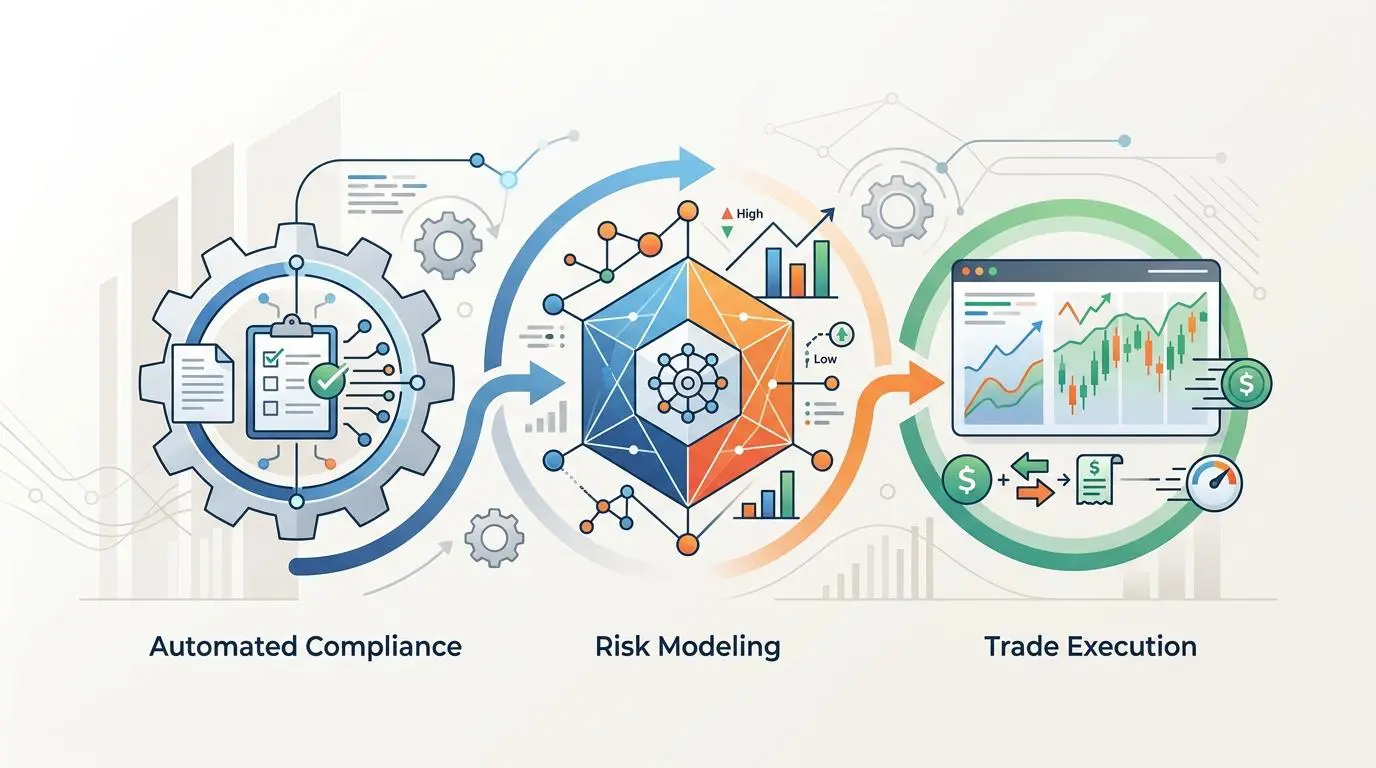
By automating compliance, trade execution, and risk modeling, financial firms can operate with a fraction of their historical overhead. This dramatic reduction in operational costs allows institutions to democratize elite financial tools. The barriers to entry for high-level wealth management have effectively been destroyed.
Retail investors can now access advanced algorithmic trading, dynamic hedging, and real-time portfolio optimization for pennies on the dollar. The democratization of these strategies ensures that middle-market users finally have the mathematical firepower required to build generational wealth.
Invisible Finance and Conversational Wealth
The steep learning curve of traditional brokerage dashboards, filled with dense charts and financial jargon, has always been a massive barrier to entry. The dominant user experience trend in modern wealth management is now shifting heavily toward invisible finance. Investors no longer need to manually parse through complex data tables to understand their net worth.
Instead, they interact with highly intuitive, conversational Wealth Agents powered by advanced natural language processing. Users can simply ask multi-modal questions like whether they can afford a new house if the market drops ten percent. The interface is designed to feel like a conversation with a trusted human advisor.
The AI instantly runs thousands of Monte Carlo simulations in the background and delivers a clear, actionable answer in plain English. This frictionless user experience transforms financial planning from a stressful chore into a seamless, conversational daily habit.
Hyper-Personalized Life Management
Historically, the financial industry has operated in strict silos, treating the act of investing as entirely separate from the reality of daily living. This disconnect often leaves users vulnerable to unexpected liquidity crunches and budget shortfalls. As we look toward the future, the market is rapidly advancing toward hyper-personalized life management.
AI-powered traders are now being designed to securely coordinate with an individual’s smart home, healthcare wearables, and employment data. By analyzing this holistic data matrix, the wealth engine can predict liquidity needs before the user even realizes a budget deficit is approaching. The system acts as a proactive guardian of the user’s financial health.
If a user’s healthcare data indicates an upcoming medical expense, the system can autonomously adjust cash reserves and temporarily halt aggressive investments. This seamless integration ensures that financial strategies are deeply intertwined with the actual rhythm and reality of the user’s daily life.
The Dawn of the Autonomous Financial Officer
The transition from basic robo-advisors to fully Autonomous Financial Officers marks the most significant evolution in personal finance history. These intelligent systems will soon manage the entire personal balance sheet, including debt, insurance, and daily spending, within a single, self-correcting ecosystem.
By eliminating emotional bias and automating complex workflows, agentic AI guarantees that wealth generation is continuous, secure, and accessible to everyone.
Navigating the intersection of modern technology, software architecture, and business growth requires a sharp strategy. To future-proof your tech stack and scale with precision, connect with Andres at Andres SEO Expert.
Frequently Asked Questions
What are Autonomous Agentic Wealth Engines?
Autonomous Agentic Wealth Engines are advanced AI systems that transform reactive, static portfolios into dynamic, self-correcting ecosystems. They execute multi-step financial workflows autonomously, scaling institutional-grade wealth management techniques down to retail investors without the need for high-touch human advisors.
How does AI help prevent emotional investing?
AI wealth engines act as a buffer against “information toxicity” by using real-time sentiment filtering to shield investors from market noise and panic. By making decisions based on mathematical certainty rather than intuition, these systems ensure long-term discipline and prevent poorly timed, impulse-driven trades.
What is the difference between legacy robo-advisors and agentic AI?
Legacy robo-advisors typically use rigid, set-and-forget models based on static onboarding forms. Agentic AI, however, functions as a multi-step operating system capable of executing complex chores like interest-rate arbitrage, estate planning, and instant account provisioning based on real-time life events and macroeconomic shifts.
Can retail investors access hedge fund-level strategies via AI?
Yes. By automating compliance, risk modeling, and trade execution, Agentic AI removes the high overhead costs typically associated with elite wealth management. This allows everyday investors to access advanced strategies like algorithmic trading and dynamic hedging for a fraction of the traditional cost.
What is the projected growth of the AI wealth management market?
According to market intelligence, the global robo-advisory market is projected to reach a valuation of $14.08 billion by 2026. Currently, algorithmic dominance has reached a point where automated systems account for approximately 70% of the total U.S. stock market trading volume.
What does “invisible finance” mean for wealth management?
Invisible finance refers to the shift from complex brokerage dashboards to intuitive, conversational AI interfaces. Instead of parsing dense charts, investors use natural language processing to interact with Wealth Agents that can run thousands of simulations to answer specific financial life questions in plain English.