Executive Summary
- Modular Architecture: Utilizes Packaged Business Capabilities (PBCs) to replace monolithic suites with specialized, best-of-breed components.
- MACH Principles: Built on Microservices, API-first, Cloud-native, and Headless technologies to ensure maximum technical agility.
- Future-Proof Scalability: Eliminates vendor lock-in by allowing individual components to be swapped or upgraded without impacting the entire ecosystem.
What is Composable Commerce?
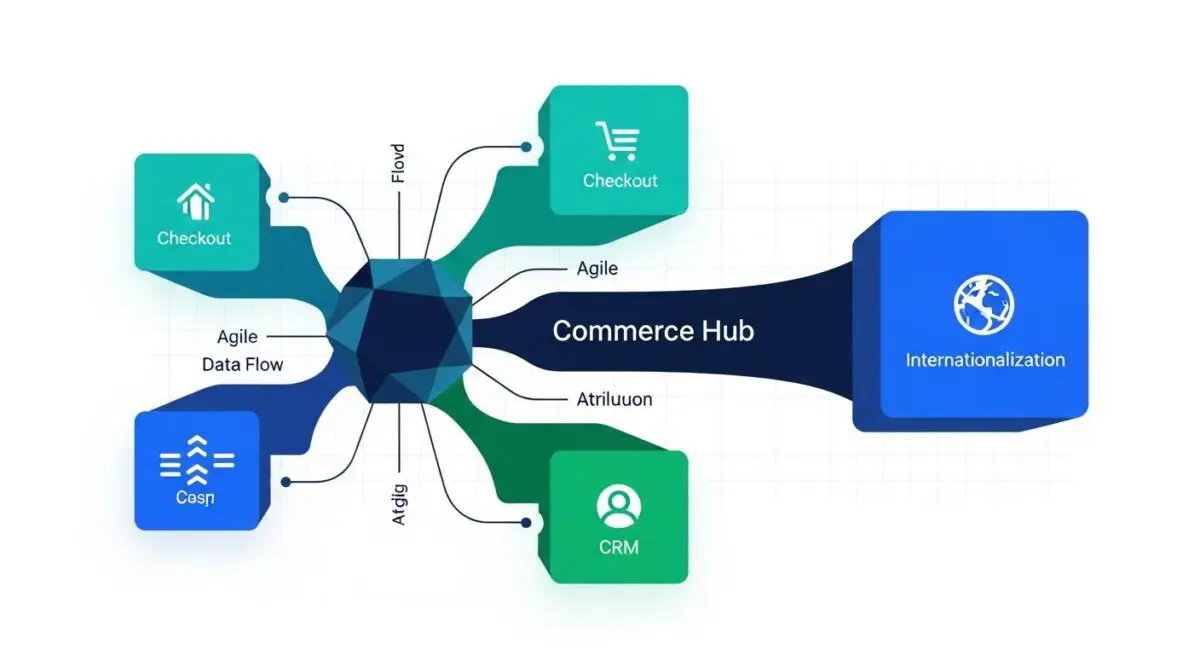
Composable commerce is a modern architectural paradigm that decouples the front-end user interface from the back-end commerce logic. Unlike traditional monolithic platforms that provide a rigid, all-in-one solution, this approach allows organizations to select and assemble various functional components from different vendors.
This methodology is strictly governed by the MACH principles, which stand for Microservices-based, API-first, Cloud-native SaaS, and Headless. By adhering to these standards, businesses can build a highly customized technology stack where each module performs a specific task, such as inventory management, payment processing, or search functionality.
At the technical core of this architecture are Packaged Business Capabilities (PBCs). These are independent software components that represent a specific business function and communicate via APIs, allowing for a distributed yet cohesive digital ecosystem that can adapt to changing market demands in real-time.
The Real-World Analogy
Consider the difference between a high-end modular home and a traditional pre-built apartment. In a pre-built apartment, the layout, plumbing, and electrical systems are fixed; if you want to upgrade the kitchen, you are often limited by the existing structure of the entire building.
A modular home, however, is constructed from independent sections designed to fit together perfectly. If you decide you need a more advanced climate control system or a larger kitchen module, you can integrate those specific components without compromising the structural integrity of the rest of the house.
How Composable Commerce Drives Strategic Growth & Market Competitiveness?
Composable commerce provides a significant competitive advantage by drastically reducing the time-to-market for new features and digital experiences. Because developers work on isolated microservices, they can deploy updates to the checkout process or the product catalog independently without the risk of breaking the entire system.
From a strategic growth perspective, this architecture optimizes the total cost of ownership (TCO) by allowing firms to pay only for the specific services they require. Instead of licensing a massive suite where 40% of the features remain unused, enterprises can allocate their budget toward high-performance PBCs that directly impact conversion rates.
The headless nature of this approach is vital for omnichannel success, as it allows a single back-end to power multiple front-end experiences. Whether a customer is shopping via a mobile app, a web browser, or an IoT device, the data remains consistent while the presentation layer is optimized for each specific touchpoint.
In the era of AI-driven search and Generative Engine Optimization (GEO), the structured data provided by an API-first architecture is invaluable. It ensures that product information is easily consumable by AI crawlers and search engines, leading to better visibility and more accurate indexing in complex search environments.
Furthermore, the cloud-native aspect ensures that the commerce stack can scale elastically during peak traffic periods like Black Friday. This prevents the performance bottlenecks and site crashes common with legacy systems, directly protecting the bottom line and maintaining high customer trust levels.
Strategic Implementation & Best Practices
- Audit Existing Technical Debt: Before transitioning, identify which parts of your current monolith are causing the most friction and prioritize replacing those with specialized PBCs.
- Prioritize API Documentation: When selecting vendors, evaluate the quality and maturity of their API documentation to ensure seamless integration and long-term maintainability of the stack.
- Implement Centralized Orchestration: Use a robust middleware or an API orchestration layer to manage data flows and authentication between disparate services, preventing the creation of new data silos.
- Focus on Developer Experience (DX): Ensure your internal teams are trained in modern DevOps practices and CI/CD pipelines to fully leverage the agility provided by a microservices architecture.
Common Pitfalls & Strategic Mistakes
One of the most frequent errors is the lack of a unified governance strategy, which leads to “integration spaghetti.” Without a clear roadmap for how different services interact, the complexity of managing multiple vendors can quickly overwhelm an internal IT department.
Another common mistake is neglecting the importance of a unified data layer. If each PBC maintains its own isolated data set without a centralized source of truth, the business will struggle with inaccurate reporting and fragmented customer profiles, undermining the benefits of the modular approach.
Conclusion
Composable commerce is the definitive architectural choice for enterprises seeking to eliminate technical debt and achieve true digital agility. By leveraging MACH principles, organizations can build a resilient, scalable, and high-performance commerce ecosystem that adapts to the future of AI and global trade.