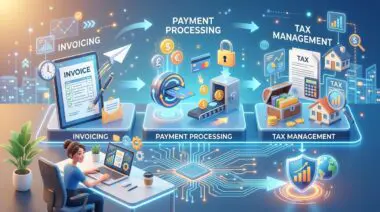
Executive Summary
- Autonomous Tax Fulfillment: The industry is shifting from reactive seasonal filing to continuous, agentic compliance embedded directly into banking and payroll APIs.
- The 22-Minute Benchmark: Modern platforms like April have reduced filing times from 13 hours to under 30 minutes by pre-filling 90% of forms using live transaction data.
- Global Real-Time Mandates: Initiatives like the EU’s ViDA are moving tax from a year-end report to a per-transaction clearance, effectively ending the traditional audit era.
The End of the Shoebox Era
For decades, the arrival of spring has been synonymous with a collective, global anxiety. Business owners and freelancers alike have spent countless hours hunting through digital receipts and bank statements to satisfy the tax collector. This annual ritual of manual reconciliation is not just a nuisance; it is a massive drain on economic productivity.
As of May 2026, we are witnessing the final days of this reactive model. The technological landscape has shifted from simple software that helps you file to autonomous systems that fulfill your obligations in the background. We are entering the era of invisible filing, where the tax code is no longer a document to be interpreted but a set of live instructions executed by AI.
The primary breakthrough driving this shift is the transition to Agentic AI Tax Systems. Unlike the basic automation of the past, these agents act as context-aware collaborators that live inside your financial infrastructure. They don’t just wait for you to upload a document; they monitor transactions as they happen to optimize your tax position in real-time.
The 22-Minute Filing Benchmark
The metric that best illustrates this disruption is the 22-minute filing benchmark. While the IRS has historically estimated that the average American spends 13 hours preparing a return, embedded platforms like April have shattered that timeline. By using direct API hooks into financial apps like Mercury, Found, or Gusto, these systems enable what is known as Done-for-You (DFY) filing.
This is achieved by pre-filling 90% of tax forms using live data feeds. When the user finally logs in to file, the work is already done. The software has already categorized expenses, identified deductions, and calculated liabilities based on real-world activity rather than manual entry.
For the modern entrepreneur, this means the end of the tax cliff. Platforms now offer continuous withholding calibration, where every deposit triggers an immediate calculation of tax liability. For a gig worker or small business owner with variable income, this dynamic adjustment can boost net take-home pay by over $1,200 annually by preventing over-withholding.
The Tax-as-a-Service (TaaS) Gold Rush
Venture capital has recognized that the future of compliance is not in standalone software but in infrastructure. The smart money is flowing toward the plumbing that allows any fintech platform to become a tax-authorized entity. This has given birth to the Tax-as-a-Service (TaaS) model, which is currently seeing a massive influx of investment.
In 2025, April secured a $38M Series B round, bringing its total funding to $78M. This investment signals a major shift, as April became the first new tax tech company in over 15 years to achieve national e-file coverage. Meanwhile, Lettuce raised $52M to automate the solopreneur stack, integrating AI bookkeeping with real-time tax strategy.
Think of traditional tax filing like a dam that breaks once a year, flooding the village with paperwork and panic. Real-time filing is a sophisticated irrigation system that diverts every drop of water exactly where it needs to go, the moment it hits the ground, keeping the fields fertile without ever risking a flood.
Even established giants like Intuit are pivoting their business models. They are moving away from one-time filing fees and toward high-margin, monthly Financial Intelligence subscriptions. For $40 to $60 a month, users now get access to AI agents that manage their compliance year-round, representing a shift from seasonal tools to permanent infrastructure.
Solving the Fragmented Data Crisis
The core problem being solved in 2026 is the reconciliation gap. Historically, businesses spent the majority of their accounting time matching invoices to bank statements and tax codes. This manual process was the primary source of the math errors and inconsistencies that triggered 70% of audits.
Today, algorithmic validation is neutralizing that risk. By the time a user clicks the file button, an AI agent has already cross-referenced their data against millions of pages of IRS code. This democratization of advisory means that high-tier tax strategies, which once required expensive CPA fees, are now available to everyone for a small monthly SaaS fee.
This is particularly evident in the world of eCommerce sales tax. For a merchant selling across multiple jurisdictions, managing nexus is a nightmare. Tools like Avalara and TaxJar now provide transaction-level determination, automatically registering the business and remitting taxes as soon as a sale occurs in a new state.
Global Trajectory: The Real-Time Economy
The transition we are seeing in the United States is part of a larger global movement toward the Real-Time Economy. In Europe, the VAT in the Digital Age (ViDA) initiative is setting a new standard for transparency. By late 2026, real-time reporting of every B2B transaction will be mandatory in multiple G20 nations.
This moves tax from a year-end report to a per-transaction clearance. In this model, the government has real-time visibility into the economy, which could potentially end the era of the traditional tax audit. Some disruptors are even using blockchain technology to create immutable, timestamped records of payments and exemptions.
The next logical step is agentic orchestration. We are moving toward a world of cross-platform tax concierges that navigate between your bank, your payroll provider, and government servers autonomously. These agents will negotiate payment plans or claim refunds the moment they are detected, requiring the human user only to review a push notification.
The Andres Expert Outlook: Preparing for the Invisible Era
Looking ahead to the next 24 months, the concept of a tax season will become an anachronism. For businesses, the priority must shift from choosing filing software to selecting the right financial infrastructure. If your bank or your payroll provider does not have deep, real-time tax integration, you are operating at a significant disadvantage.
The real winners in this new landscape will be those who embrace autonomous compliance as a competitive edge. By eliminating the administrative burden of taxes, you free up cognitive capital to focus on growth and innovation. We are moving toward a state of invisible compliance, where the system is audit-ready by design every single day.
As the digital landscape continues to evolve at breakneck speed, having a strategic foundation that anticipates these shifts is vital. Staying ahead of the curve requires more than just new tools; it requires a new way of thinking about how your business interacts with the digital economy. If you are looking to future-proof your digital strategy, Andres SEO Expert is here to help you navigate the complexities of this new era.