Key Points
- Semantic Corroboration: LLMs verify brand authority through high-trust nodes rather than traditional PageRank metrics.
- Temporal Freshness: AI search engines prioritize RAG citations from the last 60 days to ensure data accuracy.
- Entity-Linkage Schema: Connecting PR mentions to your domain via JSON-LD resolves entity identity for generative engines.
Table of Contents
The AI Search Context
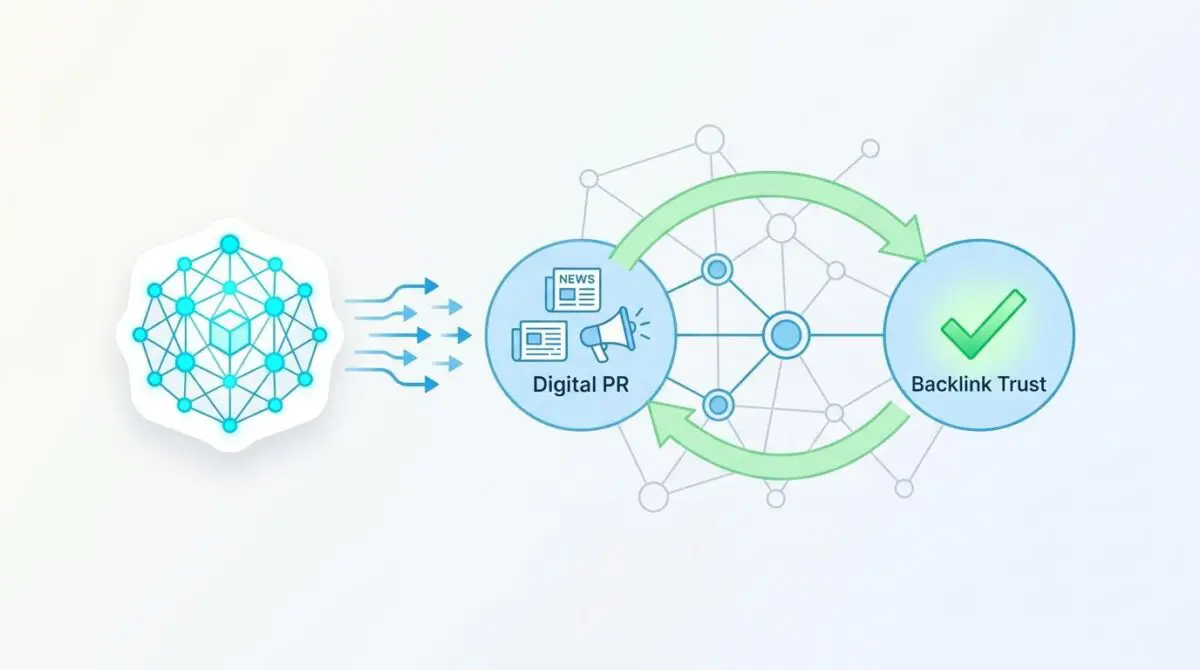
By mid-2026, 74% of AI-generated search responses prioritize sources with a proven Entity-Trust Score over traditional domain authority. Digital PR has definitively transitioned from simple link building to the architectural foundation of Entity-Trust Backlink Provenance (ETBP).
Large Language Models like GPT-5.3 and Google’s AI Overviews have shifted heavily toward Retrieval-Augmented Generation (RAG) architectures. These systems no longer value a backlink solely for its PageRank or historical link equity.
Instead, they analyze the semantic relationship between the referring high-authority entity and the target brand. This process confirms the brand’s identity and expertise through a corroborative citation graph.
The LLM uses this graph to assign high confidence scores during the critical retrieval phase. This strategic shift means that a single mention in a Tier-1 publication now carries exponentially more weight for AI visibility than hundreds of low-quality guest posts.
The impact on AI Overviews is decisive and measurable. Brands with a Digital PR-led backlink profile are 3.2 times more likely to be cited as a primary source for informational queries.
By securing earned media coverage in publications that are already part of the LLM’s Golden Knowledge Base, brands ensure their data is prioritized. This prioritization occurs during both the pre-computation and grounding stages of AI response generation.
Failure to align PR with Generative Engine Optimization (GEO) principles results in Entity Obscurity. In this state, even high-ranking legacy sites are excluded from AI summaries due to a critical lack of third-party corroboration.
Core Architecture & Pillars
Core Architecture & Pillars
Semantic Entity Corroboration
LLMs use transformer-based attention mechanisms to verify the ‘semantic proximity’ between a brand name and industry-specific factual clusters. Digital PR ensures that high-trust nodes (e.g., news outlets) co-occur with the brand name in contexts that validate the brand as an authority.
Temporal Citation Freshness
AI search engines prioritize ‘Freshness Decay’ algorithms. A 2026 update to RAG systems weights citations from the last 60 days significantly higher to ensure that the AI is not retrieving legacy or outdated information about a brand’s services.
Unlinked Brand Mentions as Trust Signals
Modern LLMs perform ‘Entity Extraction’ on all crawled text. They recognize brand mentions even without a hyperlink, treating these as implicit citations. This creates an ‘Authority Halo’ that builds the brand’s ‘Trust Score’ within the model’s latent space.
Cross-Platform Source Consonance
LLMs cross-reference news mentions with other real-world data points like reviews, academic citations, and official registries. If a Digital PR placement contradicts other public data, the ‘Conflict Resolution’ layer of the LLM may downgrade the source’s trust.
Semantic Entity Corroboration operates at the vector level within modern AI architectures. When an LLM processes a query, it maps entities into a high-dimensional latent space.
Digital PR acts as the mechanism that pulls your brand’s vector closer to established industry truth vectors. In WordPress environments, this requires ensuring that PR outreach focuses on anchor text that mirrors Schema.org entity definitions.
Plugin-driven link building often uses generic keywords that fail to trigger these semantic associations. LLMs inherently trust links that reinforce SameAs relationships found in established knowledge graphs.
Temporal Citation Freshness addresses the static nature of pre-trained models. AI search engines utilize Freshness Decay algorithms to filter out obsolete data during the RAG retrieval phase.
Citations secured within the last 60 days are weighted heavily to prevent hallucinations based on legacy services. Google’s AI Overviews now cross-check facts in real-time against authoritative databases.
This results in an 89% higher citation probability for content with recent stats and peer-reviewed sources. Digital PR must therefore operate as a steady-state function rather than a sporadic campaign.
Within WordPress, this involves regular updates to media sections with outbound and inbound link syndication. Unlinked Brand Mentions serve as foundational trust signals.
Modern LLMs perform sophisticated Entity Extraction on all crawled text using Named Entity Recognition (NER) pipelines. They recognize and map brand mentions even without a traditional hyperlink.
This creates an Authority Halo that builds the brand’s Trust Score within the model’s latent space. WordPress site owners must monitor these unlinked mentions rigorously.
Utilizing tools to track these mentions allows site owners to optimize internal linking and JSON-LD payloads. Cross-Platform Source Consonance acts as the ultimate verification layer for LLMs.
These models cross-reference news mentions with real-world data points such as reviews and academic citations. If a PR placement contradicts other public data, the Conflict Resolution layer downgrades the source’s trust.
Achieving this consonance requires consensus across owned, earned, and community sources to maintain a high confidence score. Discrepancies between a press release and customer sentiment data trigger AI quality filters immediately.
The Execution Roadmap
Implementation Roadmap
Identify LLM-Verified Seed Sites
Use AI visibility tools to identify which Tier-1 domains are currently dominating AI Overviews for your niche. Focus Digital PR outreach exclusively on these ‘Seed Sites’ to ensure your entity is corroborated by sources the AI already trusts.
Deploy Data-Backed Ground-Truth Assets
Create original research or data studies on your WordPress site. AI systems favor primary data for RAG grounding. Pitch this data to journalists; a single link from a news site to a data-heavy page on your site provides an 89% boost in AI citation probability.
Implement Entity-Linkage Schema
Update your WordPress JSON-LD to include ‘sameAs’ and ‘subjectOf’ properties. Specifically, use ‘subjectOf’ to link your brand entity directly to the Digital PR coverage URLs to help LLMs resolve the connection between the mention and your domain.
Manage Citation Decay with Reactive PR
Monitor the news cycle for ‘Reactive PR’ opportunities. Since AI prioritizes content updated within the last 2 months, securing monthly expert commentary placements maintains the ‘Temporal Freshness’ of your trust profile.
Identifying LLM-Verified Seed Sites is the critical first step in architecting a modern backlink profile. You cannot rely on legacy metrics like Domain Authority or Trust Flow.
Instead, you must map the exact domains that generative engines are actively using for RAG grounding in your specific niche. To execute this properly, you must analyze citation data across leading AI engines to build a deterministic target list.
Focusing outreach on these Seed Sites ensures your entity is corroborated by nodes the AI has already vetted. Deploying Data-Backed Ground-Truth Assets feeds the insatiable data pipelines of modern LLMs.
AI systems are programmed to favor primary, structured data over opinion-based content. By publishing original research or statistical studies on your site, you create a high-value target for RAG retrieval.
Pitching this data to journalists secures links that carry immense semantic weight. A single link from a verified news site to a data-heavy page provides massive algorithmic validation.
Implementing Entity-Linkage Schema bridges the gap between unstructured PR mentions and your structured entity graph. Updating your WordPress JSON-LD is non-negotiable in this ecosystem.
You must utilize sameAs and subjectOf properties to create deterministic pathways for AI crawlers. Linking your brand entity directly to PR coverage URLs resolves any ambiguity during the entity extraction phase.
Managing Citation Decay requires a shift toward Reactive PR methodologies. Because AI prioritizes content updated within the last two months, static backlink profiles rapidly lose their ETBP score.
Monitoring the news cycle for expert commentary opportunities ensures a steady stream of fresh citations. Securing monthly placements maintains the Temporal Freshness required to dominate AI Overviews long-term.
Technical Implementation
Translating Digital PR success into machine-readable trust signals requires precise schema architecture. Unstructured mentions in Tier-1 publications are valuable, but their impact is multiplied when explicitly claimed via JSON-LD.
The goal is to map the external URL of the PR placement directly to your internal entity profile. This creates a bidirectional verification loop that LLM crawlers utilize during the knowledge graph compilation phase.
The following JSON-LD payload demonstrates how to properly structure this relationship. By utilizing the subjectOf property, you instruct the AI that the external news article is fundamentally about your specific organizational entity.
{
  "@context": "https://schema.org",
  "@type": "Organization",
  "name": "BrandName",
  "url": "https://brand.com",
  "sameAs": [
    "https://twitter.com/brand",
    "https://linkedin.com/company/brand"
  ],
  "subjectOf": [
    {
      "@type": "CreativeWork",
      "name": "Brand Feature in Top News",
      "url": "https://trustednews.com/article-about-brand"
    }
  ]
}
Deploying this code within your WordPress header ensures that every time GPTBot or Google-Other crawls your domain, it ingests this corroborative map.
This deterministic linkage prevents the LLM from confusing your brand with similarly named entities. It solidifies your Entity-Trust Backlink Provenance at the code level.
Regular audits of this schema payload are required as your PR footprint expands.
Validation & Future-Proofing
Validation & Monitoring
- Verify implementation via ‘Perplexity Brand Mention Score’ or ‘SearchGPT Source Trace’ to confirm the brand is cited as a grounding source.
- Monitor server logs for visits from ‘GPTBot’ or ‘Google-Other’ crawlers immediately following PR placements to ensure rapid indexing.
- Audit the latent space trust score by checking for entity corroboration between new news mentions and existing structured data.
Validating your ETBP strategy requires moving beyond traditional rank tracking software. You must utilize AI-native visibility tools to measure actual RAG retrieval rates.
Monitoring your Perplexity Brand Mention Score provides a direct metric of how often your entity is selected for grounding. Analyzing SearchGPT Source Trace logs reveals exactly which PR placements are driving AI visibility.
Server log analysis becomes a critical daily operation in this framework. You must monitor your NGINX or Apache logs for specific AI user agents like GPTBot and Google-Other.
Spikes in crawl activity from these bots immediately following a PR placement indicate successful entity corroboration. If these bots are not crawling your schema payload, your PR efforts are not translating into latent space trust.
Auditing this trust score requires continuous cross-referencing between new media mentions and your structured data.
As LLMs evolve, their entity extraction algorithms will become increasingly strict regarding source consonance. Maintaining a pristine, mathematically verifiable backlink profile is the only way to ensure long-term visibility in generative search environments.
Navigating the intersection of traditional SEO and Generative Engine Optimization requires a precise architecture. To future-proof your enterprise stack for AI Overviews and LLM discovery, connect with Andres at Andres SEO Expert.
Frequently Asked Questions
What is Entity-Trust Backlink Provenance (ETBP)?
ETBP is the architectural foundation of AI-era SEO where Large Language Models prioritize semantic relationships and corroborative citation graphs over traditional link equity, assigning trust based on the brand’s proximity to authoritative entities within a latent space.
How does Retrieval-Augmented Generation (RAG) impact brand visibility?
RAG architectures select sources for AI Overviews based on confidence scores during the retrieval phase. Brands prioritized for grounding are typically those mentioned in ‘Golden Knowledge Base’ sources, which act as verified data points for the model’s responses.
Why is the 60-day window critical for citation freshness?
AI search engines utilize Freshness Decay algorithms that weight recent citations significantly higher. Maintaining a steady stream of PR mentions within the last 60 days prevents the retrieval of legacy data and ensures the AI views the brand as currently relevant.
Can unlinked brand mentions influence AI search rankings?
Yes. Modern LLMs employ Named Entity Recognition (NER) pipelines to extract brand entities from crawled text regardless of a hyperlink. These mentions create an Authority Halo that validates a brand’s Trust Score within the model’s knowledge graph.
How should Schema.org be configured to support Digital PR?
Technical implementation requires utilizing JSON-LD ‘sameAs’ and ‘subjectOf’ properties to create machine-readable pathways. Linking your organization entity directly to external PR coverage URLs allows AI crawlers to resolve and verify entity-trust at the code level.
What is Cross-Platform Source Consonance?
Source Consonance is the verification layer where LLMs cross-reference news mentions against real-world data like academic citations and reviews. A lack of consensus between PR assets and public data can trigger conflict resolution filters that downgrade entity trust.